

Imports
How to Import from China | A Step-by-Step Guide for Beginners in 2026
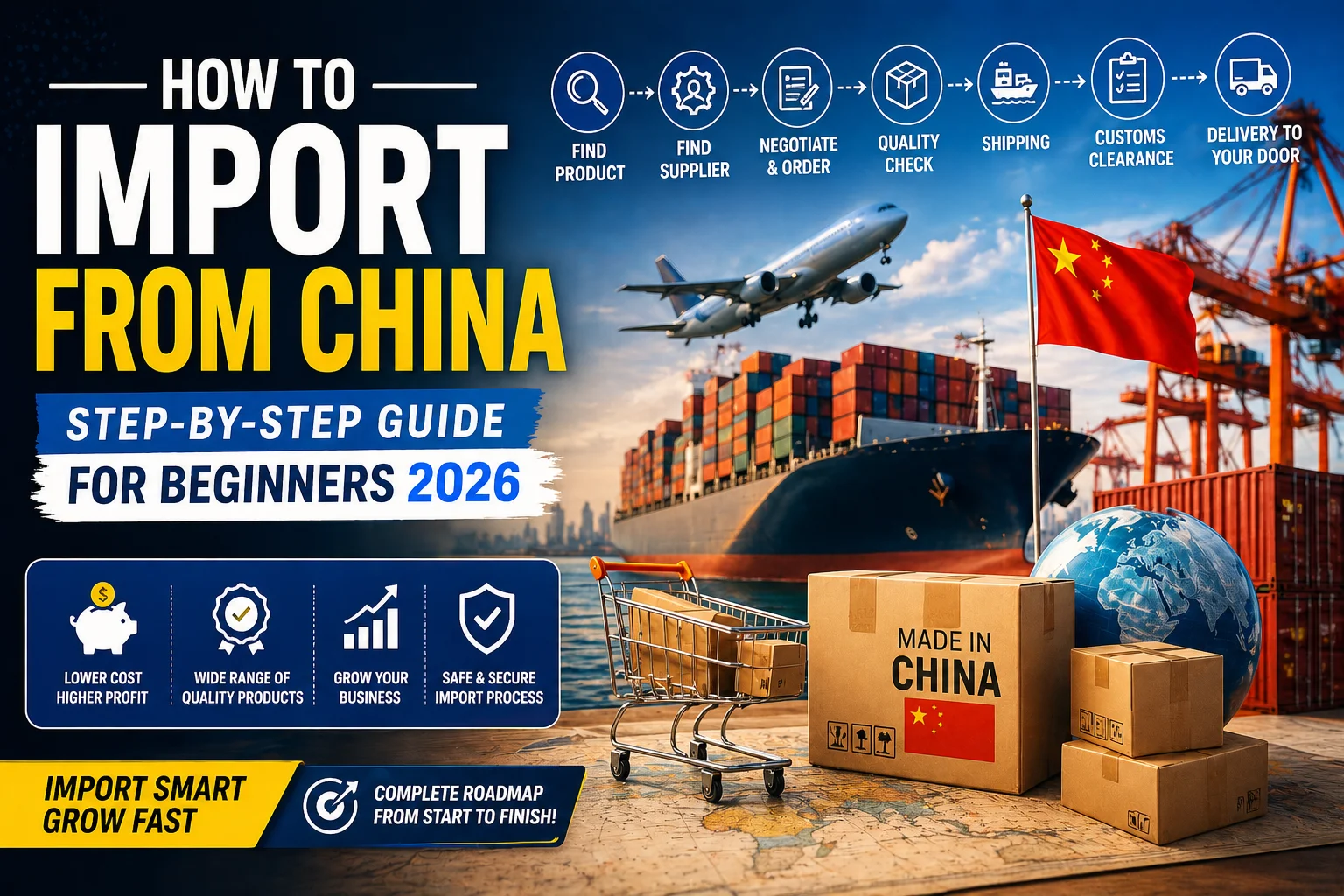
Importing from China is one of the most powerful growth levers a small business can use — and one of the easiest places to lose money if you don't know what you're doing. This guide walks you through every step in plain English, with real numbers, real shipping comparisons, and the exact mistakes most beginners make so you can avoid them.
What you'll learn in this guide
- The 8-step import process at a glance
- Step 1: Understand the basics & legal requirements
- Step 2: Find reliable suppliers
- Step 3: Request samples & verify quality
- Step 4: Negotiate pricing & MOQ
- Step 5: Calculate the real total cost
- Step 6: Choose your shipping method
- Step 7: Handle customs clearance
- Step 8: Final delivery & what to do after
- Real cost breakdown example
- Shipping methods compared
- Common mistakes beginners make
- Pro tips to reduce risk & avoid scams
- Country-specific tips: Germany, UK, Canada
- Frequently asked questions
The 8-step import process at a glance
Before we get into the details, here's the full journey from idea to delivery. Most beginners skip steps in the middle and pay for it later in unsold inventory or unexpected fees. Don't be most beginners.
Step-by-step process
Your roadmap to importing from China
1
Legal requirements
Confirm your tax ID, restricted goods, and import rules.
2
Find suppliers
Use Alibaba, Made-in-China, Global Sources, or a sourcing agent.
3
Order samples
Test quality and packaging before committing to a bulk order.
4
Negotiate price
Push for a better unit price, lower MOQ, and clear payment terms.
5
Calculate cost
Add product, shipping, duties, and broker fees before deciding.
6
Pick shipping
Air, sea, or express — each option has real trade-offs.
7
Clear customs
Submit documents, pay duties, release the goods cleanly.
8
Receive & review
Inspect the shipment and plan your next reorder.
From order to delivery, the full process usually takes 30 to 60 days for first-time buyers. Sea freight stretches that closer to 70 to 90 days. Plan accordingly.
Step 1: Understand the basics and legal requirements
The moment you buy goods from a Chinese supplier, you become an importer in the eyes of your government. That sounds heavier than it is, but it is a real legal status with real responsibilities. Most countries do not ask for a special "import license" for general goods. What they do require is a tax or business identifier so customs can register your shipments and collect any duties owed.
What you need before you place your first order
- United States: An EIN (for businesses) or your SSN (for personal-use imports). Larger commercial shipments need a customs broker.
- European Union: An EORI number, registered with your local customs authority.
- United Kingdom: A UK EORI number (different from the EU one post-Brexit).
- Canada: A Business Number from the Canada Revenue Agency, plus an import-export account.
- Australia: No general import license needed for most goods, but ABN registration is recommended.
You also need to confirm your product is allowed into your country. Items like fresh food, animal products, certain electronics, branded goods, and chemicals carry extra rules. Spend ten minutes on your customs authority's website before you spend ten thousand dollars on inventory.
Worth knowing
Search the HS code (Harmonized System code) for your product. The HS code tells you the exact duty rate, restrictions, and any required certifications. Every product has one — and getting it right at the start saves you from customs surprises.
Step 2: Find reliable suppliers
This is where most first-time importers either set themselves up for success or set themselves up for an expensive lesson. China has millions of suppliers. Your job is to find the few who actually fit your product, your volume, and your standards.
The main places to look
Alibaba is the obvious starting point. It is the largest B2B platform in the world and lets you compare suppliers, request quotes, and pay through Trade Assurance, which protects your money if the supplier does not deliver. Stick to Verified Suppliers and Gold Suppliers with several years of history.
Made-in-China and Global Sources are strong alternatives, often with better quality factories for industrial and electronics products.
1688.com is Alibaba's domestic Chinese platform. Prices are usually 20 to 40% cheaper, but the site is in Chinese and most suppliers will not ship internationally without an agent.
Canton Fair (held twice a year in Guangzhou) is the gold standard for serious importers. You meet manufacturers face to face and inspect samples in person.
Sourcing agents are local representatives in China who find suppliers for you, negotiate, inspect quality, and arrange shipping. They typically charge 5 to 10% of order value, which often pays for itself by helping you avoid bad suppliers.
How to spot a real supplier
- They have been in business at least 3 to 5 years
- They have a real factory address (ask for it and check it on Google Maps)
- They answer technical questions clearly, not just with price quotes
- They accept Trade Assurance or letter of credit (not just personal Western Union)
- They give you a clear MOQ, lead time, and unit price upfront
- They are willing to send samples
Red flag
If a supplier insists on payment to a personal bank account, refuses Trade Assurance, or pressures you to pay quickly before "the price goes up," walk away. These are the most common scam patterns in China sourcing.
Service overview
Importing from China — full advisory service from Trade Globe Consultants
Our services
Import Consulting Services — supplier shortlisting, vetting, and sourcing strategy
Step 3: Request samples and verify quality
Never, ever skip samples. This is the single biggest mistake new importers make.
A sample shows you exactly what your customers will receive. It reveals problems your supplier will not mention — wrong colors, weak stitching, plastic that smells off, packaging that falls apart, certifications that do not actually exist.
How to handle samples like a pro
Order samples from your top 2 to 3 shortlisted suppliers. Do not pick a supplier based on the cheapest sample alone — pick based on the best balance of quality, communication, and price.
Expect to pay for samples. Most suppliers charge sample fees (often credited back when you place a bulk order) plus express shipping, which usually runs $30 to $80 by DHL or FedEx. If a supplier offers free samples, take it, but do not count on it.
When the sample arrives, test it the way your customers will use it. Drop it, wash it, plug it in, leave it in the sun. Compare it to competitor products on Amazon. If it is not better than what is already on the market, you do not have a winner.
Practical tip
Ask the supplier for a "golden sample" — a reference unit they keep on file that matches your bulk order specifications exactly. If the production batch ever differs, you have proof of what was agreed.
Step 4: Negotiate pricing and MOQ
Chinese suppliers expect negotiation. The first quote is rarely the best price — it is the starting point. Done politely and with real volume context, you can usually save 10 to 25% on the unit price and lower the MOQ significantly.
What to negotiate
- Unit price. Ask for tier pricing at different volumes (500, 1,000, 5,000 units).
- MOQ. Most factories will lower the MOQ for first orders, especially if you offer a slightly higher unit price.
- Payment terms. Try for 30% deposit and 70% before shipping (instead of 100% upfront).
- Lead time. Confirm in writing how many days production takes after deposit.
- Custom packaging. Branded boxes, hang tags, and inserts can often be added for a small fee.
- Quality inspection. Some suppliers offer pre-shipment inspection for free or low cost.
How to negotiate without burning the relationship
Be respectful and direct. Do not pretend you have huge volumes you cannot deliver — Chinese suppliers spot bluff orders fast and stop taking you seriously. Instead, share your real situation: "I am a new buyer testing the market with 500 units. If this works, I will be ordering 5,000 next quarter." Honesty plus a clear future picture works far better than fake urgency.
Worth knowing
MOQ stands for Minimum Order Quantity. It is the smallest batch a factory is willing to produce. MOQs exist because factories have machinery setup costs that have to be spread across each unit. Lower volumes mean higher unit prices — but for first orders, that is often a worthwhile trade-off.
Step 5: Calculate the real total cost
This is where most beginners go wrong. The price the supplier quotes you is not what your goods actually cost. The real number is called landed cost — the total price after every fee, duty, and shipping charge is added.
Skipping this calculation is how importers end up with inventory they cannot sell at a profit. Here is what to include in every cost calculation:
- Product cost — unit price × quantity
- Sample fees — already paid before bulk order
- Inland transport in China — factory to port (usually $50 to $200)
- Export documentation — packing list, commercial invoice, certificate of origin
- International shipping — air, sea, or express
- Insurance — typically 0.3 to 0.5% of cargo value
- Customs duties & tariffs — based on HS code and country of import
- Import VAT or sales tax — varies by destination
- Customs broker fees — usually $80 to $250 per shipment
- Port handling and terminal fees — $200 to $500 for sea freight
- Last-mile delivery — port or airport to your warehouse
Now let's see all of these in action with a real example.
Real cost breakdown: a worked example
Let's say you are a US-based seller importing 1,000 units of a wireless Bluetooth speaker from a factory in Shenzhen. Here is what your real costs look like.
| Cost item | Amount (USD) | Notes |
|---|---|---|
| Product cost (1,000 × $8.50) | $8,500 | FOB Shenzhen pricing after negotiation |
| Inland transport (factory to port) | $120 | Trucking and handling |
| Export documentation | $80 | Invoice, packing list, B/L |
| Sea freight (Shenzhen → LA, LCL) | $650 | About 3 cubic meters, 28 days transit |
| Cargo insurance | $45 | 0.5% of cargo value |
| US import duty (HS 8518.22, ~3.7%) | $315 | Calculated on product + shipping |
| Customs broker fee | $150 | Single-entry brokerage |
| Port terminal handling | $280 | LA port fees |
| Last-mile trucking | $220 | Port to warehouse, California |
| Total landed cost | $10,360 | $10.36 per unit |
Notice what just happened. Your supplier quoted $8.50 per unit, but the real cost is $10.36 per unit — almost 22% higher. If you planned to sell at $14.99 thinking you would make $6.49 profit per unit, your actual margin is closer to $4.63. That is the difference between a thriving import business and a frustrated one.
Now imagine you had shipped by air freight instead — costs could have jumped another $1,500 to $2,500. Or imagine you had missed the duty entirely. These small details decide whether your import is profitable or painful.
Hidden costs to watch
Demurrage and detention fees if your container sits at the port too long ($75 to $250 per day). Currency conversion fees on bank transfers (1 to 3%). Storage fees if your warehouse cannot receive on the scheduled day. Always build a 5 to 10% buffer into your landed cost calculations.
Step 6: Choose your shipping method
Three main options: air freight, sea freight, and express courier. Each makes sense for different situations. Picking the wrong one will either kill your margin or kill your launch timeline.
Shipping methods compared
| Method | Speed | Cost | Best for |
|---|---|---|---|
| Express (DHL/FedEx/UPS) | 3 – 7 days | $5 – $9 per kg | Samples, very small orders, urgent restocks under 100 kg |
| Air freight | 5 – 10 days | $3 – $6 per kg | High-value, low-weight goods. Orders 100 – 500 kg where speed matters |
| Sea freight (LCL) | 25 – 40 days | $80 – $200 per CBM | Mixed cargo under 15 CBM. Best for first orders |
| Sea freight (FCL) | 25 – 45 days | $1,800 – $4,500 / 20ft | Full containers. Bulky goods, large orders, lowest unit cost |
| Rail (China–Europe) | 18 – 22 days | Between air & sea | European importers wanting faster than sea, cheaper than air |
A simple rule of thumb: if your shipment fits in a few boxes and you need it fast, use express. If it is somewhere between a pallet and half a container, use air freight or sea LCL. If it is a full pallet stack or more, sea freight is almost always the cheapest path.
"The best shipping choice isn't the cheapest one — it's the one that matches your timeline, your margin, and your customer's expectations."
Step 7: Handle customs clearance
Customs is the part of importing most beginners fear. The reality is, it is mostly paperwork — and once you have done it twice, it stops feeling intimidating.
What customs needs from you
- Commercial invoice — what was sold, to whom, at what price
- Packing list — the box-by-box contents of your shipment
- Bill of lading (B/L) for sea, or air waybill (AWB) for air
- Certificate of origin — which country the goods were made in
- HS code classification — used to assess duty rate
- Product-specific certifications (FCC, FDA, CE, UKCA, etc.)
For first-time importers, hiring a customs broker is almost always worth the $80 to $250 fee. They file your paperwork, pay duties on your behalf, and resolve issues if customs flags your shipment.
How long does clearance take?
For routine shipments with clean paperwork, customs clearance takes 1 to 3 business days. If something is missing or flagged, it can stretch to a week or more. Goods sitting at the port accrue storage fees, so accuracy upfront saves money fast.
Step 8: Final delivery and what to do after
Once customs releases your shipment, your freight forwarder or trucker delivers it to your warehouse, fulfillment center, or home. Inspect every box at delivery — note any damage on the delivery receipt before you sign.
Then comes the part most importers skip: the after-action review.
- How did the actual landed cost compare to your estimate?
- Was the quality consistent with the sample?
- Did the supplier hit the agreed lead time?
- What would you do differently next order?
Send your supplier a polite thank-you message and confirm receipt. Then start planning your reorder. Repeat business is where Chinese suppliers give you their best prices, fastest production, and most flexibility. Your second order is almost always smoother than your first.
Common mistakes beginners make
Most failed China imports trace back to the same handful of errors. If you avoid these, you are already ahead of 80% of new buyers.
- Choosing the cheapest supplier. The lowest quote is almost always the riskiest. Cheap usually means corner-cutting on materials, quality control, or both.
- Skipping samples. Ordering 1,000 units based on a product photo is how warehouses fill up with unsellable goods.
- Ignoring landed cost. Calculating only the unit price and shipping is the fastest way to launch an unprofitable product.
- Paying via Western Union or personal bank transfer. If the supplier disappears, your money is gone. Use Trade Assurance, PayPal (for samples), or letter of credit.
- Vague specifications. "Make it like the photo" leads to surprises. Spell out materials, dimensions, colors, packaging, and labeling in writing.
- Underestimating lead time. Production takes 15 to 45 days, then shipping adds another 25 to 40. Plan 60 to 90 days from order to inventory in hand.
- Ordering before you have sold anything. Validate demand with a small test before committing to large quantities.
Trust your instincts here
If a supplier cannot answer basic questions about their factory, materials, or production timeline in your first conversation, that is your answer. The person you trust with your money should be able to give you straight, specific answers — not reassurances and generalities.
Pro tips to reduce risk and avoid scams
Verify the factory before you pay
Use Alibaba's Verified Supplier badge as a starting filter, but go further. Ask for the supplier's business license and run the registration number through China's National Enterprise Credit Information Publicity System (gsxt.gov.cn). You can confirm the company is real, registered, and active.
Use Trade Assurance for first orders
Trade Assurance holds your payment in escrow until the supplier ships and meets the agreed terms. It is free to use on Alibaba and protects you against the most common scams — non-shipment, late shipment, or wrong product.
Hire a third-party inspector
Companies like SGS, Bureau Veritas, and QIMA can visit the factory before shipment and verify your goods match the sample. A pre-shipment inspection costs $200 to $400 and can save you thousands in unsellable inventory.
Negotiate INCOTERMS carefully
FOB (Free On Board) gives you control of the shipping after the goods leave the Chinese port. EXW (Ex Works) means you handle everything from the factory door — usually messy for first-timers. CIF (Cost, Insurance, Freight) means the supplier handles shipping to your destination port — convenient, but often pricier than FOB plus your own forwarder.
Build a relationship, not a transaction
Chinese business culture values long-term relationships. Do not switch suppliers every order chasing $0.10 savings. A supplier who knows you, trusts your payments, and understands your specs will deliver better quality and faster turnarounds than any one-time deal.
Insider tip
If you plan to import regularly, consider visiting your supplier in person at least once. A 5-day trip to Guangzhou, Yiwu, or Shenzhen pays for itself many times over in trust, supplier insight, and product ideas you would never find online.
Going it alone vs. working with a consultant
Many first-time importers wonder whether to figure things out themselves or bring in a consultant. Both paths are legitimate. Here is the honest comparison.
Doing it yourself
What to expect
- Full control over every decision
- Lower upfront cost
- Steep learning curve in first 2 to 3 orders
- Higher risk of supplier or compliance mistakes
- Trial-and-error pricing & shipping choices
- You build your own playbook over time
With a consultant
What changes
- Vetted supplier shortlist from day one
- Landed cost calculated correctly first time
- Compliance built in, not retrofitted
- Faster path to a profitable first shipment
- Network access (agents, inspectors, brokers)
- Engagement fee, but cheaper than one bad order
Related article
How to Find Import & Export Consulting Services for Your Business
Country-specific tips: Germany, UK, Canada
Import rules vary by destination. Here is what changes if you are shipping into the most common Western markets.
🇩🇪
Germany
Requires an EU EORI number. VAT is 19%, charged at import. CE certification is mandatory for electronics, toys, and machinery. Hamburg is the main entry port.
See Germany guide →
🇬🇧
United Kingdom
Needs a UK-specific EORI (post-Brexit). VAT is 20%. Felixstowe and Southampton are the main ports. UKCA marking now replaces CE for many product categories.
See UK guide →
🇨🇦
Canada
Requires a Business Number with import-export account. GST/HST applies depending on province. Vancouver is the primary West Coast entry. Bilingual labeling rules apply.
See Canada guide →
For the United States, you will work with US Customs and Border Protection (CBP) and need an EIN. Tariffs vary widely by HS code, and certain product categories (electronics, textiles, steel) carry additional Section 301 duties. Always confirm current rates before placing an order.
Read next
What Is an Import Export Consultant? Roles, Services & When You Need One
Frequently asked questions
Is importing from China profitable in 2026?
Yes — but only when you do the math properly. Categories like consumer electronics, home goods, apparel, and accessories still deliver healthy margins for importers who choose the right product, calculate full landed cost, and avoid common beginner mistakes. The buyers who lose money are usually the ones who skipped samples, picked the cheapest supplier, or forgot to add duties to their cost calculation.
Do I need an import license to bring goods from China?
For most general goods, no. You need a tax or business identifier — an EIN in the US, an EORI number in the EU and UK, or a Business Number in Canada. Specific product categories like food, drugs, cosmetics, electronics, and chemicals do require additional permits or certifications, so always check your country's customs authority for your specific HS code.
What is MOQ and can I order less than the supplier's MOQ?
MOQ stands for Minimum Order Quantity — the smallest batch a factory will produce. Most factories set MOQs because of setup costs that need to be spread across the production run. Yes, you can often negotiate lower MOQs for first orders, especially if you offer a slightly higher unit price or commit to a larger second order. Trading companies (rather than factories) typically have lower MOQs but slightly higher prices.
How long does shipping from China actually take?
Express (DHL, FedEx, UPS) takes 3 to 7 days. Air freight takes 5 to 10 days. Sea freight takes 25 to 40 days for LCL or 25 to 45 for full containers. Always add 15 to 45 days for production lead time before shipping starts. Plan 60 to 90 days from order to inventory in hand for sea freight, or 30 to 45 days for air.
Is Alibaba safe for first-time buyers?
Alibaba is generally safe when you stick to Verified Suppliers and Gold Suppliers with multi-year history, use Trade Assurance for payments, and never wire money to a personal bank account. The platform itself is legitimate — most scams happen when buyers ignore the safety features and pay outside the system.
What's the difference between a sourcing agent and a freight forwarder?
A sourcing agent finds suppliers, negotiates prices, inspects quality, and acts as your representative in China. A freight forwarder handles the physical shipping — booking cargo, preparing documents, and arranging customs. For first-time importers, using both gives you the most coverage. As you grow, many importers either bring sourcing in-house or use freight forwarders directly while keeping a trusted supplier base.
How much money do I need to start importing from China?
For a small first order, plan for $2,000 to $5,000 in total — including product cost, samples, shipping, duties, and a buffer for surprises. Larger product categories or full container loads start around $10,000 to $20,000. Always start small, validate the product, then scale. Beginners who try to launch with a full container often end up with stuck inventory.
Talk to us
Contact Trade Globe Consultants — get expert guidance for your China import journey
Importing from China rewards the patient
The buyers who succeed treat each shipment as a learning loop, not a one-shot bet. Always order samples. Always calculate landed cost before you commit. Build relationships with suppliers you trust. Do those three things consistently, and importing from China becomes one of the most reliable growth levers in your business.



Contact us today to schedule a NO-CHARGE INTIALS 30-MINUTE consultation. Ask questions and learn from the experts.