

Imports
How to Import from China to USA: A 2026 Buyer's Playbook for Profitable Sourcing
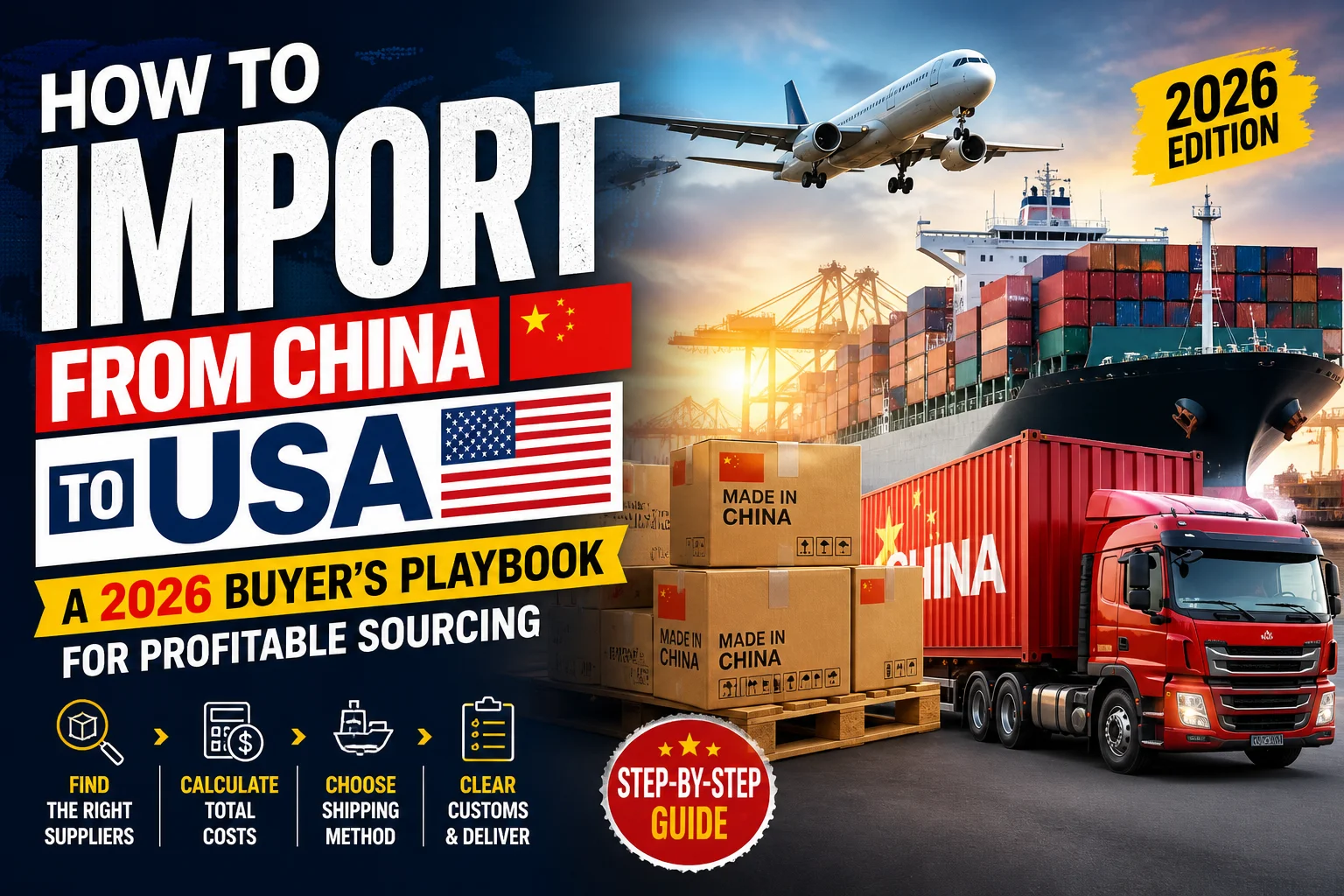
The China-to-USA trade lane is still the busiest sourcing route on the planet, but the rules have shifted. New tariffs, the suspension of the $800 de minimis exemption, and tighter customs scrutiny mean that importers who succeed in 2026 are the ones who plan carefully. This guide shows you how to import from China to USA the right way, what products are worth buying, and how to build a profitable sourcing operation from your very first shipment.
What you'll learn in this guide
- Why China remains the top sourcing partner for US buyers
- The full process: how to import from China to USA
- Step 1: Legal setup and importer requirements
- Step 2: Choose a product that actually sells in the US
- Step 3: Find verified Chinese suppliers
- Step 4: Order samples and confirm quality
- Step 5: Calculate the real landed cost (with 2026 tariffs)
- Step 6: Pick the right shipping method
- Step 7: US customs clearance, ISF, and duties
- Step 8: Final delivery and reorder strategy
- Most profitable items to import from China to USA in 2026
- Restricted and banned items you should avoid
- Mistakes that wipe out new importers
- Frequently asked questions
Why China remains the top sourcing partner for US buyers
The numbers tell the story before any opinion can. The United States imported hundreds of billions of dollars in goods from China in 2025, and even with new tariffs in play, China still leads the world in manufacturing scale, factory speed, and product variety. That dominance did not happen by accident. Decades of investment in industrial parks, port infrastructure, skilled labor, and supply chain integration mean Chinese factories can move from sample to mass production faster than almost anywhere else on the planet.
For a US buyer, that translates into three real advantages. You get access to product categories you simply cannot match domestically at the same price point. You get rapid prototyping and customization, often inside two to four weeks. And you get a level of scale that lets you start small and grow your orders without changing partners.
The catch is that the playing field has changed. The de minimis loophole that let small parcels under $800 enter duty-free is gone for China-origin goods as of August 2025. Section 301 tariffs from earlier rounds remain in place, and additional measures stack on top of base duty rates for many categories. None of this kills the opportunity. It simply makes planning matter more than ever.
2026 policy update
The de minimis exemption that previously allowed China-origin shipments under $800 to enter the US duty-free was suspended in August 2025. Every commercial import from China is now subject to customs duties and tariffs regardless of value, so landed cost calculations matter for shipments of every size.
If you are still deciding whether China sourcing fits your business, our parent guide on how to import from China walks through the global fundamentals before you focus on the US-specific layer covered here.
The full process: how to import from China to USA
Before we go deep on each step, here is the full sequence at a glance. Most beginners skip steps three, five, or seven, then wonder why their first shipment loses money. Take this seriously and you will avoid most of the expensive lessons that catch new importers.
Step-by-step process
Your roadmap to importing from China to USA
1
Legal setup
Get your EIN, register with CBP, secure a customs bond.
2
Pick a product
Validate demand, check tariffs, confirm legal to import.
3
Find suppliers
Use Alibaba, Global Sources, or a sourcing agent.
4
Order samples
Test quality, packaging, and certifications.
5
Calculate cost
Add product, shipping, duties, broker, and tariffs.
6
Pick shipping
Choose air, sea, or express based on weight and timing.
7
Clear customs
File ISF, submit entry, pay duties, release goods.
8
Receive & review
Inspect shipment, log lessons, plan reorder.
From order placed to inventory in your warehouse, plan for 45 to 90 days on a typical sea freight order. Air freight cuts that to 30 to 50 days. Express runs even faster but costs more per kilogram. Each step below tells you exactly what to do at that stage.
Step 1: Legal setup and importer requirements
You become a US importer of record the moment your name goes on the customs entry. That status comes with real responsibilities, but the setup itself is straightforward and most of it takes a single afternoon.
What you need before your first order
- EIN (Employer Identification Number). Free from the IRS. Required for any business importer.
- Importer of Record number. Your EIN doubles as this for most US importers.
- Customs bond. Required for shipments over $2,500 or for any goods regulated by federal agencies. Costs $50 to $500 per year for a continuous bond.
- Licensed customs broker. Not legally required, but strongly recommended for first-time importers. Brokers file your entries and prevent costly errors.
- State business registration. Most states require an LLC or corporation for commercial imports.
- Resale certificate. If you will resell, get one from your state to handle sales tax correctly.
Product-specific clearances you cannot skip
Some product categories trigger additional federal agency oversight. If your product falls into any of these buckets, build the clearance into your timeline before you commit to a supplier.
- Food, beverages, supplements, cosmetics: FDA registration and prior notice on every shipment.
- Electronics that emit radio signals: FCC compliance, often with lab testing and an FCC ID.
- Children's products and toys: CPSIA testing and a Children's Product Certificate.
- Textiles and apparel: Country of origin labeling, fiber content, and care instructions.
- Vehicles, vehicle parts, tires: DOT and EPA approvals.
- Wood products: Lacey Act declaration; some require fumigation certificates.
Worth knowing
The HTS (Harmonized Tariff Schedule) code for your product is the single most important piece of data in your entire import. It dictates the duty rate, any tariff stacks, and which agencies must clear your goods. Look up your code on the official US ITC HTS database before you negotiate with any supplier.
Step 2: Choose a product that actually sells in the US
Picking the right product is more important than picking the right supplier. A great supplier with a mediocre product will leave you with stuck inventory. An average supplier with a strong product will still pay your bills.
The four filters for a winning product
Demand: Use Amazon Best Sellers, Helium 10, Jungle Scout, and Google Trends to confirm there is real, repeated buying happening in your category. A product that sells 1,000 units a month at $25 is a much safer bet than one that "feels" trendy on TikTok with no purchase data behind it.
Margin: Aim for at least a 3x markup on landed cost so your margin survives advertising, returns, and platform fees. If your landed cost is $10, you want to sell for $30 or more. With Section 301 tariffs in play, this rule is even more important than it used to be.
Shipping density: Light, compact products keep freight cheap and storage manageable. Avoid bulky items that turn a $5 unit cost into a $20 landed cost just from cubic meter charges.
Differentiation: Pick a product where you can add a real point of difference, even a small one. Better packaging, a clearer instruction manual, a bundled accessory, or a niche-specific design. Selling a generic Alibaba product with no differentiation is the fastest way to get caught in a price race to the bottom.
You can preview the most profitable categories for 2026 in the most profitable items section below, but the filters above apply regardless of category.
Step 3: Find verified Chinese suppliers
Suppliers fall into three rough buckets and you should know which you are dealing with before you negotiate anything.
Factories are the actual producers. They have the lowest unit prices but tend to set higher MOQs and may resist customization for small orders. Best for buyers who know exactly what they want and have volume to back it up.
Trading companies are middlemen with relationships across multiple factories. They charge a small markup but offer lower MOQs, faster communication, and bilingual project management. Most first-time importers end up working with a trading company without realizing it, and that is often the right choice for a first order.
Sourcing agents work directly for you, not for a factory. They find suppliers, negotiate, manage QC, and arrange shipping. Their fee runs 5 to 10 percent of order value, and a good agent pays for themselves many times over by helping you avoid bad suppliers.
Where to find them
- Alibaba. The largest B2B platform. Filter for Verified Suppliers and Gold Suppliers with at least three years of trade history. Use Trade Assurance for every payment.
- Made-in-China. Strong for industrial, electrical, and machinery products. Often has higher-quality factories than Alibaba's mass listings.
- Global Sources. Specialty platform with verified electronics and consumer goods manufacturers, many of whom export to major US retailers.
- 1688.com. The Chinese-language domestic version of Alibaba. Prices are 20 to 40 percent cheaper, but you almost always need a sourcing agent to use it effectively.
- Canton Fair and Yiwu Market. In-person trade fairs in Guangzhou and Yiwu that draw serious buyers and serious factories. Worth the trip if you plan to import regularly.
How to vet a supplier in 30 minutes
- Confirm registration on China's National Enterprise Credit Information system (gsxt.gov.cn).
- Ask for the factory address and verify it on Google Maps or Baidu Maps.
- Request the business license, then check the registration year and capital.
- Ask for ISO 9001, BSCI, or sector-specific certifications and verify them.
- Search the company name plus "scam" or "complaint" in English and Chinese.
- Insist on Trade Assurance or letter of credit. Walk away from any supplier who only accepts Western Union or personal bank transfers.
Service overview
Importing from China — full advisory and supplier vetting from Trade Globe Consultants
Step 4: Order samples and confirm quality
This is the step that separates importers who survive from importers who burn through capital. A sample shows you what your customer will actually receive, not what the product photo promised. Skipping samples is the single most expensive mistake in China sourcing.
How to do samples right
Order samples from your top two or three shortlisted suppliers, never just one. Pay the sample fee (typically $30 to $150 plus express shipping). When the samples land, test each one the way your customer will use it. Drop it. Wash it. Run it through a full work cycle. Compare it to top-rated competitor products on Amazon. The sample that wins on quality plus communication wins the order, not the sample with the lowest price.
Once you pick your supplier, ask them to seal a "golden sample" — a reference unit they keep on file and use as the visual standard for your bulk production. If anything in the production batch differs from the golden sample later, you have a paper trail to dispute it.
Practical tip
Pay for a third-party pre-shipment inspection before your goods leave the factory. Companies like SGS, QIMA, and Bureau Veritas charge $200 to $400 to send an inspector to the factory, randomly check 100 to 200 units, and certify that production matches your golden sample. This single step has saved more importers from disaster than any other.
Step 5: Calculate the real landed cost (with 2026 tariffs)
The price your supplier quotes is not what your goods cost. The real number is the landed cost — the total dollars you spend to get one unit from the factory floor in China to your warehouse shelf in the US, ready to sell. Most beginners build their pricing on the supplier quote alone, and that is why most beginners struggle to make a profit.
Every cost line you need to add
- Product cost — unit price multiplied by quantity (FOB or EXW basis).
- Inland China transport — factory to port of departure, usually $50 to $250.
- Export documentation — invoice, packing list, B/L, certificate of origin.
- International shipping — air, sea, or express depending on what you choose.
- Cargo insurance — typically 0.3 to 0.5 percent of shipment value.
- US customs duty — base rate by HTS code, often 0 to 10 percent.
- Section 301 tariff — additional 7.5 to 25 percent on many China-origin categories.
- Other tariffs and fees — IEEPA-related tariffs and Merchandise Processing Fee (0.3464 percent).
- Customs broker fee — $80 to $250 per single entry, less per shipment for continuous bond holders.
- Port and terminal handling — $200 to $500 for sea freight, less for air.
- Last-mile delivery — port or airport to your warehouse.
- Storage and warehousing — if you use a 3PL or fulfillment center.
A worked example: 1,000 wireless earbuds, Shenzhen to Los Angeles
Let's run a real calculation so you can see how the numbers stack up in 2026 conditions. The product is a 1,000-unit order of wireless earbuds from a Shenzhen factory, shipped LCL sea freight to Los Angeles, with a Section 301 tariff stack on electronics.
← Swipe to see all columns →
| Cost line | Amount (USD) | Notes |
|---|---|---|
| Product cost (1,000 × $9.20) | $9,200 | FOB Shenzhen, after negotiation |
| Inland China transport | $140 | Trucking, factory to port |
| Export documentation | $80 | Invoice, packing list, B/L |
| Sea freight LCL (Shenzhen → LA) | $720 | ~3.5 cubic meters, 28-day transit |
| Cargo insurance | $50 | 0.5% of cargo value |
| Base US duty (HTS 8518.30, ~4.9%) | $486 | Calculated on product + freight |
| Section 301 tariff (15%) | $1,488 | Stacks on top of base duty |
| Merchandise Processing Fee | $36 | 0.3464% of entered value |
| Customs broker fee | $165 | Single-entry brokerage |
| Port terminal handling (LA) | $310 | Container freight station fees |
| Last-mile trucking | $240 | Port to warehouse, California |
| Total landed cost | $12,915 | $12.92 per unit |
Look at what just happened. The supplier quoted $9.20 per unit. The real cost to your warehouse is $12.92 per unit, almost 40 percent higher. If you were planning to sell at $24.99 expecting a $15.79 margin, your actual margin is $12.07 before any platform fees, advertising spend, or returns. That is the difference between a strong business and a stressful one.
Hidden costs to budget for
Demurrage fees if your container sits at the port too long ($75 to $300 per day). Detention charges if you hold the empty container too long after pickup. Currency conversion fees on bank wires (1 to 3 percent). Storage overruns at your 3PL. Always build a 5 to 10 percent contingency buffer into your landed cost calculations.
Step 6: Pick the right shipping method
Three real options exist for moving freight from China to the USA. Picking the wrong one will either crush your margin or kill your launch timing. Picking the right one feels obvious in hindsight.
← Swipe to see all columns →
| Method | Speed | Cost (rough) | Best for |
|---|---|---|---|
| Express courier (DHL/FedEx/UPS) | 3 – 7 days | $5 – $9 per kg | Samples and urgent restocks under 100 kg |
| Air freight | 5 – 10 days | $3 – $6 per kg | High-value, low-weight goods. 100 – 500 kg orders |
| Sea freight LCL | 25 – 40 days | $80 – $200 per CBM | Mixed cargo under 15 CBM. First orders |
| Sea freight FCL (20ft) | 25 – 40 days | $1,800 – $4,500 | Full container, lowest cost per unit |
| Sea freight FCL (40ft) | 25 – 45 days | $2,500 – $6,000 | Bulk orders. Use for repeat sellers |
The simple rule: if your shipment fits in two or three boxes and you need it fast, use express. If you have a few hundred kilograms and can wait a week, use air freight. If you have more than 2 cubic meters of cargo, sea freight will almost always be cheaper per unit even with the longer transit time.
Choosing your US port
Sea freight from China typically lands at one of three major US gateways. Los Angeles and Long Beach together handle the majority of trans-Pacific cargo and are best for buyers in California, the Southwest, and the Mountain states. New York and New Jersey are the dominant East Coast option for buyers east of the Mississippi, though transit time is longer (35 to 45 days) because ships route via the Panama Canal. Seattle and Tacoma handle Pacific Northwest cargo and offer slightly faster transits on northern routes.
"The best shipping choice isn't the cheapest one. It's the one that matches your cash cycle, your lead time, and your warehouse capacity."
Step 7: US customs clearance, ISF, and duties
US customs is paperwork heavy but predictable once you have done it once or twice. The agency you are dealing with is US Customs and Border Protection (CBP), and your customs broker handles most of the actual filing.
The five filings you need to know
ISF (Importer Security Filing), known as "10+2". Required for sea freight, this 10-data-point filing must be submitted at least 24 hours before the cargo is loaded onto the vessel in China. Late or inaccurate ISF filings carry penalties of up to $5,000 per violation.
Entry Summary (CBP Form 7501). Filed within 10 working days of arrival, this is your formal declaration of the shipment, its value, classification, and country of origin. Your customs broker prepares this from your commercial invoice and packing list.
Customs bond. Required for any commercial shipment over $2,500. Single-entry bonds work for one-off imports; continuous bonds make more sense if you import regularly.
FDA Prior Notice. Required for any food, beverage, or supplement entering the US. Filed electronically and must be accepted before goods can be released.
Other agency clearances. Depending on product, you may need filings with the FCC (radio devices), CPSC (children's products), DOT (vehicles and parts), or USDA (wood, plants, food).
What customs duties actually look like in 2026
Three layers can apply to your China import. The base HTS duty is set in the Harmonized Tariff Schedule and ranges from zero (most apparel from non-tariff countries) to 25 percent or more (some specialty items). Section 301 tariffs add 7.5 to 25 percent on top of the base rate for thousands of HTS codes covering electronics, machinery, furniture, and apparel. IEEPA-based tariffs introduced in 2025 stack additional duties on many China-origin categories. The exact combination depends entirely on your HTS code, so look it up before you sign any purchase order.
Worth knowing
Some Chinese suppliers will offer to "ship as samples" or undervalue invoices to dodge duties. Do not do this. The penalties for customs fraud start at twice the duty owed and escalate to seizure of goods, multi-year audits, and personal liability for the importer of record. The risk far outweighs any savings.
Step 8: Final delivery and reorder strategy
Once CBP releases your shipment, your freight forwarder coordinates the last-mile delivery. Inspect every box on arrival before you sign the delivery receipt. Note any visible damage, count cartons against the packing list, and photograph anything that looks off.
Then, before you move on to the next thing, run a quick post-mortem on the order. The importers who scale fastest are the ones who treat each shipment as a learning loop, not a one-shot transaction.
- Did the actual landed cost match your forecast? Where did it differ and why?
- Was the quality consistent across the production batch?
- Did the supplier hit the agreed lead time? If not, what caused the slip?
- Was the freight forwarder's communication strong enough?
- What single change would make your next order go smoother?
Finally, send your supplier a polite thank-you and a clear signal about the next order. Repeat business is where Chinese suppliers give you their best pricing, fastest production slots, and most flexibility on customization. Your second order will almost always be smoother and cheaper than your first.
Most profitable items to import from China to USA in 2026
The right product changes year by year as markets shift, but a few categories have consistently delivered strong margins for US importers when paired with smart sourcing. Here are the buckets worth your attention in 2026, with realistic margin notes.
Consumer electronics accessories
Phone cases, charging cables, wireless chargers, screen protectors, and earbuds remain perennial winners. Margins of 50 to 70 percent on landed cost are common. The key is differentiation through better packaging, bundled accessories, or design.
Fitness, yoga, and home gym gear
Resistance bands, yoga mats, foam rollers, and compact home gym accessories sell year-round in the US. Profit margins typically run 40 to 60 percent. Lightweight items keep shipping cheap and Section 301 tariffs are lower than on electronics.
Beauty tools and skincare devices
LED face masks, derma rollers, jade rollers, and at-home spa devices have grown sharply. Margins of 60 to 80 percent are achievable for branded products with good marketing assets, though FDA registration applies to some categories.
Pet products
The US pet industry is one of the most resilient consumer categories. Pet beds, harnesses, grooming tools, and feeding accessories all source well from China. Margins of 50 to 70 percent on differentiated products.
Smart home devices
WiFi plugs, smart bulbs, security cameras, and home automation accessories sell well, but FCC certification is mandatory and Section 301 tariffs apply. Build the testing and certification cost into your numbers from day one.
Kitchen gadgets and small appliances
Air fryer accessories, kitchen organizers, knife sets, food storage systems, and barware all source competitively from China. Margins of 40 to 60 percent. Watch out for FDA scrutiny on anything that contacts food.
Outdoor and camping gear
Tents, hammocks, camping chairs, hiking accessories, and travel organizers remain strong sellers. Margins vary widely but well-branded products at the niche level can clear 50 percent.
Seasonal home decor
Holiday decorations, wall art, throw pillows, and decorative storage move quickly and reorder predictably. Lower margins (30 to 50 percent) but high volume and strong repeat purchase rates.
Whichever category you pick, run it through the four filters from step two first: demand, margin, shipping density, and differentiation. A "profitable category" only matters if your specific product checks all four boxes.
Restricted and banned items you should avoid
Some product categories will eat your shipment, your money, and your time if you try to import them without the right framework. A few are flat-out illegal. Learn the list before you commit.
- Counterfeit branded goods (Nike, Apple, Disney, etc.) — seizure plus personal liability for the importer.
- Hoverboards and lithium-ion devices without UL certification.
- Children's toys without CPSIA testing and a Children's Product Certificate.
- Cosmetics or skincare without proper FDA-compliant ingredient labeling.
- Food, supplements, or pet food without FDA registration and prior notice.
- Wildlife products, ivory, animal hides, or anything covered by CITES.
- Firearms, ammunition, and tactical gear without ATF and ITAR clearances.
- Medical devices without 510(k) or other FDA clearance.
- Electronics with unverified batteries or non-FCC-compliant radios.
- Drug paraphernalia, e-cigarette hardware in restricted states, and CBD products.
Mistakes that wipe out new importers
Most failed China-to-USA imports trace back to the same handful of errors. Avoiding these alone puts you ahead of the majority of first-time buyers.
- Picking the cheapest supplier. The lowest quote almost always cuts corners on materials, certifications, or QC.
- Skipping samples. Ordering 1,000 units based on a stock photo is how warehouses fill up with unsellable goods.
- Forgetting Section 301. Calculating duties at the base HTS rate and ignoring the 7.5 to 25 percent stack is how margins disappear at the port.
- Wiring money to a personal account. If the supplier vanishes, your money is gone. Always use Trade Assurance or letter of credit.
- Vague product specs. "Make it like the photo" leads to wrong colors, wrong materials, and wrong packaging. Spell out everything in writing.
- Missing the ISF deadline. $5,000 per filing in penalties for late or inaccurate "10+2" submissions on sea freight.
- Ordering before testing demand. Validate with 50 to 100 units before committing to thousands.
- Chasing $0.10 supplier savings. The relationship is worth more than the rounding error. Switching factories every order leaves you with zero leverage.
Doing it solo versus working with a consultant
Plenty of US importers learn the trade through their own trial and error. Plenty more wish they had brought in help on order one. Here is the honest trade-off.
Doing it yourself
What to expect
- Full control over every decision
- Lower upfront cost
- Steep learning curve in first 2 to 3 orders
- Higher risk of supplier or compliance errors
- Trial-and-error pricing and shipping choices
- You build your own playbook over time
With a consultant
What changes
- Vetted supplier shortlist from day one
- Landed cost calculated correctly first time
- Compliance built in, not retrofitted
- Faster path to a profitable first shipment
- Network access — agents, inspectors, brokers
- Engagement fee, but cheaper than one bad order
If you want a structured deep-dive on whether consulting is the right path for you, our guide on how to find import and export consulting services walks through the criteria, the questions to ask, and the red flags to avoid.
Frequently asked questions
Is it still profitable to import from China to USA in 2026?
Yes, importing from China to USA can still be highly profitable in 2026, but the math is tighter than it was a few years ago. With the suspension of the $800 de minimis exemption and additional tariffs on many product categories, importers must calculate full landed cost carefully. Categories like consumer electronics accessories, home goods, fitness gear, beauty products, and small kitchen appliances continue to deliver healthy margins for buyers who pick the right product and supplier.
Do I need a license to import from China to USA?
There is no general import license required to import from China to USA. You do need a US tax identifier (an EIN for a business or your SSN for personal-use imports), and commercial shipments worth more than $2,500 typically require a customs bond and a licensed customs broker. Specific products such as food, cosmetics, medical devices, and electronics may require FDA, FCC, or other agency clearances before they can enter the country.
What are the most profitable items to import from China to USA?
The most profitable items to import from China to USA in 2026 include consumer electronics accessories, fitness and yoga equipment, beauty and skincare tools, kitchen gadgets, pet products, smart home devices, and seasonal home decor. Profitability depends less on the category and more on choosing a product with a clear point of difference, manageable shipping weight, and strong margin after duties and tariffs.
How long does shipping from China to USA take?
Shipping from China to USA varies by method. Express courier services like DHL, FedEx, and UPS take 3 to 7 days. Air freight takes 5 to 10 days. Sea freight LCL takes 25 to 40 days, and full container loads take 25 to 45 days depending on the West Coast or East Coast destination port. Always add 15 to 45 days of factory production time before shipping begins.
What is the customs duty for importing from China to USA?
US customs duty rates depend on your product's HS code and country of origin. China-made goods often face a base duty of 0 to 10 percent plus additional Section 301 tariffs of 7.5 to 25 percent on many categories. As of August 2025, the $800 de minimis exemption has been suspended for China-origin shipments, meaning every commercial import is now duty-assessed regardless of value. Always look up your specific HTS code on the US ITC database before placing an order.
What is ISF and do I really need it?
ISF stands for Importer Security Filing, also known as "10+2". It is a mandatory filing for any sea freight shipment entering the US, due at least 24 hours before the cargo is loaded onto the vessel at the Chinese port. Late or inaccurate filings carry penalties of up to $5,000 per violation. Your customs broker handles the filing, but you must give them the data on time. ISF does not apply to air freight or express courier shipments.
How much money do I need to start importing from China to USA?
For a small first commercial order, plan for $3,000 to $7,000 total. That covers product cost, samples, sea freight LCL, US duties and tariffs, customs broker fees, last-mile delivery, and a buffer for surprises. A first full container (FCL) typically starts around $15,000 to $25,000. Always start small, validate the product with real customers, then scale. Beginners who try to launch with a full container often end up with stuck inventory.
Can I import from China to USA without a business?
Yes, individuals can import from China to USA for personal use using their SSN as the importer of record number. However, commercial-quantity imports (defined loosely as anything you intend to resell) require an LLC or corporation, an EIN, a customs bond, and proper compliance with sales tax laws. If you plan to sell what you import, set up a business entity before you place your first order.
Read more on importing and global trade
If you found this guide useful, here are related resources from our blog and service library that go deeper on adjacent topics.
Read next
What Is an Import Export Consultant? Roles, Services, and When You Actually Need One
Related guide
What Is an International Business Consultant? A Complete Guide
Service
Import Consulting Services from Trade Globe Consultants
Going the other way?
Exporting to China: A US Seller's Guide to the Chinese Market
The buyers who win plan twice and ship once
Importing from China to USA in 2026 rewards careful planners. Calculate landed cost with the new tariffs in mind. Vet every supplier before you wire a dollar. Order samples, run pre-shipment inspections, and build relationships you can ride for years. Do those four things and you will join the importers who quietly compound their advantage every shipment.



Contact us today to schedule a NO-CHARGE INTIALS 30-MINUTE consultation. Ask questions and learn from the experts.