

Industrial Import Playbook
Importing Machinery to the USA: The Complete 2026 Business Guide with Real Tariff Math and Sourcing Strategy
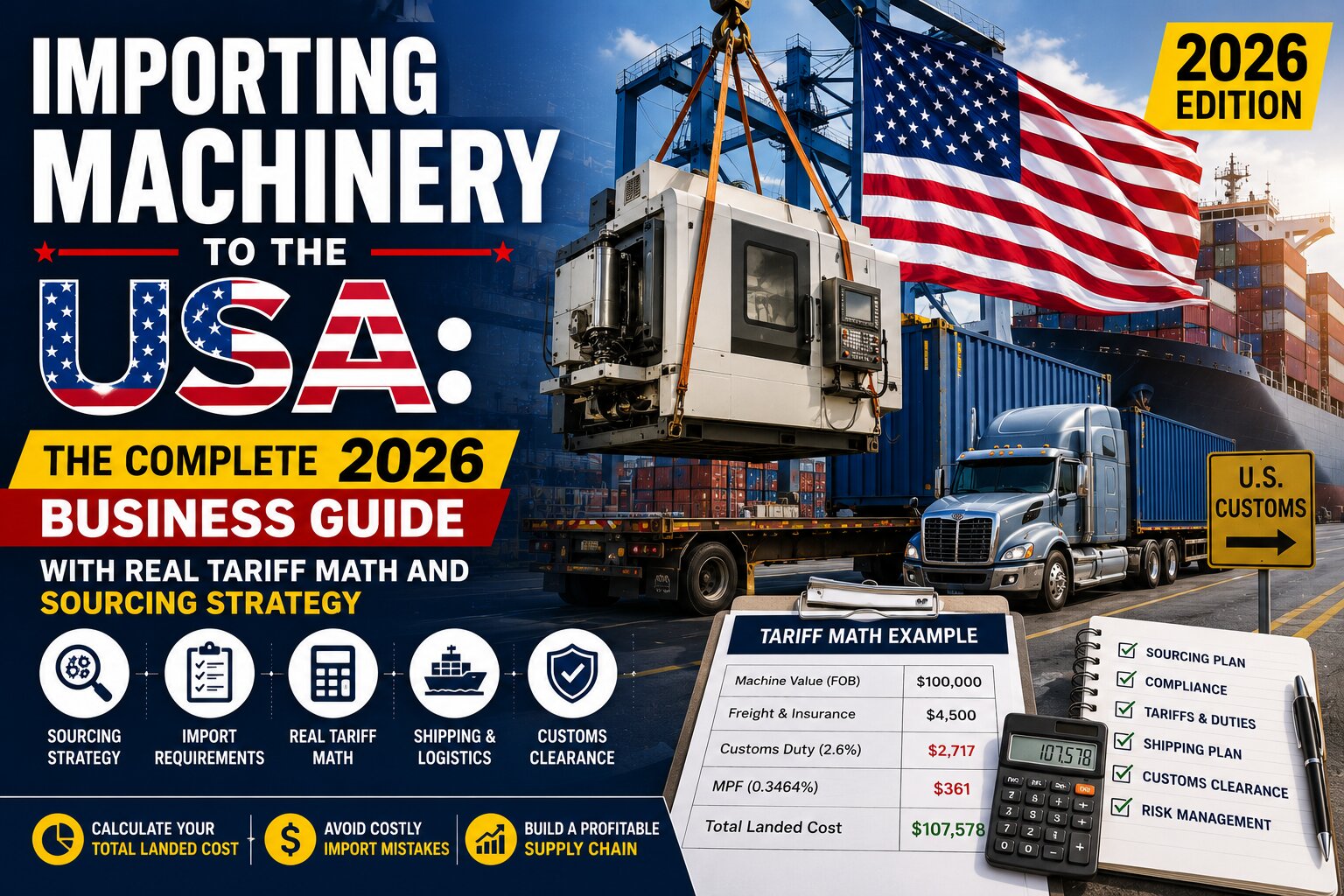
Importing machinery into the USA in 2026 involves navigating a tariff environment that has shifted significantly in the last 18 months. Section 232 steel and aluminum derivative product duties apply to specific, enumerated derivative mill products and components contained within imported machinery. Section 301 tariffs continue to add 25 percent on Chinese-origin equipment. The February 2026 Supreme Court ruling striking down IEEPA tariffs opened up refund opportunities that most industrial importers still don't know exist. Meanwhile, USMCA continues to offer duty-free entry for qualifying Canadian and Mexican machinery — often the single largest cost advantage available to US buyers. This guide walks through the complete 2026 process for importing machinery, with real tariff math, sourcing country comparisons, and the operational steps that turn a purchase order into delivered equipment on the shop floor.
What you'll learn in this guide
- What counts as machinery under US customs law
- The 2026 machinery tariff landscape
- Section 232 derivative products — the trap most importers miss
- Country-of-origin sourcing comparison for 2026
- The Canadian USMCA advantage
- The seven-step machinery import process
- Documents you must have for machinery entries
- New machinery vs used machinery imports
- Partner agency requirements (EPA, DOT)
- Real 2026 cost example: importing a CNC machining center
- Common mistakes that stop machinery at the border
- Frequently asked questions
What counts as machinery under US customs law
Machinery is one of the broadest import categories under US customs law. The Harmonized Tariff Schedule of the United States (HTSUS) devotes two full chapters to machinery — Chapter 84 covers mechanical machinery, and Chapter 85 covers electrical machinery and equipment. Between them, these chapters classify everything from precision CNC machining centers to industrial forklifts, from bulldozers and excavators to milling machines, from generators to boilers, and from packaging equipment to semiconductor manufacturing tools.
Getting the classification right matters more than most first-time importers realize. HTSUS codes drive your duty rate, determine which partner agencies get involved, and dictate what documentation CBP requires at entry. A CNC lathe classified as 8458.11.0030 pays a different duty rate than the same physical machine classified as 8459 for a milling machine. Both may attract Section 232 derivative product duties on the steel and aluminum content. Getting classification wrong triggers back-duty assessments, CBP holds, and ongoing customs scrutiny.
Here are the main machinery subcategories US importers most commonly deal with:
- Chapter 84 machinery — CNC machines, industrial pumps, forklifts, construction equipment, agricultural machinery, packaging equipment, boilers, bearings, engines
- Chapter 85 electrical machinery — motors, generators, transformers, industrial control panels, medical imaging systems, semiconductor equipment
- Chapter 87 vehicles — construction vehicles that overlap with heavy equipment (dump trucks, mixer trucks)
- Chapter 90 instruments — precision measuring equipment, laboratory machinery, optical machinery
Some machinery categories are prohibited or restricted entirely. Anything on the OFAC restricted party lists, machinery subject to specific export controls from origin countries, and equipment covered by the US Munitions List (USML) all require careful vetting before purchase. Most industrial and commercial machinery, however, imports freely subject to standard classification and duty payment.
The 2026 machinery tariff landscape
The tariff picture on imported machinery in 2026 has multiple overlapping layers. Understanding which layers apply to your specific import is the difference between a profitable landed cost and an unpleasant surprise at customs clearance.
The base HTSUS duty
Base duty rates on machinery under Chapter 84 range from 0 percent (many agricultural implements and some industrial machinery) up to about 5 percent (a few specialized categories). Most industrial machinery falls in the 1 to 3 percent base duty range. Chapter 85 electrical machinery follows similar bands. Compared to consumer goods, machinery generally enjoys favorable base rates because tariff policy has historically supported industrial capacity building.
Section 301 tariffs on Chinese-origin machinery
Machinery of Chinese origin faces Section 301 tariffs on top of the base rate. Most industrial machinery categories fall under List 1 or List 3, adding 25 percent to the duty owed. This is not a temporary measure — Section 301 has been in effect since 2018 and continues in 2026. For an importer choosing between a Chinese-origin machine and a comparable machine from another country, the Section 301 tariff alone can shift landed cost math significantly.
Section 232 steel and aluminum derivatives
This is the tariff layer most machinery importers underestimate. Section 232 tariffs originally targeted steel and aluminum imports directly, but expanded coverage of derivative products means any machinery containing steel or aluminum components may face additional tariffs based on the metal content. The specific application varies by product, but the principle affects a huge portion of imported machinery. We cover this in more detail in the next section because it deserves its own attention.
The IEEPA situation as of February 2026
Between February 2025 and February 2026, IEEPA tariffs added additional duty layers to imports from various countries. In February 2026, While historical tariff adjustments have faced legal challenges, industrial machinery importers must closely monitor ongoing trade policy updates and regulatory adjustments regarding specific tariff classifications. If your business imported machinery in 2025 or early 2026, this represents a meaningful recovery opportunity worth investigating.
USMCA and other FTA preferences
Machinery qualifying under free trade agreements can enter duty-free. USMCA covers Canadian and Mexican machinery meeting rules of origin. KORUS covers qualifying Korean machinery. Multiple other FTAs offer preferences for machinery from specific countries. When applicable, FTA duty-free entry is often the single largest cost advantage available on machinery imports.
0%
Duty rate on qualifying Canadian machinery under USMCA
25%
Section 301 tariff on Chinese-origin machinery
$166B
IEEPA tariffs collected 2025-Feb 2026 — potentially refundable
Ch 84 & 85
HTSUS chapters covering most industrial machinery
Section 232 derivative products — the trap most importers miss
Every ranking guide on importing machinery talks about base HTSUS duties and (sometimes) Section 301. Almost none of them properly address Section 232 derivative product duties. This is the single most expensive blind spot for first-time machinery importers, and understanding it before you commit to a purchase saves substantial money.
What Section 232 derivatives actually cover
Section 232 tariffs originally targeted primary steel and aluminum imports. But the derivative product designation expanded coverage to finished goods and components containing meaningful steel or aluminum content. The specific list of covered derivative products is technical and evolves over time, but the practical result is that a large portion of imported machinery — anything with substantial metal fabrication content — potentially triggers additional Section 232 duty exposure.
Why this catches machinery importers by surprise
Machinery is heavy. Machinery is metal. The typical CNC lathe, industrial press, boiler, or forklift contains hundreds or thousands of pounds of steel and aluminum. When the derivative products list captures your machinery's HTS classification, the additional duty applies to the metal content value — which for machinery is often a substantial portion of the total value. On a $200,000 industrial press, the Section 232 derivative exposure alone could add $10,000 to $25,000 in unexpected duty depending on classification.
How to handle it
Two practical steps. First, verify your specific machinery HTS code against the current Section 232 derivative products list before you commit to purchase. Your customs broker or a consultant should do this analysis — do not rely on the foreign supplier's classification. Second, factor the derivative duty exposure into your landed cost calculation from the start. Being surprised at customs clearance is the worst place to discover this tariff exists.
Section 232 mechanics
Importing Auto Parts into the US: The Section 232 Reality in 2026
Country-of-origin sourcing comparison for 2026
Sourcing country choice drives more of your machinery landed cost than almost any other single decision. Here is the realistic 2026 comparison across the five major sourcing countries US machinery importers actually use, with the tariff picture that applies to each.
← Swipe to see all columns →
| Country | Tariff exposure (2026) | Strengths | Weaknesses |
|---|---|---|---|
| Canada | 0% under USMCA (qualifying goods) | USMCA duty-free, proximity, short lead times, English-language contracts | Higher unit prices than Asia; capacity varies by category |
| Germany | Base HTSUS only (typically 1-3%) | World-class precision machinery, quality reputation, established support networks | Higher unit prices; longer shipping lead times |
| Japan | Base HTSUS only + Section 232 derivatives | Excellent industrial machinery quality, well-established export infrastructure | Higher unit prices; Section 232 exposure on metal content |
| China | Base + 25% Section 301 + potential Section 232 | Lowest base prices, vast capacity, deep supplier network | 25%+ Section 301 stack; supplier vetting critical |
| Mexico | 0% under USMCA (qualifying goods) | USMCA duty-free, proximity, lower labor costs than Canada | Capacity concentrated in specific machinery categories |
The headline insight from this table: the total landed cost math on machinery imports has shifted meaningfully in favor of USMCA sources (Canada and Mexico) in the current tariff environment. A Canadian machinery supplier offering the same specifications as a Chinese supplier at even a 15 to 20 percent higher unit price often delivers a lower total landed cost once Section 301 and Section 232 exposure is factored in on the Chinese source.
The Canadian USMCA advantage
Canada deserves its own section because of how significantly the USMCA duty-free pathway changes the machinery import math. This is especially true for heavy equipment, industrial machinery, and construction equipment where Canadian manufacturers and dealers have deep capacity and established US customer relationships.
How USMCA qualification works for machinery
Machinery qualifies for USMCA duty-free treatment when it meets the rules of origin — either the tariff shift rule (all non-originating materials undergo a specified tariff classification change) or the regional value content requirement (typically 60 to 75 percent North American content depending on the specific machinery category). For machinery genuinely manufactured in Canada, meeting the rules of origin is usually straightforward.
The USMCA Certificate of Origin does not have to follow a mandatory form (unlike the old NAFTA Certificate), but it does have to contain nine specific data elements. Your Canadian supplier prepares this certificate, and your customs broker uses it to claim the USMCA preference on entry. This is the operational key to the duty-free treatment — without a properly completed certificate, your entry defaults to Most Favored Nation duty rates.
Why Canada often wins on total landed cost
Beyond the duty-free treatment, Canadian machinery imports carry several structural advantages: shipping is by truck across land borders rather than ocean freight (faster, cheaper, less risk to sensitive equipment), lead times are days or weeks rather than months, warranty and service support is easier to arrange, and English-language contracts eliminate translation friction. For heavy equipment specifically — bulldozers, excavators, cranes, and similar construction machinery — Canada is often the single most economical sourcing option in North America.
The deep operational side of Canadian heavy equipment imports is worth its own detailed treatment. Our companion piece on importing heavy equipment from Canada to USA walks through the complete playbook for contractors, dealers, and buyers — including USMCA qualification steps, real cost examples on Caterpillar and John Deere equipment, and the specific documentation requirements for construction and industrial equipment moving across the northern border.
Worth knowing
For most US buyers evaluating machinery sourcing options in 2026, running the numbers on Canadian USMCA-qualifying equipment as a first option often surprises them favorably. Even when the unit price is higher than an Asian equivalent, the combination of duty-free treatment, faster shipping, and lower total logistics cost frequently produces the best landed cost overall.
Planning a machinery import?
Get a structured sourcing analysis for your specific machinery needs
Our consultants compare landed cost math across sourcing countries for your specific machinery category, evaluate USMCA qualification opportunities, and map out the operational steps required to get equipment on your shop floor. No charge, no obligation for the initial planning conversation.
The seven-step machinery import process
Every successful machinery import follows the same fundamental sequence. The steps below are the operational backbone, whether you are importing a $50,000 packaging line from Canada or a $2 million semiconductor tool from Germany.
The complete process
Seven steps to import machinery into the USA
1
Classify HTSUS
10-digit HTS code and Section 232 derivative check.
2
Verify FTA eligibility
USMCA, KORUS, or other applicable preferences.
3
Purchase order
Incoterms, payment, warranty, service terms.
4
Arrange transport
Truck (Canada/Mexico), ocean, or air freight.
5
File ISF (if ocean)
Importer Security Filing 24 hrs before loading.
6
Customs entry
CBP Form 7501, partner agency filings, duty payment.
7
Delivery & setup
US-side inland, installation, commissioning.
Time from committed purchase order to installed equipment varies dramatically by origin. Canadian truck shipments can complete the full cycle in 2 to 4 weeks. Ocean freight from Europe or Asia typically runs 8 to 14 weeks total. Air freight (used for high-value, time-sensitive machinery like semiconductor tools) compresses the shipping portion to 3 to 7 days but adds significant cost.
For the comprehensive framework covering both import and export procedures across all product categories, our guide on what is import export procedure walks through each step with US-specific examples and the complete regulatory framework.
Documents you must have for machinery entries
Machinery imports require more documentation than most consumer goods because of the higher values, partner agency oversight, and technical specifications involved. Here is the complete document list every machinery import needs.
Core commercial documents
- Commercial invoice — from the seller, with full technical description, model numbers, serial numbers, and declared value
- Packing list — detailed breakdown of crates, dimensions, weights, and contents
- Bill of Lading (BOL) — from the carrier, ocean or truck
- Certificate of Origin — mandatory for USMCA/KORUS/other FTA preference claims
- Insurance certificate — cargo insurance covering the shipment value
Customs filings
- CBP Form 7501 (Entry Summary) — filed by your customs broker
- ISF 10+2 (Importer Security Filing) — required 24 hours before ocean loading
- HTSUS classification worksheet — supports the classification claim on the entry
- Section 232 derivative products declaration — for machinery with steel/aluminum content
Partner agency filings (as applicable)
- EPA Form 3520-21 — for engine-powered equipment subject to EPA emissions regulations
- EPA Form 3520-1 — for on-highway vehicles and off-road engines
- DOT compliance — for on-road equipment or safety-regulated machinery
- FDA declarations — for machinery contacting food or pharmaceuticals
- USDA APHIS — for machinery treated with wood packaging materials (ISPM 15)
Missing documentation is the number one reason machinery gets held at US customs. Broker experience specifically with machinery imports matters here — a broker who has moved hundreds of CNC machines knows which partner agencies get involved and which forms need to be filed simultaneously with the customs entry rather than after.
New machinery vs used machinery imports
New and used machinery follow the same fundamental import process but differ meaningfully in documentation requirements, valuation, and partner agency scrutiny. Understanding these differences before purchase saves problems at customs clearance.
New machinery
Import characteristics
- Manufacturer commercial invoice at list price
- Standard HTS classification
- Manufacturer warranty documentation
- Original CE/UL/CSA certifications
- Full engineering documentation
- Straightforward EPA/DOT compliance
Used machinery
Import characteristics
- Bill of Sale showing actual purchase price
- Same HTS but different valuation method
- Maintenance records essential
- Refurbishment history documentation
- Detailed condition assessment
- Additional EPA scrutiny on older engines
Used equipment valuation questions
CBP scrutinizes used machinery valuation carefully because it is a common area for undervaluation attempts. The declared value should reflect actual arm's-length purchase price supported by the Bill of Sale, plus any freight and insurance to the point of importation. Attempting to declare a suspiciously low value on used equipment typically triggers CBP inquiries and potentially binding ruling requests to establish proper valuation.
Engine emissions scrutiny
Used machinery with older engines — construction equipment, industrial generators, agricultural machinery — faces additional EPA scrutiny to prevent circumvention of newer emission standards. The EPA has specific rules about importing older-tier engines, and some categories require certificate of conformity or tier-specific exemptions. This is one of the most common places used machinery imports get held.
Partner agency requirements (EPA, DOT)
Beyond CBP, several federal partner agencies get involved in machinery imports depending on the equipment type. Missing partner agency filings creates the same import holds as missing CBP documents — sometimes worse, because port storage costs continue accumulating while you sort them out.
EPA requirements
EPA regulates emissions from engines and certain machinery categories. Any machinery with a diesel or gasoline engine typically requires EPA emissions compliance, either through a Certificate of Conformity or an applicable exemption. This includes construction equipment (excavators, bulldozers, loaders), industrial generators, agricultural machinery, forklifts with combustion engines, and various off-road equipment categories.
EPA also regulates certain refrigerants and chemicals contained in machinery. HVAC equipment, industrial chillers, and machinery containing regulated refrigerants require specific declarations at import.
DOT requirements
DOT regulates equipment operating on public roads. This includes commercial trucks, trailers, mobile equipment operating on roads, and any machinery required to meet DOT safety standards. Most industrial machinery installed in factories does not trigger DOT requirements, but crossover equipment (like mobile cranes or truck-mounted industrial equipment) often does.
FDA and USDA requirements
FDA regulates machinery that contacts food or pharmaceuticals during operation. Food processing equipment, packaging machinery for pharmaceuticals, and dairy equipment all typically require FDA registration and declarations. USDA APHIS requirements apply to wood packaging materials (crates, pallets) accompanying machinery — the wood must be treated to ISPM 15 standards to prevent pest transmission.
Real 2026 cost example: importing a CNC machining center
Here is a realistic 2026 cost breakdown for importing a used Haas VF-4SS CNC machining center from Germany to Ohio. This example illustrates how the various tariff and cost layers combine on a typical mid-value industrial machinery import.
← Swipe to see all columns →
| Cost line | Amount (USD) | Notes |
|---|---|---|
| Machine purchase price (used, Germany) | $85,000 | Ex-works price from German dealer |
| Inland freight (Germany to Hamburg) | $1,800 | Truck to port of loading |
| Export documentation (Germany side) | $450 | Export declaration, invoice prep |
| Ocean freight / flat-rack (Hamburg to Baltimore) | $7,500 | Heavy machinery open-top or flat-rack handling |
| Cargo insurance (0.5%) | $460 | Coverage during transit |
| Base HTSUS duty (2.5%) | $2,153 | HTS 8458.11.0030, machinery |
| Section 232 derivative duty exposure | $3,850 | Steel content estimate ~35% of value |
| MPF and HMF fees | $405 | Standard entry fees |
| US customs broker fees | $1,200 | Complex machinery entry, partner agency filings |
| Continuous customs bond | $500 | Annual, prorated |
| ISF filing | $150 | Filed 24 hrs before loading |
| EPA declaration filing | $200 | Not applicable here (no engine) — placeholder |
| Port charges (Baltimore) | $550 | Terminal handling, storage |
| US-side specialized heavy-haul transport (to Ohio) | $4,800 | Baltimore to Cincinnati by specialized heavy-haul drop-deck with permits |
| Rigging and installation setup | $3,200 | Machine positioning, calibration setup |
| Total landed cost | $106,518 | ~25% above ex-works price |
Total landed cost: $106,518 on an $85,000 ex-works price — approximately 25 percent above the base machine price. If this same CNC machining center was sourced from a Canadian dealer under USMCA, the base HTSUS duty and Section 232 derivative exposure would both drop to zero, saving approximately $6,000 in duty costs and reducing total landed cost to roughly $100,000.
If sourced from China, the same machine would face an additional 25 percent Section 301 tariff on the $85,000 machine value, adding $21,250 to the landed cost and bringing the total to approximately $128,000. The math clearly favors USMCA sourcing when comparable Canadian machinery is available.
Ready to build your machinery import operation
Expert help with HTS classification, USMCA qualification, and Section 232 planning
Our import consulting team supports US manufacturers, dealers, and end users with the complete machinery import process. From HTS classification review and Section 232 derivative analysis to USMCA qualification, customs broker selection, and partner agency compliance. Whether you're importing one CNC machine or building a fleet of heavy equipment.
Common mistakes that stop machinery at the border
Most machinery imports that get held at CBP fall into a small handful of preventable mistakes. Knowing them before you commit to purchase saves days of storage costs, missed installation schedules, and expensive rework.
- Skipping the Section 232 derivative analysis. The single most expensive blind spot. Machinery importers who budget only for base HTSUS duty and Section 301 often discover Section 232 exposure at clearance, adding thousands in unexpected duty.
- Missing the USMCA Certificate of Origin. Without a properly completed certificate, your Canadian or Mexican machinery pays MFN duty rates instead of USMCA duty-free treatment. The certificate must be prepared before entry, not after.
- Undervaluing used machinery. CBP scrutinizes used equipment valuation. Declared values that look implausibly low relative to market prices trigger inquiries, delays, and potentially binding ruling requirements.
- Forgetting EPA emissions declarations on engine-powered equipment. Any machinery with a diesel or gasoline engine likely needs EPA Form 3520-21 or similar declaration. Missing this stops the entry release.
- Wood packaging material (WPM) non-compliance. Untreated wood crates and pallets trigger USDA holds. All wood packaging must be treated to ISPM 15 standards with proper marking.
- Incorrect HTS classification. Machinery classification is technical. Using an overly broad HTS code triggers back-duty assessments; using an incorrect code triggers audits. Professional classification review is essential.
- Inadequate technical documentation for customs valuation. Missing model numbers, serial numbers, or technical specifications create valuation questions that delay release. Complete commercial invoices matter.
- Ignoring partner agency filings. CBP customs entry is only half the story. FDA, EPA, DOT, USDA — depending on the machinery type — often need parallel filings that must arrive with the entry.
"The machinery importers who scale successfully in 2026 treat tariff analysis and partner agency compliance as pre-purchase decisions, not post-arrival surprises."
Frequently asked questions
What is the tariff on imported machinery in 2026?
Machinery imports in 2026 face a tariff stack that varies significantly by country of origin and HTS classification. Base HTSUS duties on machinery under Chapter 84 range from 0 percent to about 5 percent depending on the specific subheading. Machinery from China faces Section 301 tariffs of 25 percent stacked on top of the base rate. Steel and aluminum content in machinery triggers Section 232 derivative product duties. Machinery qualifying under USMCA from Canada or Mexico can enter duty-free. Machinery from most other countries pays only the base HTSUS rate. Machinery from most other countries pays only the base HTSUS rate, while importers should continually verify changing trade enforcement measures and specific product classifications.
How do I import machinery from Canada to the USA?
Importing machinery from Canada to the USA involves five key steps: verify USMCA eligibility by confirming the machinery meets the rules of origin, obtain a USMCA Certificate of Origin from the Canadian supplier, arrange transportation across the border (typically by truck), engage a licensed US customs broker to file CBP Form 7501 and any partner agency filings, and complete US-side inland transport to the final destination. Machinery qualifying under USMCA enters duty-free, making Canada one of the most cost-effective sourcing countries for industrial and construction equipment in 2026.
What documents are required to import machinery?
You need eight core documents to import machinery into the USA: the commercial invoice from the seller showing purchase price and full technical description, the packing list detailing crated components, the Bill of Lading (BOL) from the shipping carrier, the Certificate of Origin (especially if claiming USMCA or other FTA preferences), CBP Form 7501 Entry Summary filed by your customs broker, ISF 10+2 for ocean shipments filed 24 hours before loading, EPA declarations for engine-powered equipment, and DOT compliance documentation for on-road or safety-regulated equipment. Used machinery requires additional documentation including maintenance records and refurbishment declarations.
How much does it cost to import industrial machinery in 2026?
Total landed cost for industrial machinery imports in 2026 typically runs 15 to 45 percent above the machinery purchase price, depending on country of origin, machinery category, and shipping requirements. For a $100,000 CNC machine imported from Germany, expect roughly $18,000 to $28,000 in additional costs including ocean freight, base HTSUS duties, customs broker fees, continuous customs bond, cargo insurance, port handling, US-side inland transportation, and any partner agency compliance costs. Chinese-origin machinery adds 25 percent Section 301 tariff on top. Canadian-origin machinery under USMCA typically has the lowest total landed cost.
Do I need a customs broker to import heavy equipment?
Yes, practically every serious machinery import requires a licensed customs broker. Machinery entries involve complex HTSUS classification, potential Section 232 derivative product analysis, USMCA rules of origin verification, EPA and DOT partner agency filings, and continuous bond requirements. Self-filing is theoretically possible for personal-use imports under $2,500, but essentially no commercial machinery import falls in that range. Broker fees ($400 to $1,800 per entry depending on complexity) are inexpensive compared to the cost of classification errors, back-duty assessments, or CBP holds that stop production line delivery.
What is the difference between importing new and used machinery?
New and used machinery follow the same fundamental import process but differ in documentation, valuation, and partner agency scrutiny. Used machinery requires proof of purchase (Bill of Sale rather than a manufacturer invoice), valuation based on documented market value rather than manufacturer list price, potential refurbishment declarations, and detailed maintenance records if the equipment includes engines subject to EPA regulation. Some used equipment categories face additional scrutiny to prevent evasion of newer emission standards. Working with a customs broker experienced in used equipment imports prevents most of the common valuation and classification disputes.
Can I import machinery under USMCA duty-free?
Yes, machinery qualifying under USMCA rules of origin enters the United States duty-free from Canada or Mexico. Qualification requires either meeting the tariff shift rule (all non-originating materials undergo a specified tariff classification change) or the regional value content requirement (typically 60 to 75 percent North American content depending on the specific machinery category). Your Canadian or Mexican supplier prepares a USMCA Certificate of Origin containing nine required data elements, and your US customs broker uses this certificate to claim the preference at entry. Without a properly completed certificate, the entry defaults to standard MFN duty rates.
What types of machinery cannot be imported into the USA?
Most industrial and commercial machinery can be imported into the USA subject to standard duty payment and partner agency compliance. Categories that face restrictions or prohibitions include: machinery on the US Munitions List (USML) requiring ITAR compliance, machinery subject to export controls from the origin country, equipment involving OFAC-sanctioned entities or countries, machinery containing prohibited materials or refrigerants, and specific categories where CPSC, FDA, or other agencies impose category-specific requirements. Most commercial CNC machines, industrial pumps, forklifts, and construction equipment import freely subject to standard classification and duty payment.
Read more on importing equipment and international trade
If this guide was useful, here are related resources from our blog that go deeper on adjacent topics.
Pillar guide
Importing Heavy Equipment from Canada to USA: A 2026 Playbook
Port operations
Los Angeles Import Customs Clearance: The Complete 2026 Guide
Container shipping
How to Import a Container from China: A 2026 Playbook
Business structure
Top Import Company Guide for 2026: How to Start and Scale
Ready to import machinery the right way?
Get expert support from HTS classification to installed equipment
From verifying tariff exposure and USMCA qualification to customs broker selection, partner agency compliance, and delivery coordination — our team helps US manufacturers, dealers, and end users turn machinery imports from a source of tariff risk into a straightforward operational sequence. Start with a no-cost conversation about your equipment needs.
The machinery import opportunity is real — the tariff math determines whether it works
Importing machinery in 2026 remains a viable strategy for US buyers who understand the current tariff environment and structure their sourcing accordingly. The businesses that succeed treat HTS classification, Section 232 derivative analysis, and USMCA qualification as pre-purchase decisions rather than post-arrival surprises. Canada frequently wins the total landed cost comparison. Germany and Japan offer premium quality at competitive total costs. China works for categories where no alternative exists. Whatever your machinery need, running the full tariff math before you commit is the discipline that separates profitable imports from margin-destroying surprises.



Contact us today to schedule a NO-CHARGE INTIALS 30-MINUTE consultation. Ask questions and learn from the experts.