

Import Business Playbook
Top Import Company Guide for 2026: How to Start, Structure, and Scale an Import and Export Business in the US
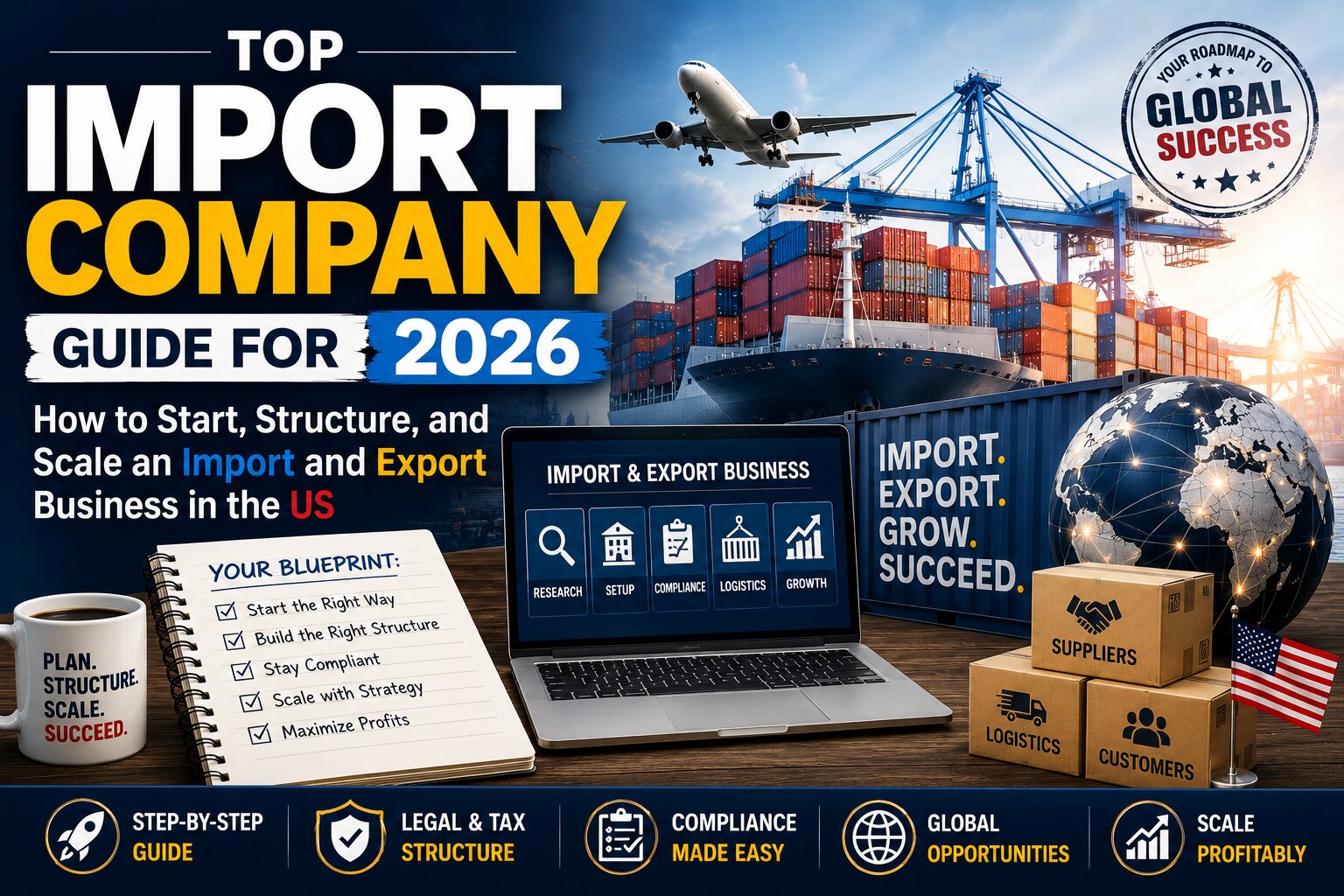
The honest reality of starting and running an import company in 2026 looks different from the guides published two or three years ago. Section 301 tariffs on Chinese-origin goods now stack on top of base duties at 25 percent for most categories. IEEPA tariffs have collected over $166 billion from US importers in just over a year. China sourcing has become a deliberate decision rather than a default, and Vietnam, Mexico, India, and Korea have emerged as major alternatives. This guide walks through what import and export companies actually look like in 2026, the six different business models, real 2026 startup costs, and the operational steps that turn a business plan into a working import operation.
What you'll learn in this guide
- What an import company actually is in 2026
- Six types of import and export companies
- Why 2026 is a different environment for import companies
- The 12-step framework to launch your import company
- Legal structure and Importer of Record status
- Country sourcing comparison for 2026
- Choosing products and target categories
- Real 2026 startup costs for an import company
- Daily operations of a successful import company
- Mistakes that sink new import companies
- How import companies scale beyond the first year
- Frequently asked questions
What an import company actually is in 2026
An import company is a business that purchases goods from foreign suppliers and brings them into the United States for resale, distribution, or use in its own operations. At its simplest, that definition covers a solo entrepreneur sourcing one product line from one supplier in one country. At its most complex, it covers a multi-billion-dollar distributor managing thousands of SKUs across dozens of supplier countries.
The legal anchor for every import company is the Importer of Record (IOR) designation. The IOR is the party legally responsible for the entry filing, duty payment, regulatory compliance, and recordkeeping for each shipment. Whether you are running a five-person operation or a five-hundred-person enterprise, your company will likely be the Importer of Record on its own shipments — and that carries real legal weight under US law.
An import and export company is the broader category that includes businesses operating in both directions: bringing goods into the US and selling US goods to foreign buyers. Many established import export companies grew this way naturally — they started importing one product, built supplier relationships, then discovered that their suppliers wanted access to other markets too. The two flows often reinforce each other, especially in industries like electronics, textiles, food, and industrial components.
This guide focuses primarily on the import side because that is where most new businesses start, but the operational principles and regulatory framework are similar enough that import export companies handling both directions follow the same disciplines. For a deeper look at how the two flows differ, our companion piece on the difference between import and export walks through twelve dimensions where the procedures diverge.
Six types of import and export companies
The phrase "import company" covers six distinct business models. Knowing which one you are running matters because each model has different capital requirements, regulatory exposure, and growth dynamics. Most articles on this topic confuse these — clarifying them upfront helps you make the right decision early.
Business model overview
Six common types of import and export companies
1
Direct importer
Imports for own resale; owns inventory; common SMB model.
2
Import distributor
Imports and sells through retail or wholesale channels.
3
Sourcing agent
Connects US buyers with foreign suppliers for a fee.
4
Export management co (EMC)
Manages export operations for US manufacturers.
5
Export trading co (ETC)
Buys US goods to resell abroad; takes inventory risk.
6
Customs broker / 3PL
Service providers, not import companies themselves.
Direct importer
The simplest model. Your company purchases goods from foreign suppliers, takes title, brings them into the US, and resells them under your own brand or distribution channels. The company is the Importer of Record and carries all inventory risk. Most small-to-mid-sized import companies operate this way.
Import distributor
An import distributor functions like a direct importer at larger scale, with established channels to retail buyers, e-commerce platforms, or wholesale partners. Distributors maintain warehouses, fulfillment infrastructure, and often deeper supplier relationships. The Importer of Record status is the same; the volume and complexity are higher.
Sourcing agent
A sourcing agent does not take title to goods. Instead, the agent connects US buyers with foreign suppliers, manages the supplier relationship, and earns a commission or service fee. This model carries far less capital risk than direct importing but caps upside potential. Many sourcing agents specialize in a single product category or country.
Export Management Company (EMC)
An EMC operates as an outsourced export department for US manufacturers. The EMC handles foreign buyer identification, documentation, AES filing, and shipping logistics — but does not take title to the goods. The US manufacturer remains the legal exporter. EMCs typically earn fees plus performance-based commissions on closed deals.
Export Trading Company (ETC)
An ETC buys US-made goods outright and resells them in foreign markets, taking title and inventory risk along the way. This model gives ETCs more pricing flexibility but exposes them to the same inventory and currency risks as a direct importer. ETCs typically focus on specific industries or destination markets.
Customs broker and 3PL providers
These are service providers, not import companies. Customs brokers file customs entries on behalf of importers and earn fees per transaction. Third-party logistics providers (3PLs) handle warehousing, fulfillment, and transportation. Both are essential vendors for most import companies but operate under different licensing regimes and business models.
Which model fits you
If you have a product idea and capital but limited trade experience, start as a direct importer with a single supplier relationship. If you have strong relationships but limited capital, the sourcing agent model gets you started without inventory risk. If you have established channels and want to scale fast, the import distributor model fits. Few new import companies start as ETCs or EMCs — those typically grow from established direct-importer operations.
Why 2026 is a different environment for import companies
The fundamentals of running an import company have not changed in 2026 — but the trade environment around it has changed dramatically. New import companies launching now face conditions that did not exist five years ago, and operating profitably requires building the strategy around the current reality rather than the assumptions of the 2010s.
Section 301 tariffs on Chinese-origin goods
The 25 percent Section 301 tariff on most Chinese imports stacks on top of base import duty. For an import company sourcing a $40,000 container of consumer goods from China, that is an additional $10,000 in tariff cost before any other expense. This is not a temporary measure — Section 301 has now been in place since 2018 and is treated as a long-term cost of sourcing from China.
IEEPA tariffs and the $166 billion question
The International Emergency Economic Powers Act tariffs introduced between February 2025 and February 2026 collected approximately $166 billion from US importers. The Supreme Court is currently reviewing aspects of this regime, and the refund process under CAPE filing has become a major operational issue for active importers. New import companies need to understand which tariff regimes apply to their goods at the time of entry.
Country sourcing diversification
China was the default sourcing country for new US import companies through 2020. That is no longer true. The combination of Section 301 tariffs, geopolitical tension, and supplier capacity expansion in alternative countries has made Vietnam, Mexico, India, Korea, and Thailand serious competitors for Chinese suppliers. New import companies in 2026 typically evaluate at least three sourcing countries before committing.
Phase Two trade framework
The China Phase Two trade framework announced in late 2025 stabilized parts of the US-China trade relationship, particularly in agricultural commodities. This adds another layer of complexity for import companies that work in or adjacent to categories covered by the framework.
China sourcing
How to Import from China to USA: A Complete 2026 Guide
The 12-step framework to launch your import company
Every successful import company follows the same fundamental sequence in its first year, regardless of which business model it uses or what product category it targets. The 12 steps below are the operational backbone of getting from idea to first cleared shipment.
- Form a legal entity — typically an LLC for personal liability protection, occasionally a C-Corp if you plan to attract outside investors
- Obtain an EIN — IRS Employer Identification Number, required for commercial customs entries above $2,500
- Identify your target product category — based on demand research, your industry knowledge, and capital constraints
- Choose your sourcing country — evaluate at least three countries for cost, quality, tariff exposure, and lead time
- Vet foreign suppliers — verify business registration, request samples, conduct factory audits where feasible, check references
- Classify products under the Harmonized Tariff Schedule — the 10-digit HTSUS code determines your duty rate and which agencies care about the shipment
- Engage a customs broker — for almost all new importers, professional broker services are far cheaper than the cost of mistakes
- Obtain a continuous customs bond — typically $500 to $1,500 annually for most importers, required for entries above $2,500
- Set up Importer Security Filing (ISF) — 24-hour pre-loading requirement for ocean freight; broker typically files
- File the customs entry through ACE — Automated Commercial Environment is the CBP platform for all commercial entries
- Pay duties, fees, and any tariff add-ons — including base duty, MPF, HMF, Section 301 where applicable, and IEEPA tariffs if any
- Receive cargo and retain records — five-year recordkeeping requirement on every entry, including documentation supporting valuation and classification
From committed first purchase order to delivered inventory in a US warehouse, plan for 60 to 120 days on a typical first shipment. The timeline compresses in subsequent shipments once supplier relationships and operational infrastructure are in place. For the complete step-by-step framework that applies to both directions of trade, our piece on what is import export procedure walks through each step in detail with US-specific examples and the full regulatory framework.
Planning to start an import company?
Get a structured launch plan for your specific product and target market
Tell us about your products, target sourcing countries, and projected volumes. Our consultants will walk through entity setup, supplier vetting strategy, tariff exposure, and operational steps — at no charge, no obligation.
Legal structure and Importer of Record status
The legal foundation of your import company shapes everything that follows — liability exposure, tax treatment, banking relationships, and the cleanliness of your customs operations. Get this right at the start.
Why LLC is the default for most import companies
The Limited Liability Company structure protects your personal assets from business liabilities, gives you tax flexibility (default pass-through taxation, with the option to elect S-Corp treatment), and is straightforward to maintain. Most new import companies form as LLCs in Delaware, Wyoming, or their home state. The cost is typically $300 to $1,500 depending on state and whether you use a formation service.
When a C-Corp makes sense
Choose a C-Corp if you plan to raise outside investment (venture capital, angel investors), issue stock options to employees, or operate at a scale where the corporate tax treatment becomes more favorable than pass-through taxation. For most direct-importer business models, C-Corp adds complexity without proportional benefit until annual revenue exceeds $1 million to $2 million.
The Importer of Record designation
Your company will likely be the Importer of Record on its own shipments. The IOR is the party legally responsible for:
- Filing the customs entry through ACE
- Paying all duties, fees, and tariffs
- Ensuring product classification accuracy under HTSUS
- Verifying compliance with partner agency requirements (FDA, USDA, FCC, EPA, CPSC as applicable)
- Maintaining five-year recordkeeping on every entry
- Responding to CBP inquiries, audits, and enforcement actions
The IOR carries real legal weight. Misclassification, undervaluation, or failure to comply with partner agency requirements can result in penalties that dwarf the duty amount owed. New importers sometimes assume they can use their freight forwarder or supplier as IOR — that is rarely a clean arrangement and almost never the best approach for ongoing operations.
Country sourcing comparison for 2026
The choice of sourcing country has become one of the most consequential decisions an import company makes. The table below compares the five major sourcing countries that US import companies actually use in 2026, with realistic assessments of each.
← Swipe to see all columns →
| Country | Strengths | Weaknesses | 2026 tariff status |
|---|---|---|---|
| China | Vast capacity, deep supplier base, competitive base prices, mature export infrastructure | Section 301 (25%) + potential IEEPA tariffs; supplier consolidation concerns | Highest tariff exposure |
| Vietnam | Strong manufacturing capacity, lower labor costs, no Section 301 | Some categories still developing; logistics infrastructure varies | Base duty only; favorable |
| Mexico | USMCA duty-free treatment for qualifying goods, proximity, shorter lead times, lower freight | Capacity concentrated in certain industries; nearshoring competition | USMCA: 0% on qualifying goods |
| Korea | KORUS FTA duty-free, sophisticated supplier base, especially strong in electronics and cosmetics | Higher unit costs than Southeast Asia | KORUS: 0% on qualifying goods |
| India | Strong in textiles, pharmaceuticals, IT; competitive labor costs | Variable quality control; longer lead times | Base duty applies |
The headline insight from the table is that China is no longer the obvious default. For many product categories, Vietnam, Mexico, or Korea now offers better landed cost economics once Section 301 tariffs are factored in. Most successful new import companies in 2026 evaluate at least three sourcing countries before committing to one.
For the operational side of moving inventory from any sourcing country, our companion piece on how to import a container from China walks through the container shipping mechanics that apply across most sourcing countries, with adjustments for the specific origin.
Choosing products and target categories
The product decision often determines whether your import company succeeds. Most new importers focus on supplier price and overlook the deeper questions: tariff exposure, regulatory complexity, competitive density, and reorder economics.
Categories that work for new import companies
- Consumer accessories — phone cases, kitchenware, small electronics accessories with stable demand
- Apparel and fashion accessories — moderate margins, broad supplier base, fast-moving inventory
- Beauty and personal care — high margins, but MoCRA compliance adds operational complexity
- Industrial components and parts — lower volume, higher unit value, less competitive density
- Specialty food products — niche margins, but FSMA and FDA registration requirements
- Furniture and home goods — high freight costs per unit, but generally stable demand
Categories that are harder than they look
- Restricted goods — firearms, ammunition, alcohol, tobacco require federal licenses and substantial compliance overhead
- Medical devices and pharmaceuticals — FDA approval timelines and costs typically exceed small-company budgets
- Heavy regulated electronics — FCC requirements, often UL certifications, and labeling complexity
- Food (commodity scale) — extremely competitive, low margins, perishability risk
- Vehicles and automotive parts — DOT, NHTSA, EPA requirements, plus Section 232 tariffs on certain auto parts
The strongest play for most new import companies is a moderately complex product with stable demand, supplier diversity, and manageable regulatory requirements. Avoid the temptation to start with the lowest-margin commodity products — they require volume that new operators cannot achieve, and they leave no buffer for the inevitable operational mistakes of the first year.
Real 2026 startup costs for an import company
Older guides commonly cite $5,000 to $7,000 as the startup cost for an import company. That figure was reasonable in 2020 but does not survive 2026 reality. Section 301 tariffs alone often consume that entire budget before any other expense. Realistic first-year cost for a small-to-mid-sized import company in 2026 is significantly higher.
← Swipe to see all columns →
| Cost line | 2026 typical cost | Notes |
|---|---|---|
| Business entity formation (LLC) | $500 – $2,000 | State filing, registered agent, operating agreement |
| EIN application | $0 | Free from IRS |
| Business licenses and permits | $200 – $1,500 | State and local; product category dependent |
| Continuous customs bond (annual) | $500 – $1,500 | Required for entries above $2,500 |
| Customs broker setup and first 3 entries | $1,500 – $5,000 | Power of attorney, initial entries |
| HTS classification review | $500 – $2,500 | Per product category; critical investment |
| Initial inventory purchase | $8,000 – $30,000 | First container or LCL shipment |
| Section 301 / IEEPA tariffs (if China) | +25%+ on inventory | Critical math for China sourcing |
| Ocean freight (first shipment) | $2,000 – $8,000 | 20ft container Asia–US West Coast |
| Cargo insurance | $200 – $800 | 0.5 to 1% of inventory value |
| Warehouse / storage (3 months) | $1,500 – $5,000 | 3PL or self-storage |
| Website, e-commerce, branding | $1,500 – $8,000 | Shopify, basic branding, photography |
| Software (accounting, inventory) | $500 – $2,000 | QuickBooks, inventory management, etc. |
| Working capital buffer | $5,000 – $15,000 | For duty payments and operational lag |
| Total first-year cost (small-mid operation) | $22,000 – $80,000 | Depends heavily on inventory scale |
A realistic minimum to launch a serious import company in 2026 is around $22,000 to $25,000 if you keep inventory small and discipline costs. The cleaner range for a sustainable operation is $40,000 to $60,000 in first-year investment. Companies operating below the minimum tend to underinvest in compliance, supplier vetting, or working capital — all of which catch up with them within twelve months.
Daily operations of a successful import company
The first shipment is the milestone. What happens after the first shipment is the business. Successful import companies run on operational rhythms that compound over time — strong supplier relationships, clean customs records, disciplined inventory management, and quick adaptation to changing trade conditions.
Supplier relationship management
Your supplier relationships are your most valuable asset. The best import companies invest substantial time in regular communication with suppliers, periodic factory visits, and ongoing quality and capacity discussions. Suppliers who feel valued prioritize your orders when capacity tightens. Suppliers who feel treated as commodities will treat your orders as commodities.
Customs and compliance discipline
Every shipment runs through the same procedural framework, but the cleanliness of execution determines whether your company gets flagged for additional CBP scrutiny. Maintaining consistent HTS classifications, accurate valuations, complete documentation, and prompt duty payment builds a clean customs profile that compounds in your favor across hundreds of subsequent entries.
For the specific port operations side of how customs clearance actually works in practice, our companion piece on Los Angeles import customs clearance walks through the operational realities at the largest US port complex, where roughly 40 percent of all US containerized imports arrive.
Inventory and working capital
Import companies live and die by working capital management. Inventory ties up cash. Duties have to be paid before goods can move. Sales cycles take 60 to 120 days from arrival to revenue collection. Successful import companies maintain disciplined inventory turnover, negotiated payment terms with suppliers, and clear visibility into upcoming working capital needs.
Pricing and margin management
Tariff changes, freight rate movements, and currency fluctuations all hit margins. The import companies that scale profitably build pricing models that pass appropriate costs through to customers while protecting margin on existing inventory. Static pricing assumptions kill profitability in a volatile trade environment.
Build a strong foundation for your import company
Get expert guidance on suppliers, tariffs, and compliance
Our import consulting team helps US import and export companies move from "we have a business plan" to "we have a working operation" — covering supplier sourcing, classification, tariff strategy, customs broker selection, and the documentation framework that scales.
Mistakes that sink new import companies
Most failed import companies fall into the same handful of preventable mistakes. Recognizing them before you start saves you from learning the same lessons by paying for them.
- Forgetting Section 301 in inventory math. The single most expensive mistake new China importers make. A $40,000 inventory order becomes a $50,000 landed-cost order when 25 percent Section 301 is added on top of base duty. Build it into your pricing model from day one.
- Using the wrong HTS classification. Misclassification creates duty disputes, back-duty assessments, and additional CBP scrutiny on every future shipment. Invest in professional classification review for each product category.
- Picking suppliers by price alone. The lowest-quoted supplier is often the supplier with the highest defect rates, longest lead times, or most communication problems. Total cost of supplier relationship matters more than unit price.
- Skipping the customs broker. Some new importers try to file their own entries through ACE to save money. The savings vanish the first time an entry gets rejected, flagged, or held. A broker costs $250 to $500 per entry; mistakes cost ten to a hundred times that.
- Inadequate working capital. Duties have to be paid at entry. Inventory takes 60 to 120 days to convert to revenue. Undercapitalized import companies run out of cash before their second shipment arrives.
- Ignoring partner agency requirements. Food, electronics, agricultural products, and consumer goods all have specific agency filings on top of CBP entry. Missing them creates port holds that compound storage costs.
- Single-country supplier dependency. If your one supplier in your one country has a quality problem or a tariff exposure, you have no inventory. Build supplier redundancy across at least two countries from year two onward.
- Treating compliance as paperwork. Compliance is the operational discipline that lets you scale without legal exposure. Companies that treat it as an afterthought eventually face penalties that dwarf any short-term savings.
- Mispricing freight and tariffs in customer quotes. Freight rates and tariff schedules move. Quoting customers based on stale cost data eats margin and creates contract disputes.
- Skipping records retention. Five-year recordkeeping is required on every entry. Companies that lose records during a CBP audit face penalties they could have avoided with disciplined record management.
"The import companies that scale through 2026 are the ones that treat the new tariff environment as a strategic constraint to be planned for, not a temporary annoyance to be ignored."
How import companies scale beyond the first year
Reaching the first cleared shipment is the start, not the finish line. The import companies that scale through years two, three, and beyond share several growth patterns.
Diversify supplier countries
By year two, successful import companies have moved away from single-country dependency. The most resilient operations source from at least two countries per product category. This protects against tariff changes, supplier disruptions, and geopolitical events that would otherwise threaten the entire inventory pipeline.
Expand the SKU portfolio carefully
Expanding from three SKUs to ten or twenty is the right move once the first three are profitable. Expanding from three to fifty is almost always a disaster. Successful import companies grow their catalog through periodic deliberate additions rather than scattershot product launches.
Add export operations
Many growing import companies discover that their supplier relationships create natural export opportunities — supplier products that could sell into other markets, or US-made products that suppliers would value access to. Adding export operations to a working import operation is often easier than building either flow from scratch. Our companion piece on exporting goods walks through the parallel framework for the export side.
Build compliance infrastructure
The companies that scale beyond $5 million in annual import value invest in dedicated compliance personnel, software platforms, and audit programs. The transition from "broker handles compliance" to "internal compliance team plus broker" is one of the major operational milestones in any growing import company's trajectory.
Diversify customer channels
Single-customer dependency is a risk on both sides of the operation. Import companies that scale build diversified customer bases across retail, e-commerce, wholesale, and direct distribution channels. This reduces vulnerability to any single channel's economic cycle.
Frequently asked questions
What is an import company?
An import company is a business that purchases goods from foreign suppliers and brings them into the United States for resale, distribution, or use in its own operations. The company is typically the Importer of Record (IOR) — the party legally responsible for the entry filing, duty payment, regulatory compliance, and recordkeeping for each shipment. Import companies range from solo entrepreneurs sourcing a single product line from one country to large distributors managing multi-country supply chains across thousands of SKUs. The legal framework, operational requirements, and capital needs are similar regardless of size, but the complexity scales with volume and product categories.
How do I start an import company in the US?
Starting an import company in the US involves twelve core steps: form a legal entity (typically LLC), obtain an EIN from the IRS, identify your target product category and target country, vet foreign suppliers, classify products under the Harmonized Tariff Schedule, engage a customs broker, obtain a continuous customs bond, set up the Importer of Record relationship, arrange shipping and Importer Security Filing (ISF), file the customs entry through the Automated Commercial Environment (ACE), receive cargo and pay duties, and maintain records for five years. The whole process typically takes 30 to 90 days to complete the first shipment after forming the business.
How much does it cost to start an import and export company in 2026?
Starting an import and export company in 2026 typically requires between $15,000 and $50,000 in first-year costs for a small-to-mid-sized operation, well above older figures of $5,000 to $7,000 that circulated before the current tariff environment. Major cost categories include business formation ($500 to $2,000), continuous customs bond ($500 to $1,500 annually), customs broker setup ($1,500 to $5,000 for the first transactions), initial inventory ($8,000 to $30,000 depending on category), freight and logistics ($2,000 to $8,000 for the first container), insurance, website and digital infrastructure, and working capital for duties and tariffs. Companies sourcing from China should add 25 percent Section 301 tariffs to their inventory math.
What is the difference between an import company and an export company?
An import company purchases goods from foreign suppliers and brings them into the US for resale or distribution. An export company sells US-made or US-sourced goods to foreign buyers in international markets. An import and export company does both. The core difference is direction of trade and regulatory focus: import companies deal primarily with CBP, FDA, USDA, and other inbound regulatory agencies, while export companies focus on AES filing, EAR/ITAR compliance, and restricted party screening. Many businesses run both flows to balance inbound sourcing with outbound sales, especially in industries like textiles, food, electronics, and industrial components.
Do I need a license to start an import company?
Most products do not require a specific federal import license. CBP guidance indicates that the majority of commercial imports clear under standard entry procedures without product-specific licensing. However, certain categories trigger specific federal agency requirements: alcohol (TTB permit), tobacco, agricultural products (USDA permits), food (FDA registration), pharmaceuticals (FDA approval), medical devices (FDA establishment registration), firearms and ammunition (ATF license), wildlife products (FWS permit), and certain regulated chemicals. State and local business licenses are required for the company itself regardless of product category, and certain product categories may also require state-level retail or distribution licenses.
Is an import company profitable in 2026?
Yes, import companies can be highly profitable in 2026, but the margin structure has changed compared to the pre-2018 environment. The Section 301 tariff on Chinese goods has shifted economics significantly. Successful 2026 import companies typically operate on 25 to 50 percent gross margins, with net margins of 8 to 20 percent after all operational costs. The most profitable categories tend to be moderately specialized products with stable demand, manageable regulatory requirements, and supplier diversity across multiple countries. Commodity products with intense competition and razor-thin margins are harder to operate profitably as new small import companies.
Can I start an import company from home?
Yes, many import and export companies start as home-based operations and scale from there. The legal and operational framework does not change based on where the business is headquartered — the same LLC formation, EIN, customs bond, and broker relationships apply. Home-based importers typically use third-party logistics (3PL) providers for warehousing and fulfillment rather than maintaining their own inventory at home. This keeps overhead low while allowing the business to scale into larger volumes. Many successful import companies operated from home offices for the first two to three years before adding dedicated warehouse or office space.
What products are most profitable to import?
The most profitable product categories vary by importer size and strategy, but several patterns hold consistently. Consumer accessories, beauty and personal care, specialty home goods, industrial components, and niche apparel tend to offer favorable margin structures for small-to-mid-sized import companies. The common features are moderate complexity (which limits competition from larger commodity importers), stable demand (which protects inventory turnover), and manageable regulatory requirements. Avoid extremely low-margin commodity categories where competition is intense, and avoid heavily regulated categories (pharmaceuticals, medical devices, firearms) where compliance costs exceed small-company budgets.
Read more on running an import and export company
If this guide was useful, here are related resources from our blog that go deeper on specific parts of running an import company.
Export operations
Export Customs Clearance: The Complete 2026 Guide
Selecting a partner
How to Find Import & Export Consulting Services for Your Business
Strategic context
Foreign Trade Consulting: A 2026 Practical Guide
Market entry
Foreign Market Entry Strategy: A 2026 Decision Playbook
Ready to launch or scale your import company?
Get expert support from entity setup to first cleared shipment
From entity formation strategy and HTS classification to supplier vetting, tariff planning, and customs broker selection, our team helps US import and export companies turn the 2026 trade environment from a source of risk into a competitive operational foundation. Start with a no-cost conversation about your situation.
The opportunity is real — the discipline matters
Running an import company in 2026 is a different proposition than it was three years ago. Section 301 tariffs, supplier diversification, and the new regulatory environment all reshape the math. But the opportunity for well-run import and export companies is still real. The businesses that succeed are the ones that pick products carefully, source from multiple countries, treat compliance as a competitive advantage, and adapt as the trade environment keeps moving. Get those four things right and your import company runs as a sustainable operation in one of the largest trade markets in the world.



Contact us today to schedule a NO-CHARGE INTIALS 30-MINUTE consultation. Ask questions and learn from the experts.