

Global Trade Strategy

Foreign Trade Consulting in 2026: Services, Cost & How to Choose
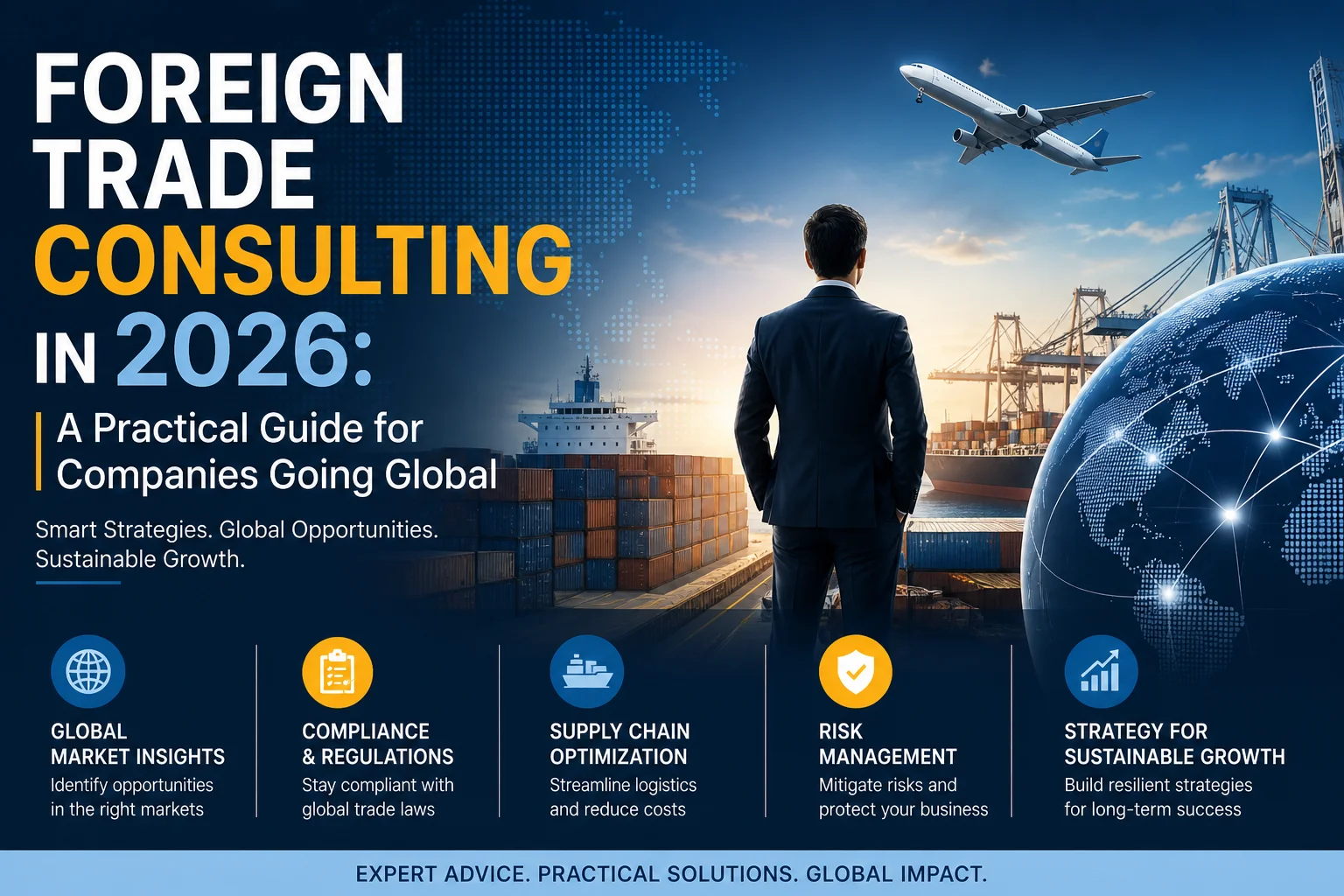
Quick Answer — TL;DR
Foreign trade consulting is specialist advisory that helps companies move goods across borders legally, efficiently, and profitably. Core services cover market entry strategy, tariff and HS code advisory, customs compliance, supplier and buyer matchmaking, trade documentation, sanctions screening, and supply chain redesign. The global trade consulting market is valued at $8.4 billion in 2026 and projected to reach $15.19 billion by 2035 at a 6.8% CAGR (MarkWide Research). With WTO projecting just 0.5% merchandise trade volume growth in 2026 — the slowest in a decade — the businesses that win are the ones navigating tariff complexity with expert support, not trial and error.
Tariffs are shifting almost every quarter. Trade agreements are being renegotiated. Customs authorities are tightening enforcement on country-of-origin rules and forced-labor disclosure requirements that didn't exist as obligations a decade ago. In this environment, the companies that grow fastest across borders are the ones that stop guessing and bring in real expertise.
This guide breaks down what foreign trade consulting actually involves, when it pays off, what good consultants charge, and how to choose a partner who delivers measurable results — not a 120-page PDF that sits on a shared drive.
If you're also exploring what the specialist roles within trade consulting look like, our guide on what an import export consultant does covers the operational detail on both the import and export sides.
- What foreign trade consulting actually means
- Why it matters more in 2026 than ever before
- The seven core services foreign trade consultants deliver
- 2026 trade landscape: the numbers that frame the case
- Foreign trade consulting vs. customs broker vs. freight forwarder
- When your business actually needs to hire one
- DIY vs. hiring a consultant: the honest trade-off
- What foreign trade consulting really costs
- How to choose the right consultant
- Red flags that should make you walk away
- What a real engagement looks like, week by week
- The tradeoff most guides won't tell you about
- Key takeaways
- Frequently asked questions
What foreign trade consulting actually means
Strip away the jargon and foreign trade consulting is exactly what it sounds like. A specialist helps your company move goods, services, capital, or operations across national borders in a way that is legal, efficient, and profitable. The job sits at the intersection of strategy, regulation, and execution — and a good consultant operates across all three.
A good foreign trade consultant tells you which markets are worth entering, which trade rules apply, how to price your goods after duties and tariffs, and how to actually move them from origin to destination without losing margin or running into compliance trouble. What separates this from generic business consulting is the depth of technical knowledge required — HS code classification, rules-of-origin calculations, free trade agreement qualification, and country-specific documentation requirements that change year over year.
Foreign trade consultants serve a wider scope than most businesses realize. Some focus on import consulting services — supply chain diversification, supplier vetting, landed cost analysis, and customs compliance for buyers. Others concentrate on export consulting services — finding overseas buyers, structuring export documentation, and managing market entry for sellers. The strongest firms work both directions, because most growing businesses both source materials abroad and sell finished goods internationally.
Worth Knowing
Foreign trade consulting is not a single profession. It covers a spectrum from high-level market entry strategy down to the technical details of HS code classification and free trade agreement qualification. The right consultant for your situation depends on which end of that spectrum your specific problem sits on — and the best ones are honest about that distinction before you sign anything.
📦 Import Consulting
Verified global suppliers, sourcing strategy, landed cost analysis, and full documentation support.
🌍 Export Consulting
Qualified international buyers, market entry strategy, export compliance, and deal facilitation.
Why foreign trade consulting matters more in 2026 than ever before
If you ran a global trade operation five years ago and you run one today, you would barely recognize the rulebook. The trade environment has shifted faster in the past 24 months than it did in the previous decade. Three structural changes are reshaping the cost of doing nothing.
Tariff stacking is eating margins
Section 301 tariffs, IEEPA-based duties, and the suspension of the de minimis exemption for China-origin shipments mean that almost every major import trade lane now carries new layers of cost that didn't exist in 2021. Importers who built their pricing models on 2020 landed costs are watching margins compress — sometimes to zero — without a clear picture of where the exposure is or how to restructure around it. This is precisely the problem that import consulting solves: identifying the duty exposure, reclassifying where legitimate, and modeling alternative sourcing strategies.
Compliance enforcement is tightening
Customs authorities in the US, EU, and UK are conducting more audits, demanding more documentation on country of origin, and pursuing forced-labor disclosures under the Uyghur Forced Labor Prevention Act (UFLPA) that did not exist as formal obligations a decade ago. The penalties for getting this wrong are real — CBP can seize entire shipments, and willful violations carry criminal exposure. Companies that built their compliance on the honor system are now facing systematic scrutiny.
Trade agreements are moving faster than internal teams can track
The USMCA review window, post-Brexit UK trade deals, the CPTPP expansion, and renegotiations across Asia-Pacific mean the rules of origin and preferential tariff rates that apply to your products can change with little warning. Companies who built their sourcing on agreements that have since been modified — or who never qualified their products for FTA benefits in the first place — are leaving real money unclaimed.
Timing Insight
The cost of foreign trade consulting is almost always lower than the cost of one bad shipment, one mis-classified container, or one missed FTA qualification. The companies that engage proactively — before a problem appears — consistently get more value than those who bring in a consultant to clean up a mess. Reactive consulting costs roughly 3x as much as proactive advisory for equivalent outcomes.
The seven core services foreign trade consultants deliver
Most engagements fall into one or more of the following service areas. The exact mix depends on whether your priority is sourcing, selling, compliance, or strategic expansion — and a good consultant clarifies this in the first meeting rather than proposing a full-scope retainer before understanding your situation.
01
Market Entry Strategy
Country prioritization, demand validation, mode-of-entry selection, and competitive landscape mapping.
02
Tariff & Duty Advisory
HS classification, FTA qualification, duty drawback, and true landed cost modeling.
03
Customs Compliance
Audit prep, documentation infrastructure, voluntary disclosures, and CBP/HMRC/AEO readiness.
04
Supplier & Buyer Matching
Vetted introductions to factories, distributors, and qualified international buyers.
05
Trade Documentation
Commercial invoices, certificates of origin, INCOTERMS structuring, and export licensing.
06
Risk & Sanctions Screening
OFAC, denied party lists, dual-use controls, UFLPA disclosure, and forced labor compliance.
07
Supply Chain Redesign
Diversification, nearshoring analysis, FTZ utilization, duty drawback optimization.
08
Cross-Border M&A Due Diligence
Trade exposure reviews, sanctions risk on target customer base, back-duty liability assessment.
Where most businesses get the most value
When I look at what actually moves the needle for clients across these service areas, two consistently stand out. The first is tariff and duty advisory. Misclassifying a single product can cost a mid-sized importer hundreds of thousands of dollars per year in overpaid duties or back-duty assessments. Verified HS classification and FTA qualification work typically returns five to ten times its cost in the first year alone.
The second is supplier and buyer matching. Finding the right counterparty is half the battle in foreign trade. Consultants with established networks save months of cold outreach and failed introductions. On the export side, this is where professional export consulting earns its fee most visibly — connecting you directly with qualified buyers who have real purchasing authority, not brokers looking for a margin clip.
2026 trade landscape: the numbers that frame the case
The argument for foreign trade consulting isn't simply that international trade is complex. It's that the specific shape of that complexity has changed — and continues to change — faster than most internal teams can track.
2026 Global Trade Environment — Key Data
$8.4B
Global trade consulting market value in 2026, projected to reach $15.19B by 2035
Source: MarkWide Research, May 2026
6.8%
CAGR of the trade consulting market through 2035, driven by tariff volatility and nearshoring mandates
Source: MarkWide Research, May 2026
0.5%
WTO forecast for merchandise trade volume growth in 2026 — the slowest annual rate in over a decade
Source: WTO Global Trade Outlook, October 2025
4.5%
Merchandise trade volume growth Jan–Sep 2025 year-on-year, frontloaded ahead of tariff increases
Source: WTO, January 2026
The deceleration to just 0.5% merchandise trade growth in 2026 — down from 4.5% in the first three quarters of 2025 — is the clearest signal of what this environment demands. The WTO's Director-General noted in October 2025 that downside risks come specifically from spreading trade policy uncertainty and trade barriers. The businesses that capture available trade volume in this environment are the ones with cleaner compliance, better counterparty intelligence, and more adaptable supply chains. That's what foreign trade consulting is built to deliver.
Foreign trade consulting vs. customs broker vs. freight forwarder
Buyers often confuse foreign trade consulting with three adjacent services. They overlap, but they are not interchangeable. Knowing the difference helps you brief the right partner — and avoid paying a consultant's rates for work a broker could handle at a fraction of the cost.
| Role | What They Do | When You Need Them |
|---|---|---|
| Foreign trade consultant | Strategic, multi-disciplinary advisor on cross-border trade decisions and operations | Market entry, supply chain redesign, compliance overhaul, expansion planning |
| Customs broker | Licensed professional who files entries and clears individual shipments | Every commercial shipment over the customs bond threshold |
| Freight forwarder | Logistics provider that books and moves cargo across borders | Booking ocean, air, rail, or trucking capacity |
| Trade lawyer | Attorney specializing in trade law, sanctions, and formal disputes | Litigation, formal disputes, complex sanctions matters |
| International business consultant | Broader market entry and global growth strategy | Multi-country expansion, JV formation, M&A advisory |
Most growing companies eventually use all of them. The trade consultant is typically the one who helps you decide which of the others you need, when, and how to coordinate them. They sit upstream of the transaction, while brokers and forwarders operate within it.
For a deeper comparison of these roles specifically in the import-export context, our article on how consultants, brokers, and forwarders differ walks through the decision framework with real examples.
When your business actually needs to hire a foreign trade consultant
Most companies wait too long to bring in trade expertise — usually because they assume they'll figure it out internally, or that a freight forwarder will catch the issues. Both assumptions cost money. Here are the situations where engaging a foreign trade consultant consistently pays for itself.
- Entering a new country for the first time: Your team knows your product. They don't know the import licensing requirements of Saudi Arabia, the labeling rules in Brazil, or the e-invoicing system in Italy. A consultant compresses six months of internal learning into a structured four-week engagement.
- Tariff or trade policy just changed: Section 301 reviews, USMCA updates, EU dual-use export changes, and the 2025–2026 IEEPA tariff layer all created winners and losers among importers. If you haven't reviewed your sourcing or pricing strategy since the most recent change, you are likely carrying unquantified exposure.
- Diversifying away from a single sourcing country: The "China plus one" sourcing strategy is now standard for serious importers. Consultants evaluate Vietnam, India, Mexico, Bangladesh, or Indonesia not just on unit cost but on tariff treatment, FTA qualification, lead times, and political stability. Our guide on importing from Vietnam covers one of the most common diversification moves in 2026.
- Customs entries keep getting flagged: Random inspections happen. Repeated holds don't. If CBP or your local customs authority keeps stopping your shipments, something in your documentation, classification, or origin declarations is triggering attention. A consultant identifies the pattern and fixes the root cause.
- Exporting to a new region: Each market has its own buyer behavior, distribution norms, and regulatory expectations. Entering a new export market without understanding its import rules is one of the fastest ways to damage a new commercial relationship before it starts.
- Evaluating a cross-border M&A target: Mergers across borders carry layered risk: hidden trade exposures, sanctions risk on the target's customer base, undisclosed back-duty liabilities, and post-close integration challenges that bankers and lawyers often miss. Trade consultants run the operational due diligence that stops a deal from souring after closing.
- Your board is asking for a global trade risk assessment: Boards are now asking pointed questions about tariff exposure, supply chain concentration, and forced-labor risk. External advisors assemble credible answers to these questions far faster than overloaded internal teams.
Free 30-Minute Consultation
Not Sure Where Your Exposure Is? Let's Map It Together.
Book a no-charge initial consultation with our trade specialists. Bring your product, your current trade lanes, and your questions — we'll identify where the risk and opportunity actually sit.
Schedule a Free Call →DIY vs. hiring a foreign trade consultant: the honest trade-off
Plenty of companies build internal trade capability rather than hiring outside help. Both paths can work. Here is the honest trade-off — including what most advocates of the DIY approach tend to undercount.
Building It Internally
- Full control over decisions and timing
- Lower direct fees — no consulting invoices
- Builds long-term institutional knowledge
- Team learns the trade lane firsthand
- No dependency on external party availability
What Gets Underestimated
- Steep learning curve: 12–18 months before real capability
- High hidden cost in compliance gaps and missed FTA savings
- Trial-and-error on supplier and buyer selection is expensive
- Regulatory changes require constant monitoring and retraining
- One compliance error can dwarf months of consulting fees
- Network-building takes years that a consultant's intro shortcuts
For most SMEs and mid-market companies, the right answer is a hybrid. Bring in a consultant for the high-stakes phases — market entry, compliance overhauls, supply chain redesigns — and run day-to-day operations internally with the playbook the consultant helped you build. A good engagement ends with your team better equipped than it was at the start, not more dependent on outside help.
Import Consulting Services
Verified global suppliers, sourcing strategy, duty analysis, and full documentation support through to first delivery.
Explore Import ServicesExport Consulting Services
Qualified international buyers, market entry strategy, export compliance, and deal facilitation through to close.
Explore Export ServicesWhat foreign trade consulting really costs
Pricing in this industry is not standardized, which is part of why so many businesses find it confusing. Most engagements use one of four fee structures — sometimes blended. The right one depends on whether your need is episodic or ongoing, and on the scope of countries and products involved.
| Engagement Type | Typical Range (USD) | Best For |
|---|---|---|
| HS code review or single-country compliance audit | $2,000 – $8,000 | SMEs verifying classifications or one-market readiness |
| Market entry assessment (1–2 countries) | $8,000 – $25,000 | Companies preparing a structured launch plan |
| Multi-country expansion strategy | $25,000 – $80,000+ | Mid-market and enterprise expansion projects |
| Monthly retainer — ongoing advisory | $2,500 – $15,000/month | Active importers/exporters needing continuous support |
| Buyer or supplier matching (success-based) | 3% – 10% of deal value | Outbound export sales or sourcing programs |
| Cross-border M&A trade due diligence | $15,000 – $60,000+ | Acquirers buying foreign trade-active targets |
One thing to watch: be wary of any consultant who quotes a flat rate without first understanding your product, your countries, and your goals. Real expertise scopes the work before it prices it. A flat-rate quote without discovery is a sign the engagement will be generic rather than specific to your situation.
For a broader perspective on how consulting structures differ between import-focused and export-focused engagements, our piece on why businesses need import export consultants walks through the ROI case by company size and trade direction.
How to choose the right foreign trade consultant
Once you've decided foreign trade consulting is worth the investment, the selection decision matters more than the spend decision. Choosing the wrong consultant wastes budget and delays the work by months. Use the checklist below before you sign anything.
- They have verifiable case examples in your industry and target markets — not just logos on a slide
- The lead advisor stays involved week to week, not just on the pitch call
- They can answer specific regulatory questions about your product without needing to prep first
- They scope the work in clear phases with milestones you can measure
- They are willing to recommend "do not enter this market" when the data supports it
- Their fee structure is transparent and explained in writing before you commit
- They cite real sources — HTS codes, trade agreements, customs rulings — not just opinions
- They can name their network of customs brokers, freight forwarders, and trade lawyers
- They understand your sector, not just trade law in general
The five questions that separate experts from generalists
The fastest way to test a consultant's depth is to ask direct technical questions in your first meeting. Strong consultants answer specifically. Weak ones get vague or give you general principles dressed in trade jargon.
- What is the HS code for our main product, and what duty rate applies in our top three target markets?
- Which free trade agreements potentially benefit our supply chain, and what are the rules of origin requirements?
- What documentation gaps would you expect to find if you reviewed our last six months of customs entries?
- How do you stay current with OFAC sanctions list updates and dual-use export control changes?
- Walk me through a recent engagement that resembled ours — including what worked and what didn't.
If the answers are precise, technical, and grounded in real examples, you're talking to someone who actually does the work. If the answers are general observations about "trade complexity" and "regulatory environments," keep looking.
For a complete step-by-step process on finding and evaluating firms, see our guide on how to find import and export consulting services.
Red flags that should make you walk away
The trade consulting market includes plenty of capable firms and a meaningful number of operators whose marketing outpaces their actual capability. The warning signs are consistent enough that you can identify them quickly.
Walk Away If You See These
They guarantee specific tariff savings or customs outcomes before reviewing any data. They quote a flat retainer fee before scoping the work. They cannot name specific HS codes, trade agreements, or recent customs rulings relevant to your industry. They push you toward partners where they earn undisclosed referral fees. They suggest "creative" structures — undervaluation, transshipment through third countries, misclassification — to dodge duties. They have no verifiable track record or contactable client references.
The misclassification point deserves particular emphasis in 2026. With CBP conducting more audits and the penalties for intentional misclassification now including criminal exposure for principals, any consultant who suggests classification approaches that "fly under the radar" is not protecting your business. They're exposing it.
What a real engagement looks like, week by week
Most well-scoped foreign trade consulting projects follow a predictable rhythm. Knowing what to expect helps you evaluate whether a project is on track — and ask better questions when it isn't.
Weeks 1–2
Discovery and diagnostic
Your consultant reviews existing trade data — customs entries, supplier contracts, product specs, financials. They interview your team to understand objectives, constraints, and prior pain points. Output: a written diagnostic that confirms scope and defines what the engagement will deliver, with measurable milestones.
Weeks 3–6
Research and analysis
Country research, tariff modeling, regulatory reviews, supplier or buyer outreach, financial scenarios, and risk assessment. Expect weekly check-ins where the consultant shares draft findings and you sharpen the direction together. This phase is where most of the client time is invested.
Weeks 7–8
Synthesis and recommendations
Research turns into a clear, actionable plan with specific recommendations, prioritized next steps, and an honest view of risks and tradeoffs. This is where you should push back, ask hard questions, and pressure-test the logic before committing to implementation.
Weeks 9–12
Implementation support
Strategy without execution is theatre. Good consultants stay involved through the early implementation phase — making introductions, reviewing first contracts, sitting in on negotiations, debugging the first shipments. This is where the value becomes visible and verifiable.
Week 12+
Ongoing advisory or clean handoff
Some engagements end with a full handoff to your team. Others transition to a lighter retainer for ongoing policy monitoring and periodic advisory. The right outcome depends on whether your team is now equipped to run independently — or whether the complexity is genuinely continuous.
The tradeoff most foreign trade consulting guides won't tell you about
Here's the point that rarely makes it into guides written by trade consulting firms: the engagement model itself matters as much as the expertise. And most businesses get the model wrong in one of two directions.
Contrarian Insight
A long retainer at the start of a new trade relationship is usually the wrong structure. The highest-value work in foreign trade consulting — market entry validation, supplier or buyer identification, initial compliance build — is front-loaded. Once those foundations are in place, a business with a competent internal team often needs periodic advisory, not a continuous full-scope retainer. The consultants worth hiring will tell you this before you sign, because they know the right structure builds trust that leads to repeat work. The ones who push you into a 12-month retainer from day one are pricing for their retention, not your outcome.
The second common mistake is the opposite: engaging a consultant for a single deliverable — "just find us a buyer in Germany" — with no support for the compliance and documentation work that comes immediately after the introduction. The buyer introduction is the easy part. What happens in the first 90 days of a new trade relationship — contracts, INCOTERMS, documentation, payment terms, first shipment logistics — is where most deals go wrong. A scoped engagement that covers discovery, matching, and first-transaction support is almost always more valuable than an introduction alone.
Export Consulting Services
Selling Internationally? We Find the Right Buyers.
Our export consulting team identifies and vets qualified international buyers in your target markets — with market research, warm introductions, export documentation, and deal support through to close.
Explore Export Consulting →
Key Takeaways
- Foreign trade consulting covers market entry strategy, tariff advisory, customs compliance, buyer/supplier matching, trade documentation, sanctions screening, and supply chain redesign — it is not a single service but a spectrum.
- The global trade consulting market is valued at $8.4 billion in 2026 and growing at 6.8% CAGR, driven by tariff volatility, nearshoring mandates, and the EU Carbon Border Adjustment Mechanism.
- WTO projects just 0.5% merchandise trade volume growth in 2026 — the slowest rate in a decade. The companies that capture available volume are the ones with better intelligence and cleaner compliance.
- Foreign trade consultants differ from customs brokers (transactional clearance) and freight forwarders (cargo movement) — they operate at the strategy level, upstream of the transaction.
- The highest-value services are tariff and FTA advisory (often 5–10x ROI in year one) and supplier/buyer matchmaking (shortcuts years of cold outreach).
- A long retainer from day one is usually the wrong structure. The best engagements are front-loaded with high-value diagnostic and matching work, then transition to periodic advisory once the foundations are in place.
- Red flags: guaranteed outcomes before data review, flat fees before scoping, no verifiable references, or suggestions to misclassify goods or route through transshipment countries.
Frequently asked questions
What does a foreign trade consultant actually do?
A foreign trade consultant helps companies plan, execute, and grow their cross-border trade operations. The work spans market research, regulatory and customs compliance, tariff strategy, supplier and buyer matching, trade documentation, and risk management. Good consultants combine commercial strategy with technical knowledge of HS codes, free trade agreements, and country-specific import-export rules. Unlike a customs broker (who handles transactional filings) or a freight forwarder (who moves cargo), a foreign trade consultant operates at the strategic level — advising before the transaction is structured, not during or after it.
When should a business hire a foreign trade consultant?
The right time is before you place your first international order, sign your first export contract, or expand into a new region — not after something goes wrong. Companies also bring in consultants when tariffs change, after a failed shipment, during cross-border M&A, or when an internal team is overwhelmed by trade compliance audits. The cost of proactive consulting is almost always lower than the cost of fixing avoidable mistakes. A single misclassified HS code on a high-volume program can generate back-duty assessments that dwarf a full year of consulting fees.
How much does foreign trade consulting cost?
Project-based engagements range from $2,000–$8,000 for a focused HS code review or single-country compliance audit, up to $25,000–$80,000+ for a full multi-country expansion strategy. Monthly retainers for ongoing advisory typically run $2,500–$15,000 per month for SMEs. Success-based fees of 3–10% of deal value are common in supplier or buyer matching work. The right fee structure depends on whether the need is episodic (a one-time project) or ongoing. Always insist on a written scope with defined deliverables before agreeing to any fee structure.
Is foreign trade consulting the same as customs brokerage?
No — these are different roles with different scopes. A licensed customs broker (in the US, licensed by CBP) handles transactional filings: customs entries, ISF submissions, and duty payments for individual shipments. They work within a transaction that's already been structured. A foreign trade consultant works upstream of that — advising on which markets to enter, how to structure trade flows, which free trade agreements apply, and how to design a long-term cross-border strategy. Most serious importing or exporting businesses need both: the consultant for strategy and structure, the broker for efficient transactional execution.
Can small businesses afford foreign trade consulting?
Yes — and SMEs often benefit most, because they have the least internal capability to absorb compliance errors. Many consultants offer scoped, fixed-fee engagements designed for smaller budgets: a country prioritization study, an HS code review, or a single-product export readiness audit. The cost of getting global expansion wrong — a seized shipment, a back-duty assessment, a failed market entry — is almost always far higher than the consulting fee. Starting with a focused, bounded project is the most cost-effective way for an SME to access trade expertise without committing to a full retainer.
What credentials should a foreign trade consultant have?
Look for verifiable engagement track record first — specific case examples in your industry and target markets. Useful formal credentials include Licensed Customs Broker certification (US, licensed by CBP), Certified Export Specialist (CES), Certified Customs Specialist (CCS), Certified U.S. Export Compliance Officer (CUSECO), and professional memberships in the NCBFAA or NAFTZ. Certifications provide a baseline of technical knowledge, but they don't tell you whether someone can navigate your specific product in your specific market. Real answers to technical questions in the first meeting are a more reliable signal than a list of certifications.
How long does a foreign trade consulting engagement typically last?
Diagnostic and assessment phases typically run 4–8 weeks. Full strategy and implementation engagements usually extend 3–6 months. Ongoing advisory retainers can continue for a year or more, though the right structure is to start with a bounded project, evaluate the relationship, and then decide on ongoing support based on actual value demonstrated. The best engagements end with your team more capable than it was at the start — not more dependent on outside help. If a consultant's engagement model doesn't include a knowledge-transfer component, treat that as a yellow flag.
What industries benefit most from foreign trade consulting?
Manufacturing, electronics, food and beverage, textiles and apparel, automotive, chemicals, healthcare products, and consumer goods all see strong returns. The common thread is significant cross-border movement of physical goods with complex compliance requirements or sensitive duty exposure. That said, any business placing its first international order — regardless of industry — benefits from upfront guidance on HS classification, landed cost modeling, and documentation requirements, because the first-time mistakes in any industry tend to be the most expensive.



Contact us today to schedule a NO-CHARGE INTIALS 30-MINUTE consultation. Ask questions and learn from the experts.