

The Complete 3-Way Comparison
Import Export Consultant vs Customs Broker vs Freight Forwarder: The 2026 Decision Guide
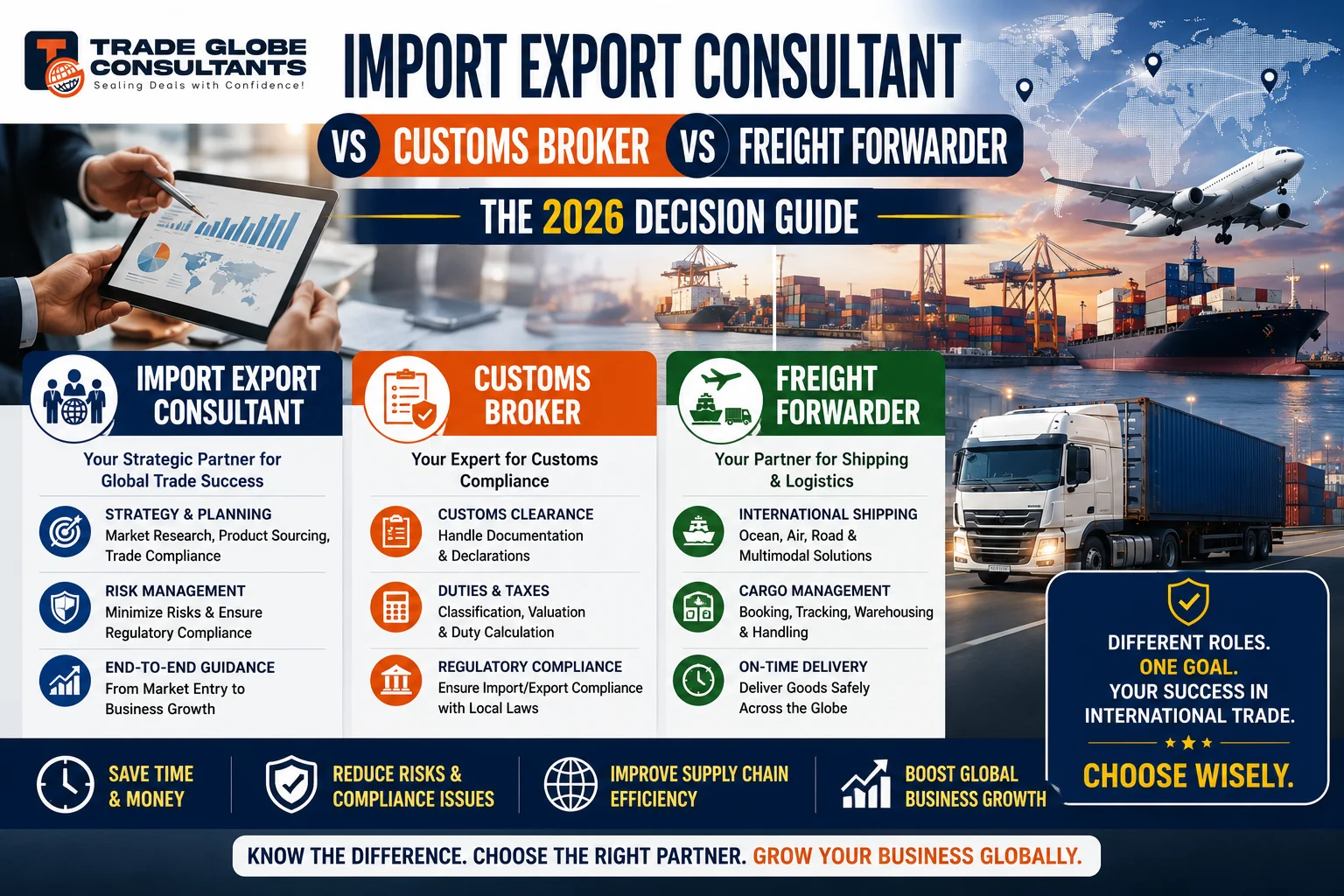
TL;DR — The 3-Way Decision in 40 Seconds
Import export consultants build the strategy, compliance systems, and market entry plans your business runs on. Customs brokers are CBP-licensed professionals who file individual customs entries. Freight forwarders are logistics providers who move physical cargo across borders. Most active importers need all three — the mistake beginners make is thinking they can substitute one for another. Consultants cost $200–$500/hour or $3K–$15K monthly. Brokers charge $150–$500 per entry. Forwarders charge $150–$500 per shipment plus transportation. Your company remains the Importer of Record in all three arrangements — none of them takes legal responsibility for your compliance.
Here is the mistake nearly every SERP article about this topic makes: they compare only two of the three roles. Type "customs broker vs freight forwarder" into Google and you'll find twenty articles. Try "import export consultant vs customs broker vs freight forwarder" and you'll find almost nothing that treats all three roles seriously. Meanwhile, businesses lose real money because they hire a freight forwarder and think their compliance is handled, or hire a customs broker and think their sourcing strategy is set. This guide fills that gap with the honest three-way breakdown of what each role actually does, where they overlap, and how to hire in the right order.
Table of Contents
- What are the three roles, and how do they differ?
- What does an import export consultant actually do?
- What does a customs broker actually do?
- What does a freight forwarder actually do?
- Side-by-side comparison: consultant vs broker vs forwarder
- Who becomes the Importer of Record?
- How much does each role cost in 2026?
- Which role should you hire first?
- Do you actually need all three?
- Where do the three roles overlap — and where they don't
- Common mistakes businesses make choosing between them
- Frequently asked questions
Key Takeaways
Nine things every business should know before choosing between these three roles
- The three roles are complementary, not competitive. Most active importers need all three at different stages.
- Only CBP-licensed customs brokers can file customs entries. Not consultants. Not freight forwarders (unless they hold a broker license).
- Only import export consultants file CAPE refund claims, Section 301 exclusions, ITAR/EAR licenses, and voluntary disclosures.
- Only freight forwarders arrange the physical transportation and handle export documentation like AES filings.
- Your company is the Importer of Record in all three arrangements — none of them takes legal responsibility for your imports.
- Consultants cost $200-$500/hour or $3K-$15K monthly retainer. Brokers charge $150-$500 per entry. Forwarders charge $150-$500 per shipment plus transport.
- Small importers typically start with a broker plus forwarder and add consulting when they scale or hit compliance issues.
- Companies handling ITAR-controlled goods should engage a consultant BEFORE their first shipment — this is not optional.
- One company can perform multiple roles (many forwarders own brokerage divisions), but the legal responsibilities remain separate.
What are the three roles, and how do they differ?
The three roles operate at completely different altitudes of your international trade operation — the consultant builds strategy and compliance systems, the customs broker handles regulatory filings for each shipment, and the freight forwarder moves the physical cargo.
Here is the simplest way to remember the difference: the consultant thinks about your business over years, the broker thinks about your shipment over days, and the forwarder thinks about your cargo over miles. Each solves a different problem, uses different licensing frameworks, and carries different responsibilities under US law.
Role 1
Import Export Consultant
- Strategic advisor
- Compliance program builder
- Market entry planner
- Not government-licensed for filings
- Multi-year engagement
Role 2
Customs Broker
- CBP-licensed filer
- Files customs entries
- Calculates duties owed
- Represents you to CBP
- Per-shipment engagement
Role 3
Freight Forwarder
- Logistics coordinator
- Arranges transportation
- Handles export docs
- Books ocean/air/rail/truck
- Per-shipment engagement
For a broader introduction to the consultant role specifically — what these professionals actually do across their engagements — our companion piece on what an import export consultant does walks through the six core service categories with concrete examples.
What does an import export consultant actually do?
An import export consultant provides strategic advice, builds trade compliance systems, plans market entry, files refund claims and licenses, and represents your interests in complex regulatory situations that brokers and forwarders cannot handle.
Consultants operate at the strategic and compliance level. Here is what typically falls under their scope:
- Trade Compliance Program design — the 14-element compliance manual, Empowered Official designation under ITAR §120.67, restricted party screening infrastructure, and employee training programs
- HTS classification review — 10-digit HTSUS classification across your entire product portfolio, not just the current shipment
- CAPE refund and Section 301 exclusion filings — recovering overpaid duties from the IEEPA regime and Section 301 tariffs
- Export licensing — DDTC applications for ITAR-controlled items, BIS applications for EAR-controlled dual-use goods
- Market entry strategy — analyzing country options, evaluating FTA opportunities, structuring supplier relationships
- Voluntary disclosure preparation — the high-stakes process of self-reporting violations to DDTC, BIS, or OFAC
- CBP audit response — representing your interests when CBP issues Form CF-28 or begins a Focused Assessment
Consultants are not government-licensed in the way brokers are, but reputable ones typically hold professional certifications like Certified Customs Specialist (CCS) or Licensed Customs Broker (LCB) credentials themselves, along with years of hands-on experience in specific product categories or regulatory regimes.
For an in-depth look at when the consultant investment specifically pays off for your business, our recent piece on why we need import export consultants lays out the 3-10× ROI math with real 2026 numbers.
What does a customs broker actually do?
A customs broker is a CBP-licensed professional who files customs entries, calculates duties, and represents importers to US Customs and Border Protection on individual shipments.
Customs brokers are the only professionals legally authorized to file customs entries on your behalf. They pass a rigorous exam, complete background checks, and receive their license directly from CBP. Their work is highly transactional — every shipment triggers a separate engagement.
Here is what customs brokers actually do:
- File CBP Form 7501 — the customs entry summary that officially declares each shipment
- File ISF 10+2 — Importer Security Filing 24 hours before ocean cargo loads at origin
- Calculate duties — applying HTSUS, Section 301, Section 232, MPF, HMF, and any other applicable duties or fees
- File through ACE — the Automated Commercial Environment platform CBP uses for all commercial entries
- Coordinate with CBP officers — respond to inquiries, provide documentation, arrange releases
- Handle partner agency filings — FDA prior notice, USDA APHIS, FCC, EPA, and other regulatory agency requirements
- Post continuous bonds — arrange the customs surety bond required for entries above $2,500
What customs brokers don't do: they don't build compliance programs, file export licenses, prepare CAPE refund claims, or represent you outside the CBP context. That's not because they're incapable — many brokers have deep expertise — but because their licensing and business model is built around the transactional customs entry function.
~14,000
Active customs brokers licensed in the US as of 2026
Source: US Customs and Border Protection
$150–500
Typical customs broker fee per entry filing in 2026
Source: Industry average, US market
$166B+
IEEPA tariffs collected from US importers, Feb 2025 to Feb 2026
Source: US Treasury Department
$5,000
Penalty per late ISF filing (Importer Security Filing) violation
Source: US Customs and Border Protection
What does a freight forwarder actually do?
A freight forwarder is a logistics service provider who coordinates the physical transportation of cargo across international borders, arranging carriers, booking space, preparing shipping documents, and managing the movement from origin to destination.
Freight forwarders act as the operational middleman between shippers and carriers. They negotiate rates, book cargo space, handle documentation, and coordinate the many moving pieces of an international shipment. Some people call them "travel agents for cargo," which captures the coordinating function reasonably well.
Here is what freight forwarders actually do:
- Arrange transportation — book ocean containers, air cargo space, rail intermodal, or trucking
- Negotiate carrier rates — leverage volume relationships with steamship lines, airlines, and trucking companies
- Prepare shipping documents — bills of lading, packing lists, commercial invoices, certificates of origin
- Handle export documentation — AES filings for US exports, Schedule B classifications, Shipper's Letters of Instruction
- Manage cargo insurance — arrange coverage for the shipment during transit
- Coordinate consolidation — combine multiple shippers' cargo into shared containers or trucks (LCL)
- Track shipments — monitor cargo movement and communicate updates to shippers and consignees
- Handle destination coordination — arrange local delivery, drayage, warehousing at the destination port
Ocean freight forwarders in the US are licensed by the Federal Maritime Commission (FMC). Air freight forwarders operate under IATA certification. These are different licensing regimes from customs brokers.
Many larger freight forwarding companies also operate a customs brokerage division under the same corporate name — this is why the roles sometimes appear to blur. But legally, the two functions are distinct: freight forwarding is regulated by FMC/IATA, and customs brokerage is regulated by CBP. The same company can do both, but through different licensed personnel or divisions.
Not sure which role you need?
Get a structured recommendation from an actual trade consultant
Our consultants walk through your specific products, sourcing countries, shipment volumes, and compliance exposure — then map out exactly which combination of consultant, broker, and forwarder support fits your business. No charge for the initial planning conversation.
Side-by-side comparison: consultant vs broker vs forwarder
The three roles differ across nine practical dimensions — from what they do to who licenses them, how they charge, and when you should hire each.
Here is the complete comparison at a glance:
← Swipe to see all columns →
| Dimension | Import Export Consultant | Customs Broker | Freight Forwarder |
|---|---|---|---|
| Primary function | Strategy, compliance, market entry | Customs filings, duty calculation | Cargo transportation, logistics |
| Licensed by | None required (professional certifications) | US Customs and Border Protection | Federal Maritime Commission / IATA |
| Engagement model | Hourly, project, or retainer | Per-entry / per-shipment | Per-shipment |
| Time horizon | Multi-year strategic | Days per shipment | Days to weeks per shipment |
| Handles ITAR/EAR licenses | Yes | No | No |
| Files customs entries | No | Yes (exclusive) | Only if also broker-licensed |
| Arranges transportation | No | No | Yes (primary function) |
| Files CAPE refunds | Yes | Rarely | No |
| Typical 2026 cost | $200-$500/hr or $3K-$15K/mo | $150-$500 per entry | $150-$500 per shipment + transport |
Who becomes the Importer of Record?
In almost every case, your company is the Importer of Record — not the consultant, not the customs broker, not the freight forwarder. All three roles work on your behalf, but the legal responsibility for the entry rests with your business.
This is the single most misunderstood aspect of international trade for new importers. Many first-time importers assume that hiring a customs broker or freight forwarder shifts the legal responsibility onto them. It does not. Under US law, the Importer of Record is the party who owns or has purchased the goods and takes responsibility for their entry into the United States.
Here is what that means in practice:
- You are legally responsible for the accuracy of the customs entry, even if your broker prepared it
- You are liable for duties owed on the goods, even if your forwarder arranged the shipping
- You must maintain records for five years on every entry, regardless of who filed it
- CBP audits target you, not your broker or forwarder, when they examine an entry
- Penalties are assessed against you for classification errors, valuation errors, or non-compliance
In rare cases, an unrelated party can act as the Importer of Record on your behalf — this is called a "non-resident IOR" or third-party IOR arrangement. These are legally allowed but expensive, restricted in application, and generally not recommended for ongoing operations. Most reputable consultants will advise you to remain the IOR on your own entries and structure your operations accordingly.
Contrarian insight
Every SERP article on this topic tells you that customs brokers "handle" the import process. That framing is misleading. Brokers act as your agent — they file the paperwork you're responsible for. The legal reality doesn't change because you outsourced the filing. Many importers discover this only when a CBP Form CF-28 lands on their desk, not their broker's.
How much does each role cost in 2026?
The three roles have fundamentally different cost structures — consultants charge for strategic time, brokers charge per shipment filing, and forwarders charge per shipment plus the actual transportation cost.
Here is the realistic 2026 cost picture for a small-to-mid-sized importer moving one to four containers per month from Asia to the US:
← Swipe to see all columns →
| Cost category | Typical 2026 range | Notes |
|---|---|---|
| Consultant — initial planning | Free – $500 | Scoping conversation before engagement |
| Consultant — hourly rate | $200 – $500 | General trade advisory work |
| Consultant — attorney-led | $400 – $750 | ITAR/EAR compliance, voluntary disclosures |
| Consultant — monthly retainer | $3,000 – $15,000 | Ongoing advisory, 10-40 hours/month |
| Consultant — project fees | $5,000 – $50,000 | Compliance program build, supplier vetting |
| Broker — per entry filing | $150 – $500 | Standard customs entry, one per shipment |
| Broker — continuous bond | $500 – $1,500 / year | Required for entries above $2,500 |
| Broker — complex entry | $500 – $1,500 | Multi-HTS, partner agency, or FTA claims |
| Forwarder — service fee | $150 – $500 / shipment | Documentation and coordination charge |
| Forwarder — ocean transport | $2,000 – $6,000 | 20ft container Asia to US West Coast |
| Forwarder — air transport | $4 – $12 / kg | Depending on origin and urgency |
The critical insight from these numbers: consultants and brokers/forwarders are not substitutes for each other financially. Skipping the consultant to save money means giving up the strategic and compliance work entirely — the broker and forwarder don't cover that scope. Skipping the broker or forwarder means either taking on legal filing work yourself (rarely feasible) or having no way to actually move cargo.
Which role should you hire first?
The right hiring order depends on your situation, but for most businesses the sequence is: consultant first if you're dealing with ITAR/EAR compliance or complex sourcing decisions, otherwise broker and forwarder first for your immediate shipment needs and consultant second as you scale.
Here is the decision framework:
Hire Consultant First
When compliance stakes are high
- You manufacture USML or dual-use goods
- Your product needs FDA/USDA/EPA approval
- You're entering a completely new market
- You have significant capital at risk pre-shipment
- Prime contractors require compliance evidence
- You've discovered a potential violation
Hire Broker + Forwarder First
When you need to move cargo NOW
- Standard consumer goods, low regulatory risk
- First few small shipments to test the market
- Budget too tight for retainer consulting
- Products with clear HTSUS classifications
- Common sourcing countries (China, Vietnam, Mexico)
- Volume too low to justify consulting fees
The trap that catches many new importers: they hire only broker plus forwarder, complete a few successful shipments, then assume they don't need a consultant. Meanwhile, they're paying full Section 301 tariffs on goods that qualify for exclusions, misclassifying products under overly broad HTS codes, and building operational habits that CBP will eventually scrutinize.
Do you actually need all three?
Most active importers and exporters do need all three roles, though the depth of engagement scales with business size, product complexity, and regulatory exposure.
Here is what "needing all three" looks like across different business profiles:
← Swipe to see all columns →
| Business profile | Consultant | Broker | Forwarder |
|---|---|---|---|
| Solo entrepreneur, 1-3 SKUs, small volume | Project-based (as-needed) | Yes (essential) | Yes (essential) |
| Growing SMB, $500K–$2M imports/year | Monthly retainer (light) | Yes (essential) | Yes (essential) |
| Mid-market, $2M–$10M imports/year | Full retainer | Yes (multiple) | Yes (multiple) |
| ITAR-controlled defense supplier | Essential from day 1 | Yes | Yes (ITAR-cleared) |
| Enterprise, $10M+ imports/year | In-house team + external | Yes (dedicated) | Yes (dedicated) |
One clarification: "having a consultant" doesn't necessarily mean a full-time retainer. For small businesses, it can mean an annual HTS classification review, a supplier vetting project, or occasional advisory calls during major decisions. What matters is that the strategic and compliance function exists somewhere in the business — either through an external consultant or through internal expertise.
"The businesses that fail as importers aren't the ones who over-invested in the wrong role. They're the ones who assumed their broker handled everything the consultant would have caught."
Building the right team for international trade
Get expert consulting alongside your broker and forwarder relationships
Our import consulting team provides the strategic layer that brokers and forwarders don't. We handle HTS classification, tariff optimization, CAPE refund filings, ITAR/EAR compliance, and market entry planning. Whether you already have broker and forwarder relationships or you're building your team from scratch, we fit into the operational picture cleanly.
Where do the three roles overlap — and where they don't
The three roles overlap in several practical areas — many companies offer bundled services — but the legal responsibilities and licensing frameworks remain distinct regardless of who's doing the work.
Where overlap actually happens
In real-world operations, the three roles blur in a few common ways:
- Freight forwarders with brokerage divisions. Many larger forwarding companies employ licensed customs brokers or operate a separate customs brokerage under the same corporate umbrella. This lets them offer bundled forwarding-plus-clearance services to clients.
- Customs brokers offering consulting. Some experienced brokers offer trade advisory work as a secondary service. This can be valuable for basic classification questions but rarely extends to full compliance program design or export licensing.
- Consultants with broker licenses. Some consulting firms employ licensed customs brokers or hold LCB credentials themselves, which lets them handle both strategic and transactional work.
- Bundled logistics companies. Large 3PL (third-party logistics) providers may offer forwarding, brokerage, and warehousing all under one contract.
Where overlap doesn't happen
Some functions remain strictly within one role:
- Only CBP-licensed brokers can file customs entries. Full stop.
- Only qualified consultants (or trade attorneys) should file voluntary disclosures to DDTC, BIS, or OFAC.
- Only FMC-licensed forwarders can operate as ocean freight forwarders in the US.
- Only your company can be the Importer of Record on your own goods (with rare exceptions).
Common mistakes businesses make choosing between them
Seven specific mistakes recur when businesses hire the wrong role, hire in the wrong order, or fail to understand what each role can and cannot do.
- Assuming the freight forwarder handles customs. Unless the forwarder holds a broker license or has an in-house brokerage division, they cannot file customs entries. Verify before assuming.
- Assuming the customs broker handles strategy. Brokers file entries. They don't build compliance programs, file export licenses, or run market entry analyses. Different scope entirely.
- Skipping the consultant to save money on ITAR-controlled goods. This is the single most expensive shortcut in international trade. ITAR civil penalties reach $1.3M per violation. A $20K compliance engagement is cheap by comparison.
- Hiring three different providers when one bundled company would fit. Some 3PLs and larger consulting firms genuinely offer integrated services. Evaluate before assuming you need three separate contracts.
- Not verifying broker license status. Some intermediaries advertise as "customs brokers" without actually holding CBP licenses. Verify the license number through CBP's public directory.
- Trusting a forwarder's classification advice as legally binding. Forwarders may suggest HTS codes for shipping documentation, but only licensed brokers can make classification determinations on customs entries, and only consultants (or attorneys) should file binding ruling requests.
- Treating the three roles as interchangeable. They aren't. Different licensing, different scope, different legal responsibilities. Hire based on what you actually need, not on which provider offered the cheapest quote.
For the fuller framework on selecting the right partners across all three roles, our companion piece on how to find import export consulting services walks through the vetting process, red flags to avoid, and interview questions that actually matter.
Procedural framework
What Is Import Export Procedure? The Complete 2026 Framework
Frequently asked questions
What is the difference between an import export consultant, a customs broker, and a freight forwarder?
An import export consultant provides strategic advice on trade compliance, sourcing, and market entry — they build the systems your business runs on. A customs broker is a CBP-licensed professional who files customs entries and calculates duties on individual shipments. A freight forwarder is a logistics provider who arranges the physical transportation of cargo across borders. Most active importers use all three: a consultant for strategy, a broker for customs filings, and a forwarder for shipping logistics. The three roles are complementary, not competitive.
Do I need all three — consultant, customs broker, and freight forwarder?
Most active importers and exporters do need all three, though the depth of engagement varies by business size and complexity. Small importers often start with just a customs broker and freight forwarder for their first shipments, then add consultant support as they scale, encounter compliance issues, or enter new markets. Businesses handling ITAR-controlled products, dealing with tariff exposure, or expanding into new countries usually benefit from engaging a consultant first — before their first shipment — to prevent expensive mistakes at the outset.
Can a freight forwarder file customs entries?
Freight forwarders cannot file customs entries in the United States unless they hold a customs broker license from US Customs and Border Protection (CBP). Many larger freight forwarding companies employ licensed customs brokers or operate a customs brokerage division under the same corporate umbrella, which is why some companies appear to offer both services. But the two functions are legally distinct: only a CBP-licensed customs broker can file entry documents, pay duties, and represent an importer to CBP.
Who is the Importer of Record — the consultant, broker, or forwarder?
In almost all cases, your company is the Importer of Record — not the consultant, broker, or forwarder. The Importer of Record is the party legally responsible for the entry filing, duty payment, regulatory compliance, and recordkeeping for each shipment. Customs brokers file entries on your behalf as your agent, but the legal responsibility rests with you as the importer. Consultants advise on IOR structuring but do not become the IOR. In rare circumstances, an unrelated party may act as IOR, but this is expensive, restricted, and generally not recommended for ongoing operations.
How much do consultants, customs brokers, and freight forwarders cost in 2026?
Import export consultants charge $200 to $500 per hour or $3,000 to $15,000 monthly on retainer for strategic advisory work. Customs brokers charge $150 to $500 per customs entry filing, with continuous bond fees of $500 to $1,500 annually. Freight forwarders charge based on shipment size, distance, and mode — a typical ocean freight forwarding fee ranges from $150 to $500 per shipment plus the actual transportation cost, which for a 20-foot container from Asia to the US West Coast might run $2,000 to $6,000 in 2026. The three fee structures are not comparable because they cover fundamentally different services.
Which role handles ITAR and EAR export compliance?
Import export consultants handle ITAR and EAR export compliance strategy — they build Trade Compliance Programs, designate Empowered Officials under ITAR 120.67, prepare license applications for DDTC and BIS, and manage voluntary disclosures. Customs brokers focus primarily on the import side and do not typically handle export licensing. Freight forwarders assist with export documentation like AES filings and Schedule B classifications, but they are not authorized to make licensing determinations or represent your company to DDTC or BIS. For any business dealing with USML-listed or dual-use goods, a consultant is essential — the broker and forwarder alone are not sufficient.
Can one company do all three roles?
Yes, some companies operate across all three roles by holding the appropriate licenses and employing qualified personnel for each function. Large 3PL (third-party logistics) providers commonly bundle freight forwarding, customs brokerage, and some consulting services. Some larger consulting firms hold customs broker licenses and offer both strategic and transactional work. However, even when one company performs multiple roles, the legal frameworks remain separate — the freight forwarding function is regulated by FMC, the customs brokerage by CBP, and consulting services carry no specific federal licensing requirement. Evaluate bundled services based on the depth of expertise in each area, not just the convenience of a single contract.
Which should I hire first — consultant, broker, or forwarder?
The right hiring order depends on your situation. If you deal with ITAR-controlled goods, dual-use technology, or significant compliance exposure, hire the consultant first — before any capital is committed to shipments. If you're a small business importing standard consumer goods with low regulatory complexity, start with a customs broker and freight forwarder for your first shipments, then engage a consultant as you scale or face specific compliance challenges. For businesses in between, engaging all three in parallel from the start prevents the operational gaps that catch mid-tier importers off guard.
Read more articles from Trade Globe Consultants
If this guide was useful, here are related resources from our blog that go deeper on specific aspects of international trade operations.
Service categories
Export Consultancy Services & Import Export Advisory: Complete Guide
Foundational concept
The Difference Between Import and Export: A 12-Dimension Comparison
Business structure
Top Import Company Guide for 2026: How to Start, Structure & Scale
Port operations
Los Angeles Import Customs Clearance: The 2026 Operational Guide
The three roles aren't in competition — they're building blocks
The businesses that succeed at international trade in 2026 aren't the ones that pick between a consultant, a broker, and a forwarder. They're the ones that understand how each role contributes to a working operation and hire in the right order for their specific situation. Get the framework right and the three roles reinforce each other. Get it wrong and you'll pay for the mistakes in ways that don't show up until the CF-28 arrives or the container gets held. Choose intentionally.



Contact us today to schedule a NO-CHARGE INTIALS 30-MINUTE consultation. Ask questions and learn from the experts.