

US–China Trade Profile
What Does the US Export to China? Top Products, 2026 Data, and the Trade Reality for US Businesses
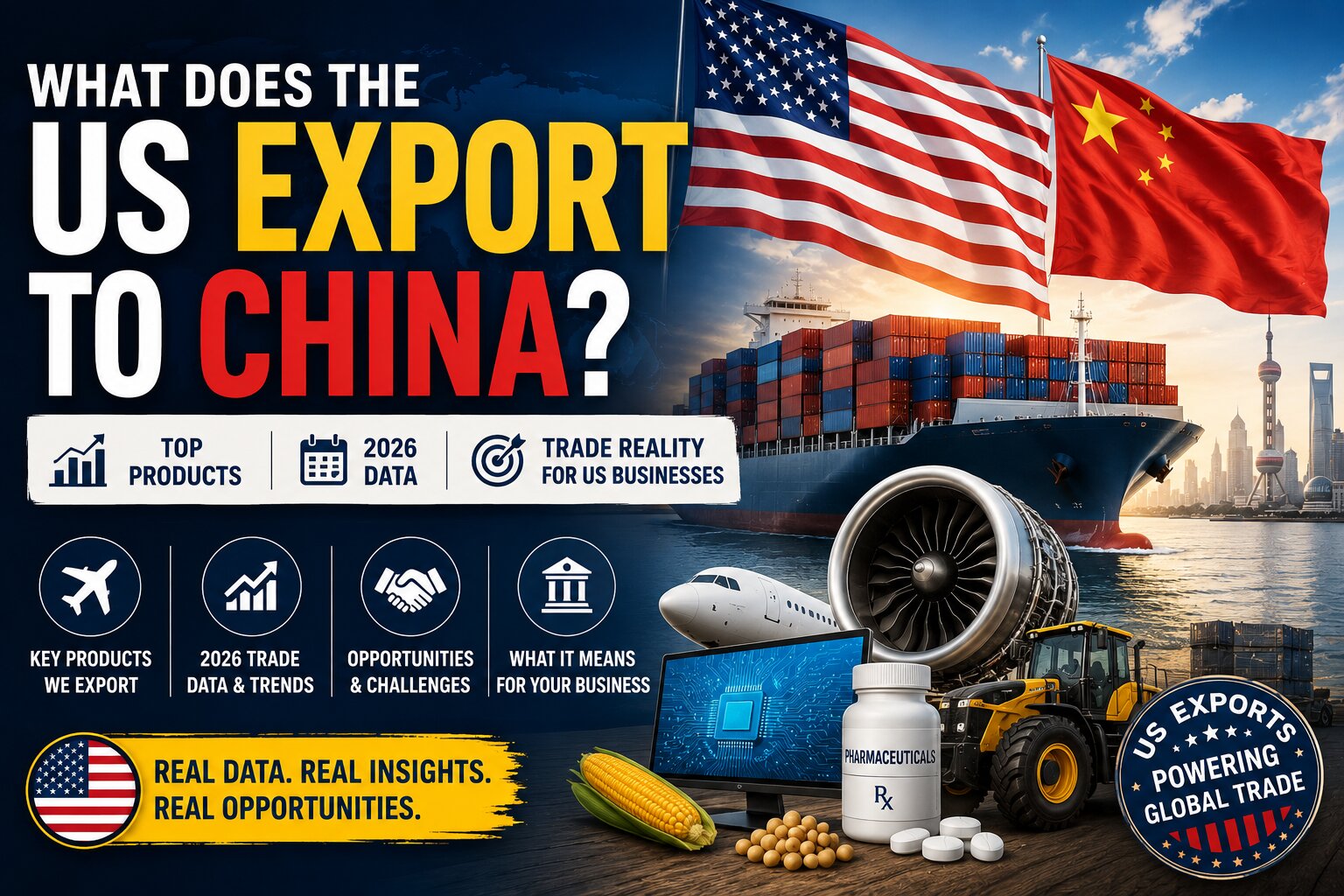
The honest answer to "what does the US export to China" looks very different in 2026 than it did even two years ago. Soybeans, the long-time top US agricultural export to China, collapsed in 2025 before partially recovering under the late-2025 Phase Two trade framework. Industrial and aerospace exports have stayed more stable. Energy products, semiconductors, and pharmaceuticals continue to flow. This guide walks through what the US actually exports to China today, the real 2025-2026 numbers, why agricultural trade dropped so sharply, what the Phase Two framework changed, and what it means for US businesses thinking about the China market.
What you'll learn in this guide
- The 2026 US–China trade snapshot
- Five main categories the US exports to China
- Agricultural exports: the 2025 collapse and Phase Two recovery
- Energy products: the growing flow
- Aerospace, aircraft, and parts
- Semiconductors, electronics, and technology
- Pharmaceuticals and medical devices
- The full top-10 US exports to China
- Year-over-year trends: 2022 to 2026
- Why agricultural exports declined so sharply
- The Phase Two trade framework explained
- What this means for US businesses in 2026
- Frequently asked questions
The 2026 US–China trade snapshot
Total US goods exports to China reached approximately $151.4 billion in 2022, declined to $144.9 billion in 2023, and slipped further to $143.5 billion in 2024. Through 2025 and into 2026, the picture is mixed: industrial, energy, and technology exports remained relatively stable, while agricultural exports collapsed under tariff pressure and Chinese supplier diversification before partially recovering under the Phase Two trade framework announced late in 2025.
China remains the third-largest single-country destination for US exports, behind Canada and Mexico. Despite the volatility, the bilateral trade relationship is still one of the largest in the world. The composition of that trade is what changed dramatically in 2025-2026, with agriculture taking the brunt of the hit while other categories proved more resilient.
For US businesses, the headline takeaway is simple. The opportunity to export to China is still real — but the rules of engagement have changed. Successful exporters in 2026 build their China strategy with current realities in mind: shifting agricultural demand, energy diversification, technology export controls, and the operational discipline that the bilateral trade environment now demands. Our dedicated guide on exporting to China walks through the operational steps for US businesses currently active in the China market or planning to enter.
Five main categories the US exports to China
If you strip away the long tail of smaller export lines, almost everything the US ships to China falls into five broad categories. These categories behave differently in the current trade environment — some are growing, some are stable, some are under pressure.
Category overview
Five main categories the US exports to China
1
Agricultural products
Soybeans, cotton, sorghum, beef, pork, tree nuts.
2
Energy products
Liquefied natural gas, crude oil, refined products, coal.
3
Aerospace & aircraft
Commercial aircraft, aircraft parts, aerospace components.
4
Semiconductors & electronics
Integrated circuits, telecom equipment, electronic components.
5
Pharma & medical devices
Vaccines, blood products, diagnostic equipment, imaging systems.
Each category has its own 2025-2026 story. The sections that follow walk through them one at a time, with the current data and the trajectory.
Agricultural exports: the 2025 collapse and Phase Two recovery
Agricultural products are the category that swung most dramatically in the 2025-2026 trade environment. The story is dominated by soybeans, but it touches every major US agricultural export to China.
The soybean trajectory
Soybeans have historically been the single largest US agricultural export to China. In 2022, soybeans accounted for approximately $17.9 billion of US exports to China. In 2024, US soybean exports to China still reached $12.5 billion, representing about half of all US soybean exports globally. Then 2025 happened.
From January through August 2025, US soybean exports to China totaled just 218 million bushels, down sharply from 985 million bushels in the same period of 2024. During June, July, and August 2025, the US shipped virtually no soybeans to China at all. Brazil exported about 2.5 billion bushels of soybeans to China over the same period, underscoring how South America captured the market share US farmers lost.
The late-2025 Phase Two trade framework included a Chinese commitment to purchase 12 million metric tons of US soybeans for the 2026 marketing year. Q1 2026 weekly export sales data shows renewed momentum — soybean sales to China are running ahead of 2025 levels and generally above the five-year average. The recovery is real but partial; agricultural trade with China is not expected to return to 2022 peak levels in the near term.
Other agricultural exports affected
The 2025 disruption was not limited to soybeans. China stopped purchasing US corn, wheat, and sorghum entirely during much of 2025. Pork and cotton exports continued but at reduced levels. USDA projected that total US agricultural exports to China would reach approximately $17 billion in 2025, down 30 percent from 2024, with a further drop to about $9 billion in 2026 — the lowest level since the 2018 trade war.
What still works in agricultural exports
- Tree nuts — almonds, walnuts, pistachios remain in steady demand in the Chinese consumer market
- Beef — high-quality US beef has growing Chinese market acceptance; included in Phase Two expansion commitments
- Dairy products — specialized cheese, whey, and infant formula ingredients continue to flow
- Specialty crops — fresh fruit, citrus, and high-value produce maintain niche demand
- Soybeans (post-Phase Two) — 12 MMT commitment provides 2026 floor
Why this matters for US exporters in 2026
The 2025 disruption made clear that overdependence on Chinese demand creates real risk for US agricultural exporters. The most resilient operations have diversified destinations — selling to Mexico, Egypt, Japan, Indonesia, and Southeast Asia alongside any China business. China remains a large market, but the era of treating it as a single dominant buyer is over.
Energy products: the growing flow
Energy is the category that has grown most consistently in US-China trade over the past several years. China is the world's largest energy consumer, and its strategic interest in diversifying energy sources has kept US energy exports flowing even through broader tariff disputes.
Liquefied natural gas (LNG)
LNG has been one of the fastest-growing US export categories to China. Driven by China's effort to reduce coal dependence and address air pollution, LNG offers a cleaner alternative for power generation and industrial use. US LNG export infrastructure on the Gulf Coast continues to expand, and Chinese buyers are part of the global customer base.
Crude oil and refined petroleum
The US exports significant volumes of crude oil and refined petroleum products to China. These exports support China's vast industrial base, transportation sector, and consumer demand. Texas and Louisiana together account for 96 percent of US oil and gas exports.
Coal
Despite China's broader transition toward cleaner energy, it still imports substantial coal volumes, and the US remains a meaningful supplier. US coal exports primarily support China's power generation and steel manufacturing sectors.
Energy products have proven more resilient to tariff disruption than agriculture because of structural demand. China needs the energy, the supplier alternatives are limited, and the long-term contracts that govern LNG and oil shipments are harder to unwind than spot agricultural purchases.
Thinking about exporting to China?
Get a structured market entry plan for the 2026 China trade environment
Tell us about your products, your target buyers, and your timeline. Our consultants will walk through Chinese market viability, tariff exposure, compliance requirements, and operational steps — at no charge, no obligation.
Aerospace, aircraft, and parts
The US is a global leader in aerospace manufacturing, and aircraft and aerospace components remain a major export to China. China's commercial airline industry continues to expand, and Boeing along with US aerospace component suppliers serve that demand.
Aerospace exports have been more volatile than other categories because they sit at the intersection of trade policy and geopolitical tension. Periodic disputes have disrupted specific commercial aircraft orders, but the underlying demand for US aerospace technology, particularly engines, avionics, and specialized components, remains strong. In 2022, aircraft and parts exports recovered to around $5.5 billion.
Smaller US aerospace component suppliers benefit from being part of the broader supply chain feeding Boeing and Airbus. Even when finished commercial aircraft sales face headwinds, parts and component exports continue to support the Chinese aviation maintenance and assembly sectors.
Semiconductors, electronics, and technology
Semiconductors and integrated circuits represent one of the highest-value US export categories to China. These products are essential for China's consumer electronics, telecommunications, automotive, and industrial manufacturing sectors.
What still ships freely
Most commercial-grade semiconductors and electronic components continue to ship to China without specific licensing requirements. Memory chips, standard processors, consumer electronics components, and most networking equipment fall in this category. Telecommunications equipment, computers, and consumer electronics remain a substantial category of US exports.
What faces export controls
Advanced semiconductor manufacturing equipment, high-end AI chips, and certain dual-use technologies face US export control restrictions under the Export Administration Regulations administered by the Bureau of Industry and Security. The control regime has tightened progressively through 2024-2026, particularly for technologies relevant to advanced AI development and military applications.
For US exporters in the semiconductor and electronics space, knowing exactly which products fall under licensing requirements is foundational. Misclassifying a controlled item as commercial creates serious legal exposure. The compliance framework that applies here is the same one covered in our broader guide on exporting goods, which walks through the AES filing process, restricted party screening, and license determination for any US export.
Pharmaceuticals and medical devices
Medical and pharmaceutical exports continued to perform well through the 2025-2026 disruption period. China's healthcare modernization, aging population, and growing middle class all drive demand for US medical technology.
In 2023, pharmaceutical exports from the US to China reached approximately $9.9 billion. Optical and medical apparatus exports stood at $11.31 billion. Major categories include:
- Diagnostic imaging equipment — MRI machines, CT scanners, X-ray systems
- Surgical instruments — scalpels, forceps, sutures, specialized surgical tools
- Patient monitoring devices — ECG machines, pulse oximeters, blood pressure monitors
- Dental equipment — chairs, drills, imaging systems
- Pharmaceuticals — vaccines, blood products, branded medications
- Lab and research equipment — specialized scientific instruments
This category has been relatively insulated from broader trade tensions, partly because the products are difficult to substitute and partly because US medical technology carries a strong reputation in China for quality and innovation.
The full top-10 US exports to China
Pulling all the categories together, here is the broader picture of what the US ships to China across the major product categories, with approximate 2024 values where available.
← Swipe to see all columns →
| Export category | 2024 value (approx) | 2025-2026 trajectory |
|---|---|---|
| Soybeans | $12.5 billion | Sharp 2025 decline; Phase Two recovery |
| Mineral fuels & petroleum products | $19.7 billion | Stable to growing |
| Optical, medical, technical apparatus | $11.3 billion | Stable growth |
| Pharmaceutical products | $9.9 billion | Stable growth |
| Integrated circuits / semiconductors | $9.4 billion | Stable in commercial-grade; controls on advanced |
| Machinery, nuclear reactors, boilers | $13.7 billion | Stable |
| Electrical machinery & equipment | $11.6 billion | Stable |
| Civilian aircraft, parts | $5.5 billion | Volatile by deal |
| Cotton (raw) | $2.0 billion | Sharp 2025 decline |
| Beef, pork, tree nuts (combined) | $4.5 billion | Beef growing; pork softer; nuts stable |
| Total US goods exports to China (2024) | $143.5 billion | 2025 declined further; 2026 mixed |
Two things stand out from the table. First, agricultural and energy products together still account for the bulk of US exports to China by value. Second, the categories that are most resilient (energy, pharmaceuticals, medical devices) are the ones with structural Chinese demand that is hardest to substitute from other suppliers. The categories most exposed (agricultural products, especially commodity grains) are the ones where supplier diversification is easiest.
Year-over-year trends: 2022 to 2026
The five-year arc of US exports to China tells a clear story. The total has trended downward, with agricultural products absorbing the steepest declines and other categories proving more stable.
← Swipe to see all columns →
| Year | Total goods exports (approx) | Key dynamics |
|---|---|---|
| 2022 | $151.4 billion | Post-COVID recovery; Phase One trade agreement active |
| 2023 | $144.9 billion | 4.3% decline; tariff frictions; agricultural softening |
| 2024 | $143.5 billion | 2.9% decline; soybeans still strong at $12.5B |
| 2025 | Further declines | Agricultural collapse; tariff escalation |
| 2026 (so far) | Partial recovery | Phase Two framework; Q1 ag momentum |
The 2025 trough is the steepest single-year decline since the 2018 trade war. The 2026 partial recovery is driven primarily by the Phase Two framework's agricultural commitments, with the broader trade volume still well below 2022 peaks.
Why agricultural exports declined so sharply
The 2025 collapse in US agricultural exports to China was driven by several reinforcing factors. Understanding them helps explain why the recovery has been partial and why the long-term picture for US agricultural exports to China looks different than the 2010-2022 era.
Retaliatory tariffs
Throughout 2024-2025, escalating tariff disputes between the US and China resulted in Chinese retaliatory tariffs on a wide range of US agricultural products. Soybeans, pork, beef, sorghum, and dairy all faced new or increased Chinese import duties at various points. The tariff math made US exports less competitive against suppliers from countries without similar duties.
Brazil and Argentina supplier shift
While US-China agricultural trade contracted, Brazil and Argentina expanded their share of the Chinese market. Brazil exported about 2.5 billion bushels of soybeans to China during the first eight months of 2025 — more than ten times the US volume in the same period. Argentine and Brazilian production capacity, favorable currency dynamics, and aggressive trade promotion all contributed to capturing Chinese demand that was previously held by US farmers.
Chinese food security strategy
Beyond immediate tariff dynamics, China has been pursuing a longer-term strategy of diversifying its food sources and reducing reliance on any single country. This includes investment in Brazilian and Argentine agriculture, deeper trade relationships with Black Sea suppliers, and domestic production expansion. Even if the immediate tariff situation eases, this structural diversification is unlikely to reverse quickly.
Currency and competitive pricing
Brazilian real and Argentine peso movements through 2025 made South American soybeans cheaper in Chinese yuan terms than US soybeans for substantial periods of the year. When the underlying commodity is largely interchangeable, even modest price differentials drive significant purchasing decisions.
The Phase Two trade framework explained
The Phase Two trade framework announced in late 2025 is the most significant US-China trade development of recent years. It aims to stabilize bilateral commercial relations and create a partial floor for agricultural and other key sectors. The key elements:
- Soybean commitment. China committed to purchase 12 million metric tons of US soybeans for the 2026 marketing year, providing a meaningful floor for that category.
- Beef expansion. Expanded purchase commitments for US beef and processed meat products.
- Partial tariff easing. Selective rollback of some retaliatory tariff measures on both sides, though not full reversal.
- Technology dialogue. Framework for ongoing discussion about technology export controls and specific product categories.
- Implementation monitoring. Mechanisms for both sides to track commitments and address compliance issues.
Q1 2026 export data has shown some early recovery momentum, particularly in soybean shipments. However, the framework is fragile. It depends on continued political will from both sides, ongoing diplomatic engagement, and absence of major shocks (geopolitical events, new tariff escalations, or major commercial disputes). US exporters who rely on Chinese demand should treat the framework as a useful tailwind but not as a return to pre-2022 trade conditions.
Worth knowing
For US businesses currently planning export strategies, the prudent assumption is that bilateral trade with China will remain volatile and category-specific. Categories with structural Chinese demand (energy, advanced pharmaceuticals, specialty medical devices) are more reliable. Commodity agricultural exports remain exposed to policy shifts. Industrial and aerospace exports sit somewhere in between, with deal-by-deal variability.
Build a sustainable China export strategy
Get expert help with market entry, compliance, and buyer connections
Our trade consulting team helps US exporters navigate the current US-China trade environment — assessing product viability, structuring compliant operations, and connecting with qualified Chinese buyers in agriculture, energy, technology, and consumer categories.
What this means for US businesses in 2026
The headline reality of "what does the US export to China" is that the answer keeps changing. For US businesses thinking about the China market — whether actively exporting, planning to start, or rebuilding after a 2025 setback — a few practical lessons apply across categories.
Diversify destinations
US exporters who depended heavily on Chinese demand in 2022-2024 felt the 2025 disruption most acutely. Operations that had already diversified into Mexico, Egypt, Japan, Southeast Asia, and other growing markets absorbed the China softening with less damage. Geographic diversification is not just a strategic preference — it is a risk management requirement in the current trade environment.
Build operational resilience
The export businesses that scaled successfully through the 2025 disruption are the ones that already had operational discipline around export documentation, restricted party screening, and licensing. When trade conditions tighten, the businesses that can move quickly and pivot product mixes outperform the ones that have to first build basic export infrastructure under deadline pressure.
Know your category's exposure
The categories that fared best in 2025-2026 were the ones with structural Chinese demand: energy, specialty medical, advanced pharmaceutical, and high-value industrial machinery. The categories that fared worst were commodity agricultural products where supplier substitution was easy. Understanding where your products sit on this spectrum determines how much risk you carry going into China.
Watch the Phase Two implementation
For agricultural exporters and companies in categories named in the Phase Two framework, watching implementation matters. The commitments are real, but they depend on continued political momentum. Quarterly USDA export sales reports and US-China official statements are the data sources that matter for tracking whether commitments are being kept.
Treat compliance as a competitive advantage
In a volatile bilateral trade environment, the US exporters who win the deals that do come up are the ones who can move fast on clean, documented, compliant terms. Chinese buyers and intermediaries increasingly prefer suppliers who reduce execution risk on their end — which means having your AES filing, restricted party screening, licensing, and documentation framework already operating cleanly.
"The era of treating China as a single dominant export buyer is over. The opportunity is still real — but it requires the kind of category awareness and operational discipline that distinguishes successful exporters from disappointed ones."
Strategic context
Foreign Market Entry Strategy: A 2026 Decision Playbook
Frequently asked questions
What does the US export to China?
The United States exports a wide range of goods to China across five major categories: agricultural products (especially soybeans, cotton, sorghum, beef, and tree nuts), energy products (liquefied natural gas, crude oil, refined petroleum), aerospace products (commercial aircraft, parts, and components), semiconductors and electronics, and pharmaceuticals and medical devices. In 2024, total US goods exports to China reached approximately $143.5 billion, though agricultural exports collapsed sharply through 2025 before partially recovering under the China Phase Two trade framework announced in late 2025.
What is the top US export to China in 2026?
Soybeans have historically been the top US agricultural export to China and remain the leading single commodity in 2026 despite a sharp downturn in 2025. After near-zero soybean shipments to China during summer 2025, the late-2025 Phase Two trade framework included a Chinese commitment to purchase 12 million metric tons of US soybeans. Across all categories, aerospace products and semiconductors remain the highest-value industrial exports. Energy products, particularly liquefied natural gas and crude oil, continue to grow as China diversifies its energy sources.
How much does the US export to China each year?
Total US goods exports to China reached approximately $151.4 billion in 2022, declined to $144.9 billion in 2023, and fell again to $143.5 billion in 2024. Agricultural exports specifically collapsed to about $17 billion in 2025 (down 30 percent from 2024) and are projected at just $9 billion in 2026, the lowest level since the 2018 trade war. Industrial, technology, and energy exports have remained more stable. The total 2026 picture depends heavily on Phase Two trade framework implementation and any further policy changes.
Why have US agricultural exports to China declined so sharply?
Several factors drove the 2025-2026 decline. First, escalating tariff disputes triggered Chinese retaliatory tariffs on US agricultural products. Second, China systematically diversified its supplier base, with Brazil and Argentina capturing soybean market share that was previously held by US farmers. Third, China deliberately reduced reliance on US agriculture as part of broader food security strategy. The Phase Two trade framework announced in late 2025 includes commitments aimed at partial recovery, but US agricultural exports to China are unlikely to return to 2022 peak levels in the near term.
What is the China Phase Two trade framework?
The China Phase Two trade framework is a US-China trade agreement announced in late 2025 that aims to stabilize the bilateral commercial relationship after the 2025 disruption. Key commitments include China purchasing 12 million metric tons of US soybeans for the 2026 marketing year, expanded purchases of US beef and other agricultural products, and a partial easing of tariff measures on both sides. Early 2026 export data shows some recovery momentum in soybean shipments to China, though overall agricultural trade remains well below 2022 peak levels.
Do all US exports to China face tariffs?
Chinese retaliatory tariffs apply to many but not all US export categories. Agricultural products bore the heaviest tariff impact during the 2025 disruption. Energy products, aerospace components, advanced pharmaceuticals, and certain medical devices faced lower tariff exposure due to structural Chinese demand and supplier diversification limits. The specific tariff treatment for any given product depends on its HS classification and the prevailing trade policy at the time of shipment. For exporters, real-time tariff verification with a customs specialist before each shipment is essential.
Can small US businesses export to China in 2026?
Yes. Small US businesses can and do export to China across many categories — specialty agricultural products, niche medical devices, industrial components, and consumer goods all have working channels for smaller exporters. The compliance requirements (AES filing, restricted party screening, documentation) are the same as for large companies but scale to the volume. Most small US exporters work with freight forwarders and trade consultants for their first several China shipments before bringing more of the operational work in-house. Phase Two stabilization of certain product categories has made small-scale entry more viable in 2026 than it was during the peak of 2025 disruption.
What does China import the most from the US?
By value, the largest single category of US exports to China is energy products, including liquefied natural gas, crude oil, and refined petroleum, totaling roughly $19.7 billion in recent years. Soybeans are the largest single agricultural export at around $12.5 billion in 2024. Other major categories include machinery and industrial equipment ($13.7 billion), electrical machinery and equipment ($11.6 billion), optical and medical apparatus ($11.3 billion), and pharmaceutical products ($9.9 billion). Together these top categories account for the majority of the $143.5 billion in total US goods exports to China in 2024.
Read more on US exports and global trade
If this guide was useful, here are related resources from our blog that go deeper on adjacent topics.
Export operations
Export Customs Clearance: The Complete 2026 Guide
Vehicle exports
Exporting Vehicles from USA: The 2026 Complete Guide
European market
Exporting to Germany — Operational Playbook for US Sellers
Strategic context
Foreign Trade Consulting: A 2026 Practical Guide
Ready to export to China?
Get expert support from market assessment to first shipment
From category viability and tariff exposure to AES filing, restricted party screening, and Chinese buyer connections, our team helps US businesses navigate the 2026 China trade environment with confidence rather than guesswork. Start with a no-cost conversation about your products and goals.
The trade reality keeps moving — successful exporters move with it
What does the US export to China? Soybeans, energy products, aerospace, semiconductors, pharmaceuticals — across a portfolio worth roughly $143.5 billion in 2024, with the composition shifting year by year. The 2025 disruption made clear that the bilateral trade relationship is more volatile and category-specific than it used to be. The 2026 Phase Two framework provides a partial stabilization. The US exporters who succeed in this environment are the ones who diversify destinations, build operational discipline, treat compliance as a competitive advantage, and adjust their China strategy as the trade reality keeps evolving.



Contact us today to schedule a NO-CHARGE INTIALS 30-MINUTE consultation. Ask questions and learn from the experts.