

Export Clearance Playbook
Export Customs Clearance: The Complete 2026 Guide to Shipping Goods Out of the USA
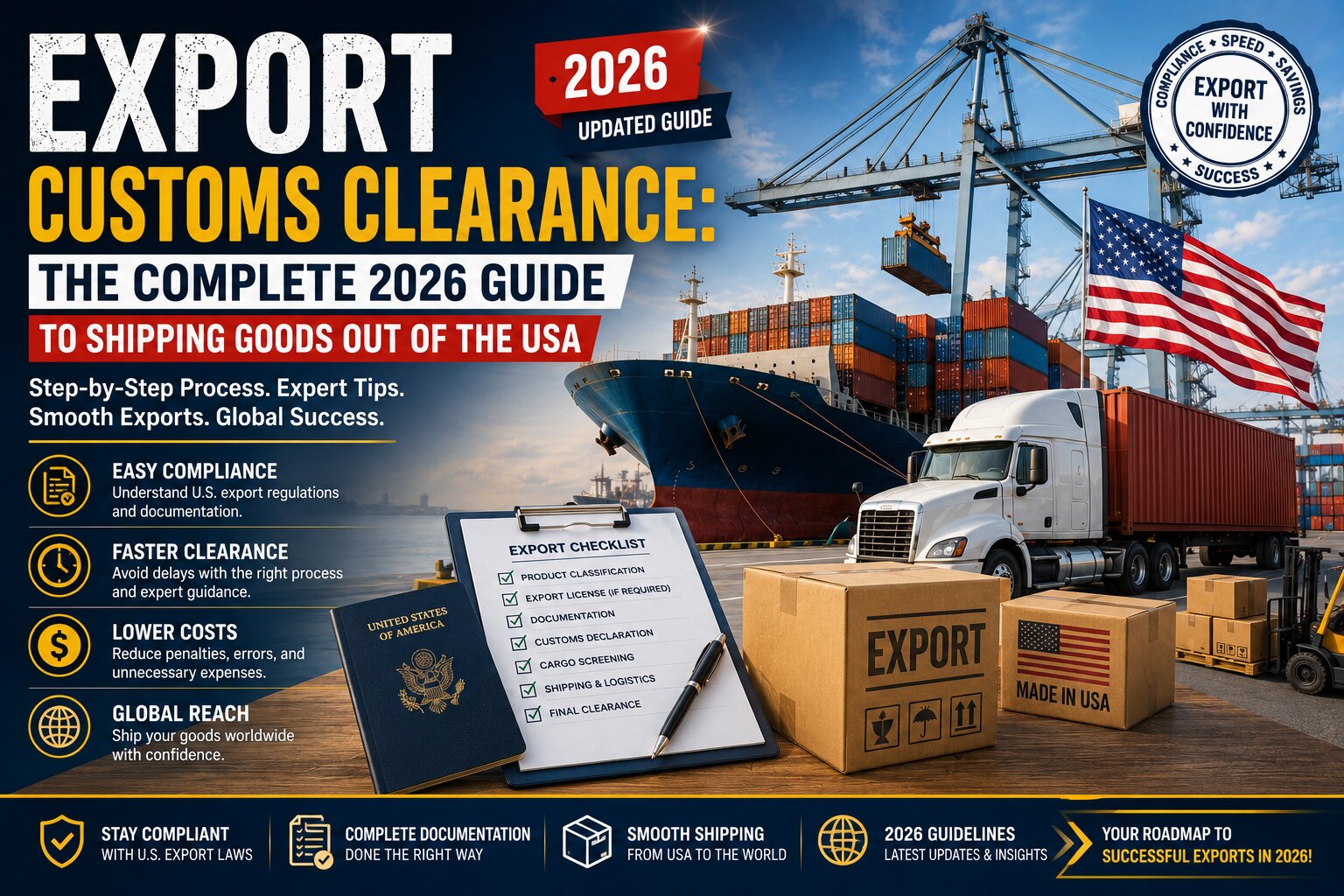
Most businesses treat export customs clearance as an afterthought — until a shipment gets held, a filing penalty arrives, or a deal falls through at the dock. Export clearance is its own discipline, separate from importing, with its own filings, its own compliance traps, and its own way of going wrong. This complete guide walks through export customs clearance from the first document to the moment the status reads "completed," with the US-specific steps, the real costs, and the compliance details that most guides skip entirely.
What you'll learn in this guide
- What export customs clearance actually means
- What "export customs clearance completed" means
- How export clearance differs from import clearance
- The 8-step export customs clearance process
- Documents you need for export clearance
- AES and EEI filing: the heart of US export clearance
- Export licensing and control compliance
- Denied party and destination screening
- How long export clearance takes
- Real cost breakdown for an export shipment
- Mistakes that delay or block exports
- Frequently asked questions
What export customs clearance actually means
Export customs clearance is the process of legally authorizing goods to leave a country. For a US exporter, it means satisfying every requirement that US Customs and Border Protection, the Census Bureau, and the relevant export-control agencies place on outbound shipments — then receiving authorization for the goods to be loaded onto the departing vessel, aircraft, or truck.
People often assume clearance only matters on the import side. That assumption causes problems. Every country, including the United States, regulates what leaves its borders, who it goes to, and whether the transaction was reported correctly. The US government wants to know what you are exporting, where it is going, who is receiving it, and whether any of it requires a license or is destined for a restricted party. Export clearance is how all of that gets checked and recorded.
Three things happen during export clearance. First, the export transaction is reported to the government, primarily through the Electronic Export Information filing. Second, the goods and their destination are screened against export-control rules and restricted party lists. Third, customs authorizes the goods to leave, and the carrier loads them for departure.
This guide is the export counterpart to our detailed walkthrough of Los Angeles import customs clearance. Where that piece covers goods coming into the country, this one covers goods going out — a process that trips up many businesses precisely because they assume it works the same way. It does not.
What "export customs clearance completed" means
When you track an outbound shipment and the status changes to "export customs clearance completed," it means your goods have satisfied every export requirement of the origin country and have been authorized to leave. For a US export specifically, that status confirms several things have happened.
- The Electronic Export Information (EEI) has been filed and accepted in the Automated Export System (AES)
- Any required export license has been obtained and referenced in the filing
- The parties and destination have passed denied party and restricted country screening
- Export duties or fees, where applicable, have been settled
- Customs has released the goods for loading onto the departing carrier
Once this status appears, your goods are legally cleared to exit the country. The shipment moves to the carrier for departure, and the next clearance event will happen at the destination country's border — that country's import customs clearance, which is an entirely separate process governed by the destination's rules.
It is worth being precise here, because the competitor content on this topic tends to blur it. "Export customs clearance completed" is about the goods leaving the origin country. It does not mean the goods have arrived, been imported, or cleared the destination's customs. A shipment can show "export clearance completed" while still being weeks away from delivery on the other side of the world.
Worth knowing
Export clearance completed and import clearance completed are two different milestones on the same journey. Export clearance authorizes the goods to leave the origin country. Import clearance authorizes them to enter the destination country. Tracking systems sometimes use similar language for both, so always check which border the status refers to.
How export clearance differs from import clearance
Export and import clearance are mirror images, but they are not symmetrical. The differences matter because exporters who assume the process works like importing get caught off guard.
← Swipe to see all columns →
| Aspect | Export clearance | Import clearance |
|---|---|---|
| Core filing | Electronic Export Information (EEI) in AES | Entry summary (CBP Form 7501) in ACE |
| Primary concern | What is leaving, to whom, and whether it is controlled | What is entering, its value, and duties owed |
| Main revenue role | Usually no export duty in the US | Import duties and tariffs collected |
| Key compliance risk | Export control violations, restricted parties | Misclassification, undervaluation |
| Responsible party | US Principal Party in Interest (USPPI) | Importer of record |
| Typical speed | Often hours to one day | 1 to 3 days, longer with exams |
The biggest practical difference is the focus of scrutiny. Import clearance is mostly about money — correct classification, correct value, correct duty. Export clearance is mostly about control — making sure the right goods go to the right people in the right countries, and that the transaction is reported accurately. The US generally does not charge export duties, but it takes export-control compliance extremely seriously, with penalties that dwarf most import duty disputes.
The 8-step export customs clearance process
Every compliant US export follows the same fundamental sequence. Knowing each step helps you see where things can stall and how to keep the shipment moving.
Step-by-step process
How goods clear export customs out of the USA
1
Classify the goods
Determine the Schedule B / HTS code and ECCN if controlled.
2
Screen parties
Check buyer, end user, and destination against restricted lists.
3
Check license need
Determine if an export license is required for the item or destination.
4
Prepare documents
Commercial invoice, packing list, certificate of origin, SLI.
5
File EEI in AES
Submit the Electronic Export Information and get the ITN.
6
Book & tender cargo
Hand the goods to the carrier with all documentation.
7
Customs review
CBP reviews the filing; clears or holds for inspection.
8
Clearance completed
Goods authorized to leave; carrier departs with the shipment.
The order matters. Classification, screening, and license determination all happen before you file, because the filing itself depends on their results. Exporters who jump straight to booking the carrier without doing the upstream compliance work are the ones who get held — or worse, who ship something they should not have.
Documents you need for export clearance
Export clearance runs on documentation. Each document plays a role, and inconsistencies between them are the most common cause of preventable delays.
- Commercial invoice — describes the transaction, the goods, the value, and the terms of sale
- Packing list — itemizes contents, weights, and dimensions of each package
- Bill of lading or air waybill — the carrier's contract and receipt for the cargo
- Electronic Export Information (EEI) — the mandatory filing in AES for qualifying shipments
- Certificate of origin — establishes where the goods were made, often needed for trade-agreement rates at destination
- Shipper's letter of instruction (SLI) — tells the freight forwarder how to handle the shipment and authorizes them to file on your behalf
- Export license — required only for controlled goods or restricted destinations
- Dangerous goods declaration — for hazardous materials shipments
- Proforma invoice — used early in the transaction for the buyer's financing or licensing
- Destination-specific certificates — phytosanitary, free sale, inspection, or others as required
The single most important consistency check is that the commercial invoice, packing list, and EEI all match. When the value on the invoice differs from the value filed in AES, or the weights on the packing list differ from the bill of lading, customs notices, and the shipment stalls while everyone reconciles the paperwork.
Exporting for the first time?
Get your export compliance set up the right way
Tell us about your products, your buyers, and your destination markets. Our consultants will help you classify your goods, screen your parties, and set up clean AES filings — so your exports clear without the costly compliance surprises.
AES and EEI filing: the heart of US export clearance
If there is one thing that defines US export clearance, it is the Electronic Export Information filing through the Automated Export System. AES is the export counterpart to the import side's ACE entry. It is where the US government collects trade statistics and enforces export controls, and getting it right is the single most important part of clearing your export.
When you must file EEI
You are required to file EEI in three situations. First, when the value of any single commodity classification (Schedule B number) in your shipment exceeds $2,500. Second, whenever the goods require an export license, regardless of value. Third, when the shipment is destined for a country subject to specific controls. If none of these apply, your shipment usually qualifies for an exemption and you cite the exemption code instead of filing.
What goes into the EEI
- USPPI (US Principal Party in Interest) name, address, and ID number
- Ultimate consignee and any intermediate consignee
- Schedule B or HTS classification number for each commodity
- Value and quantity of each commodity
- Export Control Classification Number (ECCN) if applicable
- License type or license exception, or "NLR" (No License Required)
- Country of ultimate destination
- Mode of transport and carrier information
- Domestic or foreign origin indicator
The ITN: your proof of filing
When you submit the EEI successfully, AES returns an Internal Transaction Number (ITN). This number is your proof that the export was reported. It must be provided to the carrier before the goods are loaded — the carrier cannot legally export the goods without either the ITN or a valid exemption citation. The ITN is, in effect, the green light for export clearance.
Filing deadlines matter
The EEI filing deadlines vary by transport mode. For vessel cargo, the EEI must generally be filed and the ITN obtained before the goods are loaded. For air, it is typically required before departure, and for some routes well in advance. Filing late, or letting the carrier load without the ITN, exposes both the exporter and the carrier to penalties. File early and confirm the ITN before tendering the cargo.
Most exporters either file the EEI themselves through the free ACE AESDirect portal or authorize their freight forwarder to file on their behalf via the shipper's letter of instruction. Either approach works, but remember that the legal responsibility for accuracy stays with the USPPI even when a forwarder does the typing.
Export licensing and control compliance
This is the part of export clearance that has no real equivalent on the import side, and it is where the most serious penalties live. The US controls the export of certain goods, technologies, and software — not because of their value, but because of what they are and where they might end up.
The three main control regimes
EAR (Export Administration Regulations). Administered by the Bureau of Industry and Security (BIS), the EAR governs most commercial and dual-use goods (items with both civilian and potential military applications). Each controlled item has an Export Control Classification Number (ECCN) that determines whether a license is needed for a given destination.
ITAR (International Traffic in Arms Regulations). Administered by the State Department, ITAR governs defense articles and services on the US Munitions List. ITAR compliance is strict, and the penalties for violations are severe. Exporters of anything defense-related must register and often obtain specific authorizations.
OFAC sanctions. Administered by the Treasury Department, OFAC enforces economic sanctions against certain countries, entities, and individuals. Even a commercially harmless product cannot be exported to a sanctioned party or destination without running afoul of OFAC rules.
How to determine if you need a license
The license question depends on the intersection of three things: what the item is (its ECCN or ITAR category), where it is going (the destination country), and who is receiving it (the end user and end use). A product that ships license-free to one country may require a license to another. The same product may be fine for one buyer and prohibited for another. This is why classification and screening come before filing in the export process.
For exporters selling into multiple markets, this compliance layer is exactly where structured guidance pays off. Our overview of export consulting services covers how expert support helps companies build repeatable export-control compliance rather than treating each shipment as a one-off scramble.
Export controls are unforgiving
Get expert help with licensing, screening, and AES filing
Our trade consulting team helps exporters classify goods under the EAR, determine license requirements, screen parties against restricted lists, and file clean EEI — so your shipments clear smoothly and your business stays on the right side of export law.
Denied party and destination screening
Before any export ships, the exporter must verify that none of the parties involved are on a US government restricted list, and that the destination is not subject to sanctions or embargo. This step is called denied party screening (or restricted party screening), and skipping it is one of the fastest ways to commit a serious export violation without intending to.
The lists you must screen against
- BIS Entity List — companies and organizations subject to specific license requirements
- BIS Denied Persons List — individuals and companies denied export privileges entirely
- OFAC Specially Designated Nationals (SDN) List — sanctioned individuals and entities
- State Department Debarred List — parties barred from ITAR transactions
- Unverified List — parties BIS could not verify in past transactions
The US government consolidates many of these into a single searchable Consolidated Screening List, which exporters can check before every transaction. For companies shipping regularly, automated screening software checks every party against every list automatically, flagging matches before the shipment proceeds.
Screen the whole transaction, not just the buyer
A common mistake is screening only the immediate buyer. Proper screening covers the ultimate consignee, any intermediate consignees, the end user, and even the freight forwarder and bank involved. A clean buyer can still route goods to a restricted end user, and the exporter remains responsible. Screen everyone in the chain.
Practical tip
Document every screening you perform, including the date and the result. If a transaction is ever questioned, your screening records demonstrate that you exercised due diligence. Keep these records for at least five years, the standard retention period for export documentation.
How long export clearance takes
Export clearance is usually faster than import clearance, because there is no duty assessment to negotiate and most shipments are not physically examined on the way out. But the timeline depends heavily on whether the shipment is controlled and whether the parties screen clean.
← Swipe to see all columns →
| Scenario | Typical clearance time | Notes |
|---|---|---|
| Standard shipment, EEI filed, no license | Hours to 1 business day | Most common; clears quickly with clean docs |
| Exemption-eligible (under $2,500) | Hours | No EEI filing; exemption cited instead |
| License required (EAR) | Days to weeks | License must be approved before shipping |
| ITAR-controlled goods | Weeks to months | State Department authorization process |
| Screening flag / hold | Days | Resolves once the party is verified or cleared |
| Physical export exam | Several days | Rare; CBP spot-checks outbound cargo |
The lesson is the same as on the import side: the upstream work determines the timeline. A shipment where classification, screening, and licensing were handled early clears in hours. A shipment where those questions surface at the dock can sit for days or weeks. Plan the compliance work into your schedule, not as a last-minute step.
Real cost breakdown for an export shipment
Here is what the clearance side actually costs for a typical commercial export — a 40ft container of industrial equipment (declared value $60,000) shipping from a US port to a buyer in Germany in 2026.
← Swipe to see all columns →
| Cost line | Amount (USD) | Notes |
|---|---|---|
| Freight forwarder export service | $175 | Coordination and documentation |
| EEI / AES filing fee | $45 | If filed by forwarder; free if self-filed |
| Restricted party screening | $25 | Per-transaction screening service |
| Certificate of origin | $50 | Chamber of commerce certification |
| Bill of lading / documentation | $95 | Carrier documentation fees |
| Export packing / labeling | $320 | Export-grade crating where needed |
| Terminal handling (origin) | $285 | Loading at the US port |
| Inland drayage to port | $640 | Warehouse to port of departure |
| Cargo insurance | $300 | 0.5% of cargo value |
| Export license fee (if required) | $0 | No license needed for this item/destination |
| Total export clearance & handling | $1,935 | Excludes ocean freight |
Notice what is missing: export duty. The US generally does not charge duty on exports, so unlike importing, there is no large duty line dominating the bill. The cost is mostly documentation, handling, and getting the cargo to the port. The clearance services themselves — filing, screening, certificate — total under $150. As with importing, the real value of expert help is not the filing fee but the compliance judgment that keeps you from an export violation.
The cost that dwarfs all others
The biggest financial risk in exporting is not any line on this table — it is the penalty for an export-control violation. Civil penalties for EAR violations can reach hundreds of thousands of dollars per violation, and willful violations carry criminal exposure. The few dollars spent on proper screening and classification are trivial against that risk. This is why serious exporters treat compliance as non-negotiable.
Mistakes that delay or block exports
Most export problems trace back to a short list of avoidable mistakes. Avoid these and your exports clear faster and stay compliant.
- Skipping denied party screening. Shipping to a restricted party is a serious violation even if unintentional. Screen every party in the transaction, every time.
- Filing the EEI late or not at all. The carrier cannot legally load without the ITN or a valid exemption. Late filing exposes you to penalties.
- Wrong Schedule B or ECCN classification. Misclassification can hide a license requirement or misreport the export. Classify carefully before filing.
- Assuming no license is needed. "It's just a commercial product" is not a compliance determination. Verify the ECCN against the destination before shipping.
- Inconsistent documents. When the invoice, packing list, and EEI disagree on value or weight, the shipment stalls. Reconcile before tendering.
- Misunderstanding Incoterms. Agreeing to EXW shifts export clearance responsibility to a foreign buyer, which creates US compliance gaps. Choose terms that keep clearance manageable.
- Poor recordkeeping. Export records must be kept for five years. Missing records turn a routine audit into a problem.
- Treating export like import. The processes are different. Applying import habits to exports is how compliance gaps appear.
Many exporters sell into specific markets repeatedly, and the compliance patterns become familiar over time. If you are shipping to major markets like Germany or China, our market guides on exporting to Germany and exporting to China cover the destination-specific requirements that pair with the US export clearance steps described here.
"Export clearance rewards the prepared. The compliance work you do before the shipment moves is what determines whether it clears in hours or sits for weeks."
Strategic context
Foreign Trade Consulting in 2026: A Practical Guide for Companies Going Global
Frequently asked questions
What does export customs clearance completed mean?
Export customs clearance completed means your shipment has satisfied all the export requirements of the origin country and has been authorized to leave. For US exports, this means the Electronic Export Information (EEI) has been filed and accepted in the Automated Export System (AES), any required export licenses are in place, the goods have passed denied party and destination screening, and customs has released the goods for loading onto the departing vessel or aircraft. Once completed, the goods are legally cleared to exit the country.
What documents are needed for export customs clearance?
The core documents include the commercial invoice, packing list, bill of lading or air waybill, Electronic Export Information (EEI) filing, certificate of origin, and a shipper's letter of instruction. Depending on the goods and destination, you may also need an export license, certificate of free sale, dangerous goods declaration, or other agency-specific certificates. Accurate, consistent documentation is the single most important factor in fast export clearance.
How long does export customs clearance take?
Export customs clearance is usually faster than import clearance. For a standard shipment with complete documentation and a properly filed EEI, US export clearance often completes within hours to one business day. Shipments requiring an export license, facing denied party screening flags, or carrying controlled or dangerous goods can take several days to weeks. Filing the EEI in advance and screening parties early are the best ways to speed up clearance.
Do I need to file EEI for every export?
You must file Electronic Export Information (EEI) in the Automated Export System (AES) when the value of any single commodity classification in your shipment exceeds $2,500, when the goods require an export license, or when the shipment is destined for certain controlled countries. Shipments below the $2,500 per-classification threshold to most destinations are exempt, but the exemption does not apply to licensed goods or restricted destinations regardless of value.
Who is responsible for export customs clearance?
Responsibility depends on the Incoterms agreed between buyer and seller. Under terms like FOB, CIF, and FCA, the seller (exporter) handles export customs clearance. Under EXW (Ex Works), the buyer technically handles export clearance, though this creates compliance complications for US exports. The party named as the US Principal Party in Interest (USPPI) carries the legal responsibility for accurate EEI filing and export compliance regardless of who physically does the work.
What is the difference between Schedule B and HTS codes?
Both are 10-digit classification systems based on the international Harmonized System. HTS (Harmonized Tariff Schedule) codes are used for imports and determine duty rates. Schedule B codes are used specifically for US exports and are administered by the Census Bureau for trade statistics. The first six digits are the same worldwide. For most exports you can use either the Schedule B or the HTS code, but Schedule B is the export standard for EEI filing.
What is an ITN and why does it matter?
An ITN (Internal Transaction Number) is the confirmation number AES returns when you successfully file your Electronic Export Information. It is proof that the export was reported to the US government. The carrier requires the ITN (or a valid exemption citation) before loading the goods for export. Without it, the shipment cannot legally leave the country, making the ITN effectively the green light for export clearance.
Does the US charge export duties?
No. The US Constitution prohibits taxes or duties on exports, so the United States does not charge export duties. This is a key difference from importing, where duties and tariffs are a major cost. Export costs are instead made up of documentation, handling, freight, insurance, and any compliance services. Note that the destination country will assess its own import duties when the goods arrive.
Read more on importing, exporting, and trade
If this guide was useful, here are related resources from our blog that go deeper on adjacent topics.
The import side
How to Import a Sports Car to the USA: A 2026 Buyer's Playbook
USA imports
How to Import from China to USA: A 2026 Buyer's Playbook
Going global
Foreign Market Entry Strategy: A 2026 Decision Playbook
Selecting a partner
How to Find Import & Export Consulting Services for Your Business
Ready to export with confidence?
Get expert support for smooth, compliant export clearance
From classification and licensing to AES filing, party screening, and documentation, our team helps exporters move goods out of the country efficiently and stay fully compliant with US export law. Start with a no-cost conversation about your shipments.
Clean exports start long before the dock
Export customs clearance rewards exporters who prepare. Classify your goods correctly. Screen every party in the transaction. Determine your license requirements early. File the EEI accurately and on time. Keep your records for five years. Do those five things and your exports clear smoothly, your business stays compliant, and "export customs clearance completed" becomes a routine status rather than a moment of anxiety.



Contact us today to schedule a NO-CHARGE INTIALS 30-MINUTE consultation. Ask questions and learn from the experts.