

Vehicle Import Playbook
How to Import a Sports Car to the USA: A 2026 Buyer's Playbook for Enthusiasts and Collectors
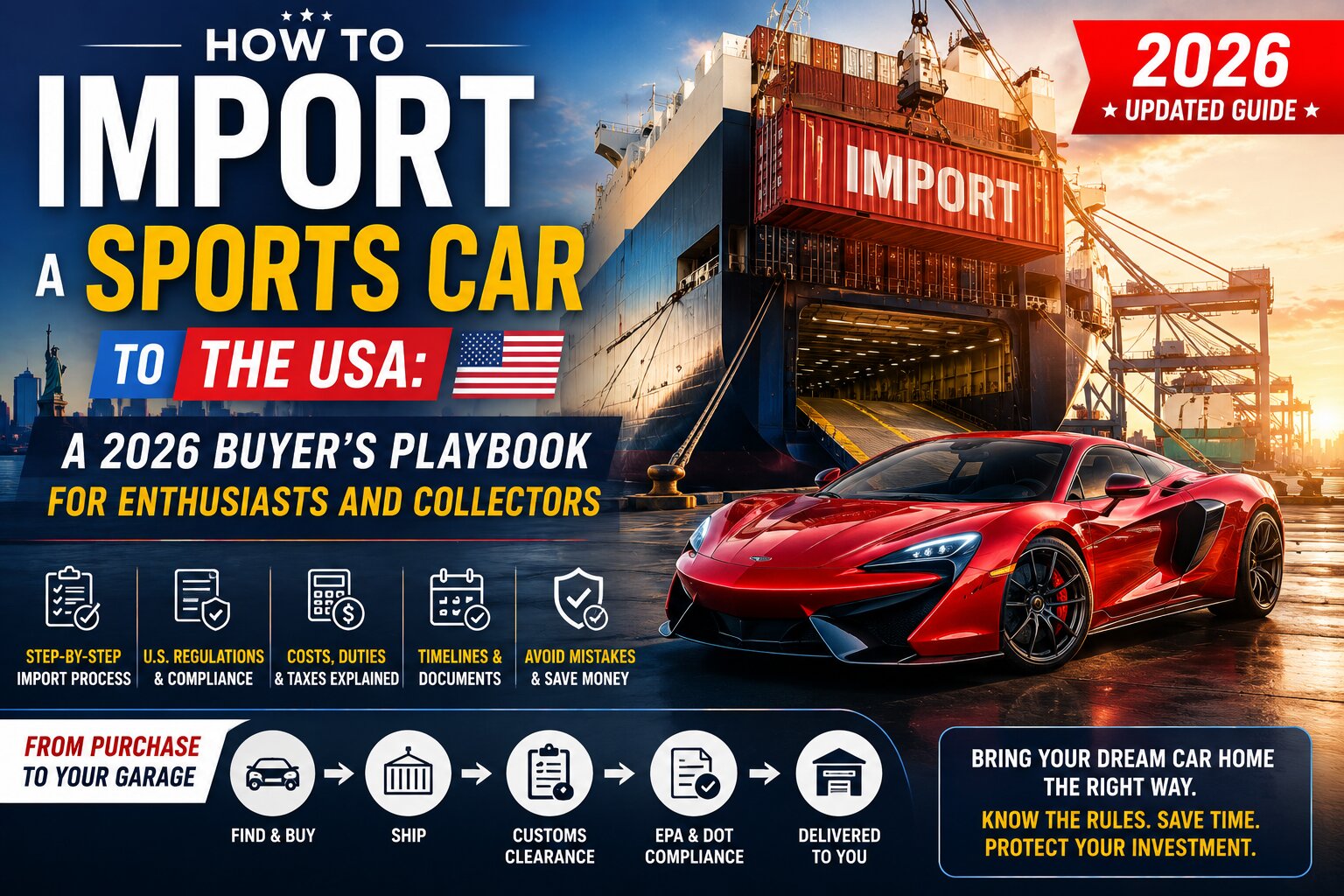
Bringing a dream car home from another country is one of the most rewarding things an enthusiast can do — and one of the easiest places to make an expensive mistake. The USA has three legal paths to import a sports car, each with its own rules, costs, and timelines. This playbook walks you through every option, the 2026 eligibility list, the real numbers, the shipping decisions, and the small details that separate the imports that arrive cleanly from the ones that get crushed at the port.
What you'll learn in this guide
- What are import cars and why people bring them in
- The three legal paths to import a sports car
- The 25-Year Rule, the most common route
- Show or Display for under-25-year supercars
- Conformance through a Registered Importer
- Which sports cars become eligible in 2026
- The 8-step import process
- Shipping decisions: RORO vs container
- Real 2026 cost breakdown
- Mistakes that get sports cars seized or crushed
- State-by-state registration realities
- Frequently asked questions
What are import cars and why people bring them in
Walk through any car meet in the United States and you will see vehicles that were never officially sold here. A Nissan Skyline GT-R. A Honda Civic Type R EK9. A Toyota Supra A80 with right-hand drive. A Mitsubishi Lancer Evolution VI. These are import cars, and they are increasingly the most coveted machines on American streets.
The term "import car" technically refers to any vehicle brought into the US from another country, but enthusiasts use it to mean something more specific. An import car is a vehicle that was never officially sold through US dealerships, brought into the country individually by someone who wanted the model badly enough to navigate federal regulations to get it. JDM (Japanese Domestic Market) cars dominate the category. European market cars come a close second. Some Australian and South African imports also turn up, but in much smaller numbers.
The reasons people import vary, but they cluster around four motivations.
The car was never available in the US. Some of the most loved sports cars of the past 40 years never crossed the Pacific. The R34 GT-R, the Toyota Chaser Tourer V, the Subaru Impreza WRX STI 22B, the Lancer Evolution VI Tommi Mäkinen Edition — none of these were sold here new. Importing is the only legal path to ownership.
The US version was watered down. Many sports cars were sold here, but in a less interesting form. The European-market BMW M3 had more power than the US version. The Japanese-market Honda Civic Type R came with features the American version never received. Importing brings home the real thing.
The car holds collector value. Sports cars from the 1990s and early 2000s have appreciated sharply over the past decade. Buying abroad and importing often costs less than buying an already-imported example in the US, especially for cars where US supply is thin.
Personal connection. Some buyers grew up watching a specific model in their home country and now want to bring it with them. Some are returning expats. Some are collectors building a specific era of vehicle. Whatever the reason, the process to import a sports car is the same.
The three legal paths to import a sports car
There are exactly three legal ways to permanently import a sports car into the United States. Every legitimate import uses one of these paths. If somebody pitches you a fourth method ("we know a way around the rules"), walk away — that is how cars get seized at the port.
Legal import pathways
Three routes to permanently import a sports car
1
25-Year Rule
Cars 25+ years old, exempt from FMVSS and EPA standards. The most common route.
2
Show or Display
Rare or historically significant cars under 25 years, with 2,500-mile annual driving limit.
3
Registered Importer conformance
Modify the car to meet US standards via an RI and ICI. Expensive and limited.
The right path depends entirely on the age, rarity, and intended use of the car. Most buyers fall under path one because they want a car from the 1990s or early 2000s — exactly the window now opening up under the 25-Year Rule.
The 25-Year Rule, the most common route
The 25-Year Rule is the foundation of US enthusiast imports. Established under the Imported Vehicle Safety Compliance Act of 1988, it exempts vehicles 25 years or older from Federal Motor Vehicle Safety Standards (FMVSS) and EPA emissions requirements. If your sports car is old enough, NHTSA and EPA get out of the way — no Registered Importer needed, no Independent Commercial Importer, no compliance modifications.
The single most important thing to understand is that the rule runs from the month and year of manufacture, not from the model year. A car built in March 2001 becomes eligible in March 2026. A car built in December 2001 becomes eligible in December 2026. The same model can be eligible or ineligible depending on which month it rolled off the production line.
What documents prove the build date
You need solid evidence the car was actually built more than 25 years ago. The cleanest proof is one of the following:
- Manufacturer's build plate showing the production month and year
- Original factory production record from the manufacturer
- First registration document showing the car was registered more than 25 years ago
- Original bill of sale from the first owner dated more than 25 years ago
- Statement from a recognized vehicle historical society if no other documentation exists
Bring multiple proofs if possible. Customs is allowed to question weak documentation, and a single questionable record can lead to your car sitting at the port while you sort it out.
What the 25-Year Rule does not exempt you from
The rule waives FMVSS and EPA federal compliance. It does not waive everything else.
- Customs duty still applies — 2.5 percent of the vehicle's declared value for passenger cars
- Merchandise Processing Fee of 0.3464 percent on commercial entries
- Harbor Maintenance Fee of 0.125 percent for ocean shipments
- EPA Form 3520-1 still has to be filed (you check Box B for vehicles 21+ years old)
- DOT Form HS-7 still has to be filed (you check Box 1 for 25+ years)
- State registration rules remain entirely separate and vary widely
- USDA undercarriage inspection — the car must be steam-cleaned before shipment
Worth knowing
When entering under the 25-Year Rule, your customs broker should classify the car using HTS code 9903.94.04. This designation confirms the vehicle qualifies for the 25-year exemption and protects you from being incorrectly assessed under Section 232 tariffs. Missing this code is one of the most common entry errors and can cost thousands in incorrect duty assessments.
First time importing a vehicle?
Get a structured plan before you wire any money overseas
Tell us about the specific sports car you want to import, where it is, and your timeline. Our consultants will walk through eligibility, total landed cost, and shipping options — at no charge, no obligation.
Show or Display for under-25-year supercars
When Bill Gates wanted to import a Porsche 959 in the late 1990s, the car was less than 25 years old and not certified for US sale. He pushed for a legal exemption, and the Show or Display rule became law in 1999. The rule lets certain rare or historically significant vehicles enter the US under 25 years old, with strict conditions.
To qualify, the car must:
- Be of "historical or technological significance" — generally meaning rare, race-derived, or a milestone model
- Have fewer than 500 examples ever produced of that exact make, model, and year combination
- Never have been sold in a US-compliant version
- Not be eligible for compliance modification through a Registered Importer
Approval comes from NHTSA on a case-by-case basis. Once a specific make, model, and year is approved for Show or Display, any other example of that exact car can be imported under the same approval without re-applying.
What you give up under Show or Display
The trade-off is real. Cars imported under Show or Display can only be driven 2,500 miles per year on public roads. NHTSA has the right to perform annual mileage inspections during the first five years. The car cannot be sold without NHTSA's written consent — they enforce this to prevent commercial exploitation of the rule. And EPA emissions compliance is still required for cars under 21 years old, often handled through an Independent Commercial Importer.
Sports cars commonly approved for Show or Display
- Porsche 959 (the original case that established the rule)
- Jaguar XJ220
- McLaren F1 and F1 LM
- Bugatti EB110
- Nissan Skyline GT-R V-Spec II Nür (limited edition variants)
- Lamborghini Reventón
- Pagani Zonda variants (specific model years)
- Koenigsegg CCR and certain other Koenigsegg models
- Various special-edition Ferrari models
NHTSA maintains a running list of approved and denied applications. If the car you want is not on the approved list, you will need to file a fresh application — a lengthy and uncertain process. Most enthusiasts wait the few years until the car becomes eligible under the 25-Year Rule rather than fight a Show or Display application.
Conformance through a Registered Importer
The third path is the rarest, most expensive, and most heavily regulated. A Registered Importer (RI) is an NHTSA-certified business that modifies non-conforming vehicles to meet FMVSS standards. An Independent Commercial Importer (ICI) does the same for EPA emissions compliance. Together they can bring a car under 25 years old into legal US use, but only if the car appears on NHTSA's list of vehicles eligible for compliance modification.
The catch is that this list is short. NHTSA only adds a vehicle to the list if a Registered Importer can demonstrate that the car can feasibly be modified to meet all current FMVSS — including crash testing, airbag standards, and bumper requirements. For most exotic and low-volume sports cars, this is either impossible or prohibitively expensive.
When conformance does work, the process typically involves:
- Contracting with both an RI and an ICI before the car arrives
- Posting a DOT bond equal to 1.5 times the vehicle's declared value at customs
- Allowing the RI 120 days to complete required modifications
- Letting the ICI perform EPA emissions testing in certified laboratories
- Receiving final EPA release before the car can legally operate on public roads
Total conformance costs commonly run $25,000 to $60,000 above the purchase price of the car. For most enthusiast sports cars, the math simply does not work. Conformance makes sense only for high-value vehicles where the rarity premium justifies the cost — typically late-model exotic or supercar imports a few years short of 25-year eligibility.
Which sports cars become eligible in 2026
This is the part of the article that updates every year. Cars built in 2001 hit the 25-year mark month by month through 2026, and a remarkable list of sports cars rolls into legal eligibility this year. If you have been waiting for one of these, your moment is here.
← Swipe to see all columns →
| Sports car (2001 build) | Origin | Why enthusiasts want it |
|---|---|---|
| BMW E46 M3 (Euro spec) | Germany | S54 inline-six, manual gearbox, considered one of the great driver's cars |
| Honda Civic Type R EP3 | UK / Japan | K20A engine, 8,000 RPM redline, never sold new in the US |
| Subaru Impreza WRX STI "Bugeye" | Japan | Rally heritage, AWD turbocharged performance icon |
| Nissan Silvia S15 Spec-R | Japan | Drift culture legend, SR20DET turbo, JDM-only |
| Ferrari 360 Modena / Spider | Italy | Mid-engine V8, accessible exotic entry point |
| Lamborghini Murciélago (early build) | Italy | V12 flagship, first Audi-era Lamborghini |
| Aston Martin V12 Vanquish | UK | James Bond car, paddle-shift V12 GT |
| Porsche 996 GT3 / GT2 | Germany | Track-focused 911 variants, raw driving feel |
| Mitsubishi Lancer Evolution VII GT-A | Japan | JDM-only auto-transmission Evo, very rare |
| Toyota Altezza RS200 (later builds) | Japan | 3S-GE Beams engine, considered the JDM IS300 |
Two things to keep in mind. First, eligibility is by month — a January 2001 build is eligible in January 2026, a December 2001 build is not eligible until December 2026. Plan your purchase and shipping timeline around the actual production date of the specific car. Second, demand often spikes the moment a model becomes eligible, which means prices abroad rise too. The smart move is to identify the specific car you want a few months early, lock in the seller, and time the shipment to clear US customs after the eligibility date.
The 8-step import process
The mechanics of importing a sports car are the same regardless of which legal pathway you use. The difference is in the documents you file with CBP at entry. Here is the full sequence.
Step-by-step process
Your roadmap to importing a sports car
1
Confirm eligibility
Verify the exact build month, pathway, and US state registration rules.
2
Find the car
Japanese auctions, European dealers, or trusted importers and brokers.
3
Inspect before paying
Pre-purchase inspection at origin. Never wire on photos alone.
4
Pay through escrow
Auction houses or escrow services protect you from seller fraud.
5
Book shipping
Container or RORO from origin port to US port of entry.
6
File ISF
Importer Security Filing 24+ hours before vessel departs origin.
7
Clear US customs
HS-7, EPA 3520-1, bill of lading, title, and duty payment.
8
Register your car
Title and tag with your state DMV. Rules vary widely.
From the moment you commit to a specific car to the moment you can legally drive it on US roads, plan for 60 to 120 days. Japanese auction purchases tend to be at the faster end. European private-sale imports often take longer because the seller's local export paperwork can be slow.
Shipping decisions: RORO vs container
There are two main ways to ship a sports car overseas. The wrong choice can leave you with a damaged or stolen vehicle. The right choice is almost always container shipping, especially for sports cars worth more than $15,000.
RORO shipping
Roll-on, roll-off
- Car drives on and off the vessel
- Cheaper: $1,200 to $2,500 from most origins
- Faster booking, more sailings available
- No personal items allowed inside the car
- Higher theft and damage risk
- Best for daily-driver cars, not collectors
Container shipping
20ft or 40ft container
- Car sealed inside private container
- More expensive: $2,500 to $4,500 for 20ft
- Personal items allowed (parts, accessories)
- Much lower theft and damage risk
- Multiple cars can share a 40ft container
- Best for sports cars, exotics, restorations
For any sports car worth more than $15,000, the extra $1,000 to $2,000 in container shipping cost is the cheapest insurance you will buy. RORO ships are notorious for petty theft at intermediate ports, and any visible damage to your sports car turns into an insurance fight you may not win. Container shipping seals the car at origin and breaks the seal only on arrival.
If you want to dig deeper into the container side of international shipping, our companion guide on how to import a container from China covers the FCL vs LCL decision, container types, and loading best practices in detail. The principles apply directly to sports car shipping from any origin country.
Real 2026 cost breakdown
The supplier price is never the real cost. Here is a worked example for a 2001 BMW E46 M3 imported from Germany to the US East Coast under the 25-Year Rule in 2026.
← Swipe to see all columns →
| Cost line | Amount (USD) | Notes |
|---|---|---|
| Vehicle purchase price | $28,000 | Clean, low-mileage Euro-spec E46 M3 |
| Pre-purchase inspection | $350 | Mechanic visit at origin |
| Inland transport (seller → port) | $280 | Trucking within Germany |
| USDA steam clean (undercarriage) | $150 | Required to prevent pest contamination |
| Export documentation | $220 | Title transfer, export declaration |
| Ocean freight (Bremerhaven → NY/NJ, container) | $2,650 | 20ft dedicated container |
| Cargo insurance | $280 | 1% of vehicle value |
| US customs duty (2.5%) | $700 | On declared value |
| Merchandise Processing Fee | $97 | 0.3464% MPF |
| Harbor Maintenance Fee | $35 | 0.125% HMF |
| Customs broker fee | $425 | Vehicle-experienced broker |
| Port handling and chassis | $320 | Container deramp and storage |
| Inland US transport (port → home) | $680 | Enclosed trailer recommended |
| State title and registration | $310 | Varies widely by state |
| State inspection (if required) | $120 | Some states only |
| Total landed cost | $34,617 | +24% over purchase price |
The purchase price was $28,000. The car sitting in your driveway with a license plate costs $34,617. That is the real number to use in your budget. For Japanese imports, replace ocean freight with $1,800 to $2,400 from Yokohama or Kawasaki and add roughly $400 for the higher Japanese export paperwork costs. For UK imports, expect ocean freight of $2,200 to $3,000 with similar paperwork.
Hidden costs to budget for
Port storage if you delay pickup ($75 to $200 per day). Currency conversion fees on the wire transfer (1 to 3 percent). State-specific safety or smog inspections in California, New York, and Massachusetts that may require minor modifications. Catalytic converter retrofit if your state requires it. Always build a 5 to 10 percent contingency buffer into your import budget.
Make every shipping dollar count
Get expert help with the customs and compliance side
Our import consulting team helps enthusiasts and collectors navigate HS-7, EPA 3520-1, customs brokerage, and state DMV requirements — so your sports car clears the port cleanly the first time.
Mistakes that get sports cars seized or crushed
Every year, dozens of imported sports cars are seized at US ports. Some are crushed. Some are exported back at the importer's cost. The mistakes that cause these outcomes are almost always avoidable.
- Misrepresenting the build date. Customs verifies build dates through manufacturer records, factory plates, and historical society confirmations. A car that turns out to be under 25 years old when you claimed 25-Year Rule treatment will be seized.
- Importing without the right HS code. Missing HTS 9903.94.04 for 25-Year Rule entries can trigger Section 232 tariff assessments and incorrect duty bills.
- Skipping pre-purchase inspection. Buying a sports car you have never seen, from a seller you cannot reach by phone, is the most common loss path. Pay for an in-country inspection before wiring funds.
- Title problems. A car with an unclear title, salvage status, or mismatched VIN will not get past CBP. Verify title cleanliness before purchase.
- USDA contamination. An undercarriage with foreign soil will require port-side steam cleaning at your expense, and serious contamination can lead to refusal. Always have the car steam-cleaned before shipment.
- Personal items in the car. Many shippers refuse cars containing personal belongings, and customs can fine you or seize the vehicle if undeclared items are found.
- Choosing a broker without vehicle experience. General customs brokers often mishandle vehicle entries because the forms (HS-7, EPA 3520-1, state DMV requirements) differ from standard cargo. Use a broker with vehicle experience.
- Forgetting state rules. Federal import doesn't equal state registration. California, New York, Massachusetts, and a few others have additional requirements. Check before shipping.
"A car that arrived at the port unprepared is a car that costs you more than it should. The cars that clear cleanly are the ones whose paperwork was finished before the ship left the origin port."
State-by-state registration realities
Clearing federal customs is only half the battle. Each state runs its own registration system, with its own rules for imported vehicles, safety inspections, emissions testing, and titling. The state you live in dramatically affects how easy your registration will be.
Easy states for imported sports cars
Montana, Florida, Texas, Tennessee, and South Dakota have relatively straightforward registration for 25-Year Rule imports. No additional emissions testing in most cases, simple title transfers, reasonable fees. Montana is famously friendly to vehicle imports and used by collectors nationwide as a registration state.
Moderate-difficulty states
Most states fall in the middle. Standard title and registration processes, occasional safety inspections, predictable fees. New York, Illinois, Pennsylvania, and Ohio all fit this category.
Difficult states
California is the toughest state to register a foreign-market sports car. Emissions standards through CARB are stricter than federal EPA, and pre-1976 cars are exempt while later cars face inspection. Maine and Rhode Island have refused to register some kei trucks. Hawaii has restrictive vehicle rules. Always check your state DMV requirements before shipping.
The Montana LLC strategy
Some collectors register their imported vehicles to a Montana LLC to avoid state sales tax and easier registration. Whether this works depends on where you actually drive and store the car, and several states have begun enforcing against residents who use this approach to evade their home-state taxes. Speak to a tax advisor before going this route.
Importing a sports car as part of a bigger picture
For most enthusiasts, importing a sports car is a one-off project — a single dream car brought home. For dealers, importers, and collectors building inventory, the work becomes recurring and benefits from the same disciplines as commercial trade. Sourcing the right cars, planning the cash cycle, understanding tariff exposure on a portfolio basis, and choosing the right logistics partners all compound over time.
If you are thinking about scaling beyond a single import — or you import cars as part of a broader business that also moves other goods across borders — our companion pieces on foreign trade consulting and foreign market entry strategy cover the structural side of cross-border operations.
Our service
Import Consulting Services — supplier sourcing, customs setup, and end-to-end import support
Frequently asked questions
What are import cars?
Import cars are vehicles brought into the United States from another country, typically because they were never officially sold in the US market. The term most often refers to JDM (Japanese Domestic Market) cars, European market cars, and limited-production sports cars that US buyers want for their performance, design, or collector value. To enter the US legally, an import car must clear NHTSA, EPA, and CBP requirements.
How do I import a sports car to the USA in 2026?
There are three legal paths to import a sports car to the USA. The first is the 25-Year Rule, which allows any car 25 years or older to be imported without FMVSS or EPA compliance. The second is Show or Display, which lets you import certain rare or historically significant sports cars under 25 years old with a 2,500 mile annual driving limit. The third is conformance through a Registered Importer and Independent Commercial Importer, which modifies the car to meet US standards.
How much does it cost to import a sports car?
Total cost to import a sports car to the USA typically ranges from $4,500 to $15,000 above the purchase price for a 25-Year Rule import, including ocean freight ($1,800 to $4,500), import duty (2.5 percent of vehicle value), customs and brokerage fees ($500 to $1,200), inland transport, EPA and DOT filings, and state registration. Show or Display imports cost significantly more due to compliance work, often $30,000 to $80,000 above purchase price.
Which sports cars become eligible to import in 2026?
Sports cars manufactured in 2001 become eligible under the 25-Year Rule month by month through 2026. Notable models hitting eligibility include the BMW E46 M3, Honda Civic Type R EP3, Subaru Impreza WRX STI Bugeye, Nissan Silvia S15 Spec-R, Ferrari 360 Modena, Lamborghini Murciélago, Aston Martin V12 Vanquish, and various JDM legends. Eligibility is based on the actual month and year of manufacture, not model year.
Is it worth importing a sports car?
Importing a sports car is worth it when the car is unique to a foreign market, holds collector value, or costs significantly less abroad than a US equivalent. Many JDM sports cars and European limited-production models cannot be replaced by anything sold new in the US, making the import the only path to ownership. The buyers who lose money usually skip due diligence on the seller, the title, or the 25-year eligibility date.
Can I import a sports car under 25 years old?
Yes, but only through two narrow pathways. Show or Display works for rare or technologically significant cars (typically with fewer than 500 examples ever produced) and limits driving to 2,500 miles per year. Conformance through a Registered Importer and Independent Commercial Importer is technically possible for some models on NHTSA's eligibility list, but costs $25,000 to $60,000 in modification fees. For most enthusiasts, waiting until the 25-year mark is far more economical.
Where do I find sports cars to import?
Japanese auction houses (USS, JU, TAA) are the most active source for JDM imports, accessed through dealer auction members who bid on your behalf. Specialist export dealers in Japan and Europe handle direct sales to international buyers. UK and German private sellers list on AutoTrader and Mobile.de. Working with a reputable importer or sourcing agent at the origin country reduces the risk of buying a misrepresented car significantly.
How long does it take to import a sports car?
From the moment you commit to a specific car to the moment you can legally drive it, plan for 60 to 120 days. The breakdown is roughly 2 to 4 weeks to finalize purchase and inspection, 1 to 2 weeks for export paperwork in the origin country, 14 to 35 days of ocean transit depending on route, 5 to 10 days for US customs clearance, and 2 to 6 weeks for state title and registration. Japanese imports typically run faster than European imports.
Read more on importing and global trade
If this playbook was useful, here are related resources from our blog that go deeper on adjacent topics.
Container shipping
How to Import a Container from China: A 2026 Step-by-Step Playbook
USA imports
How to Import from China to USA: A 2026 Buyer's Playbook
Foundations
What Is an Import Export Consultant? Roles, Services & When You Need One
Selecting a partner
How to Find Import & Export Consulting Services for Your Business
Ready to bring your dream car home?
Get a structured import plan from our consultants
From eligibility verification to customs clearance and final state registration, our team helps individual enthusiasts and collectors navigate every step of the sports car import process. Start with a no-cost conversation about your specific car.
The right import starts before the car ships
Importing a sports car is one of the most rewarding things an enthusiast can do — and one of the most regulated. The collectors who succeed verify eligibility before paying, ship in containers rather than RORO, calculate full landed cost honestly, file every form correctly, and work with brokers who understand vehicles specifically. Do those five things and the car of your dreams arrives ready to enjoy.



Contact us today to schedule a NO-CHARGE INTIALS 30-MINUTE consultation. Ask questions and learn from the experts.