

Cross-Border Boat Playbook
How to Import a Boat in 2026: The Complete Cross-Border Guide with Real Costs, Tariffs, and CUSMA Path
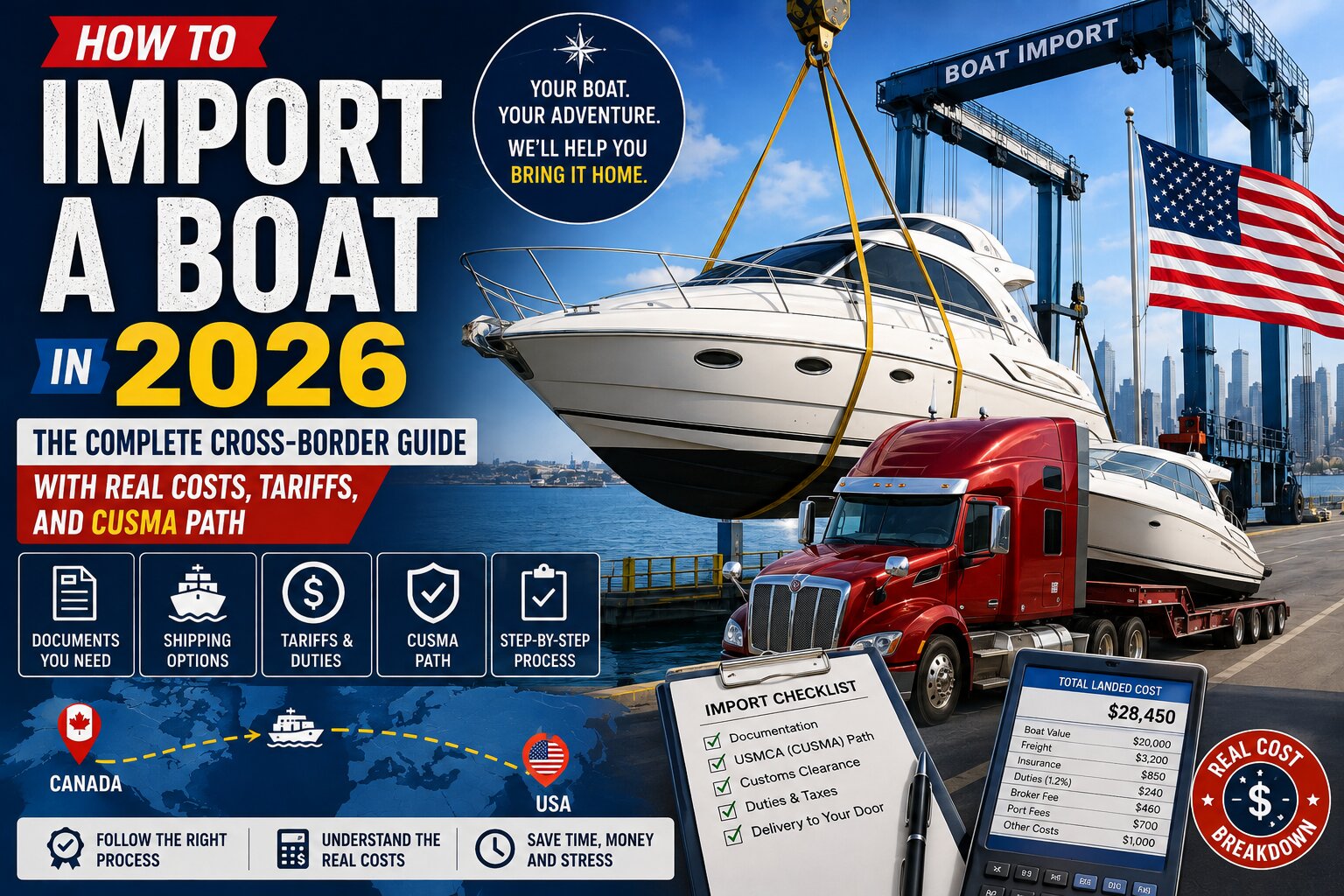
Learning how to import a boat in 2026 involves a tariff picture that has shifted meaningfully in the past 18 months. Base HTSUS duties on boats remain modest at 1.5 percent for most sailboats and motorboats. But Section 232 aluminum derivative product duties may apply to aluminum-hulled vessels — a detail no other ranking guide currently addresses properly. Meanwhile, USMCA (called CUSMA on the Canadian side) offers duty-free entry between the US, Canada, and Mexico for qualifying boats — often the single largest cost advantage available on cross-border boat trade. This guide walks through the complete 2026 process for importing a boat, whether you are a US buyer bringing a boat down from Canada, a Canadian buyer bringing a boat up from the States, or anyone importing from further afield.
What you'll learn in this guide
- What "importing a boat" actually means legally
- The 2026 boat tariff landscape
- The aluminum boat Section 232 exposure
- The USMCA/CUSMA duty-free path (US and Canada)
- The seven-step boat import process
- Documents you must have
- How to import a boat into Canada from the USA
- Importing a boat on a trailer
- New vs used boat import differences
- The cruising permit alternative
- Real 2026 cost example
- Common mistakes to avoid
- Frequently asked questions
What "importing a boat" actually means legally
Importing a boat sounds like it should be simple. It usually is not. In legal terms, importing a boat means bringing a vessel across an international border with the intent to keep it in the destination country either permanently or for extended use — which triggers customs duties, regulatory compliance requirements, and formal entry procedures. This differs meaningfully from temporarily visiting another country with your boat, which typically requires only a cruising permit or short-term declaration.
The core regulations governing boat imports into the USA sit with three federal agencies. US Customs and Border Protection (CBP) handles the customs entry, duty calculation, and formal importation record. The Environmental Protection Agency (EPA) regulates emissions from marine engines and requires Form 3520-1 declarations for most motorized vessels. The US Coast Guard (USCG) oversees vessel safety standards and documentation for larger boats. Depending on the boat category and use, other agencies may also get involved — the FDA for commercial fishing vessels, for example, or specific state agencies for tax and registration.
The most common scenarios where people learn how to import a boat are: buying a used boat in Canada and bringing it to the USA (this is the largest single boat-import flow), buying a new boat from a foreign manufacturer, importing a specialty vessel unavailable domestically, or moving personal watercraft as part of a household relocation. Each scenario follows the same fundamental framework but with different documentation and timeline realities.
The 2026 boat tariff landscape
The tariff picture on imported boats in 2026 involves multiple layers. Most competitor guides address only the base HTSUS duty and stop there. That leaves out real cost exposure that hits at customs clearance.
Base HTSUS duties on boats
Base duty rates on boats fall under Chapter 89 of the Harmonized Tariff Schedule. The main categories:
← Swipe to see all columns →
| Boat category | HTS classification | Base duty rate |
|---|---|---|
| Sailboats (with or without auxiliary motor) | 8903.91 | 1.5% |
| Motorboats other than outboard | 8903.92 | 1.5% |
| Outboard motorboats | 8903.93 | 1% |
| Yachts and pleasure vessels | 8903.99 | 1.5% |
| Inflatable boats | 8903.10 | 2.4% |
| Rowing boats and canoes | 8903.99 | 2.7% |
| Personal watercraft (jet skis) | 8903.99 | 1% |
Compared to consumer goods, boat duty rates are quite favorable. But the base rate is just the starting point. Additional tariff layers may apply depending on country of origin and boat construction.
Section 301 tariffs on Chinese-origin boats
Boats manufactured in China face Section 301 tariffs on top of the base rate. Most pleasure vessel categories fall under List 3, adding 25 percent to the total duty owed. For a $50,000 Chinese-manufactured boat, this means paying $12,500 in Section 301 tariff on top of the 1.5 percent base rate. This has meaningfully shifted the sourcing math away from Chinese boat imports in favor of North American or European alternatives.
The IEEPA situation as of February 2026
Between February 2025 and February 2026, IEEPA tariffs added additional duty layers to imports from various countries. In February 2026, the Supreme Court struck down the IEEPA regime as unconstitutional. Boat importers who paid IEEPA duties during that window may be eligible for refunds through the CAPE (Claim for Adjustment or Post-Entry) filing process. If your business imported boats in 2025 or early 2026, this represents a recovery opportunity worth investigating with a licensed customs broker.
The aluminum boat Section 232 exposure
Here is the single biggest gap in every ranking article on how to import a boat: Section 232 aluminum derivative product duties on aluminum-hulled vessels. No other top-10 competitor addresses this properly, and it catches importers of aluminum boats by surprise regularly.
What triggers the exposure
Section 232 tariffs originally targeted primary aluminum imports directly. But the derivative products designation expanded coverage to finished goods containing meaningful aluminum content. Aluminum-hulled boats — including many popular fishing boats, pontoons, jon boats, and workboats — potentially fall within the derivative products scope depending on their specific HTS classification and aluminum content.
Which boats are most affected
Categories where Section 232 aluminum derivative exposure is most likely:
- Aluminum fishing boats — popular Lund, Alumacraft, Crestliner, Starcraft, Smoker Craft, and similar aluminum fishing boat brands
- Aluminum pontoon boats — Bennington, Harris, Sylvan, Manitou, and similar pontoon manufacturers using aluminum tube and deck construction
- Aluminum jon boats and workboats — commercial workboat categories and small utility vessels
- Aluminum center-console fishing boats — increasing category with high aluminum content
What to do about it
Two practical steps. First, verify your specific boat's HTS code against the current Section 232 derivative products list before you commit to purchase. Your customs broker or a consultant should do this analysis — do not rely on the foreign supplier's classification. Second, factor the derivative duty exposure into your landed cost calculation from the start. A Canadian-manufactured aluminum boat under USMCA typically avoids this exposure entirely (see next section), which is one reason the Canadian import path is attractive for aluminum boat categories.
Section 232 details
Importing Machinery: The Complete 2026 Business Guide
The USMCA/CUSMA duty-free path (US and Canada)
The single most impactful decision for anyone importing a boat between the USA and Canada is whether the boat qualifies for USMCA (US name) or CUSMA (Canadian name) duty-free treatment. This is the same trade agreement — different names because Canada and the USA use different acronyms. When it applies, the base duty drops to zero and Section 232 aluminum derivative exposure typically disappears too.
How USMCA/CUSMA qualification works for boats
Boats qualify for USMCA/CUSMA duty-free treatment when they meet the rules of origin — either the tariff shift rule (all non-originating materials undergo a specified tariff classification change) or the regional value content requirement (typically 60 to 75 percent North American content depending on the specific boat category). For boats genuinely manufactured in Canada or the US, meeting the rules of origin is usually straightforward.
The Certificate of Origin requirement
The USMCA/CUSMA Certificate of Origin does not have to follow a mandatory form (unlike the old NAFTA Certificate), but it does have to contain nine specific data elements. Your Canadian or US supplier prepares this certificate, and your customs broker uses it to claim the preference on entry. Without a properly completed certificate, your entry defaults to Most Favored Nation duty rates and you pay the full base rate plus any applicable overlay tariffs.
Why the USMCA path matters most for aluminum boats
USMCA/CUSMA qualification is particularly valuable for aluminum-hulled vessels because it typically eliminates both the base duty and the Section 232 aluminum derivative exposure simultaneously. For a Canadian-manufactured aluminum fishing boat that would otherwise face 1.5 percent base duty plus potentially 10 percent or more in Section 232 derivative duties, USMCA treatment can save several thousand dollars on a mid-value boat.
The broader trade lane the pillar covers
The US-Canada trade lane for boats is part of a much larger picture that includes construction equipment, industrial machinery, and other heavy goods. The regulatory framework, USMCA/CUSMA rules, documentation requirements, and cross-border transport logistics all share the same fundamentals. For US buyers thinking about broader cross-border sourcing beyond just boats, our companion piece on importing heavy equipment from Canada to USA walks through the complete 2026 playbook — including USMCA qualification examples, port and border crossing operations, real cost breakdowns on Caterpillar and John Deere equipment, and the specific documentation strategies that make cross-border trade work efficiently.
Worth knowing
For most US buyers evaluating boat sourcing options in 2026, running the numbers on Canadian USMCA-qualifying boats as a first option often surprises them favorably. Even when the unit price is higher than an Asian equivalent, the combination of duty-free treatment, shorter shipping distances, and lower total logistics cost frequently produces the best landed cost overall — especially for aluminum boat categories.
Planning a cross-border boat purchase?
Get a structured import plan with real tariff math for your specific boat
Our consultants review your target boat, verify HTS classification and Section 232 aluminum exposure, evaluate USMCA/CUSMA qualification, and map out the complete cost picture before you commit to purchase. No charge, no obligation for the initial planning conversation.
The seven-step boat import process
Every boat import into the USA follows the same fundamental sequence. The steps below apply whether you are importing a $15,000 aluminum fishing boat from Canada or a $500,000 yacht from Italy.
The complete process
Seven steps to import a boat into the USA
1
Verify compliance
USCG, EPA standards for your specific boat.
2
Classify HTS
Chapter 89 code, Section 232 aluminum check.
3
Purchase agreement
Bill of Sale with HIN, Incoterms, documentation.
4
Transport arrangement
Trailer for smaller boats, ocean/river for larger.
5
Customs entry
CBP Form 7501, EPA 3520-1, USCG docs.
6
Duty payment
Base duty, Section 232 if applicable, fees.
7
State registration
Title, registration, personal property tax.
Total time from purchase agreement to registered boat in your marina slip varies significantly by scenario. Cross-border trailer moves from Canada can complete the entire cycle in 2 to 4 weeks. Ocean freight from Europe or Asia typically runs 8 to 14 weeks total. Boat imports rarely have the tight delivery deadlines that industrial equipment does, so timeline flexibility is usually higher — but the paperwork sequence still matters for avoiding storage costs at ports of entry.
For the full framework covering all import categories and both directions of trade, our guide on what is import export procedure walks through each step with US-specific examples.
Documents you must have
Missing documentation is the number one reason boats get held at CBP. The specific list varies slightly by boat category and origin, but the core documents apply universally.
Commercial and identification documents
- Bill of Sale — from the seller, showing purchase price, Hull Identification Number (HIN), make, model, year, and any engine information
- Certificate of Origin — required if claiming USMCA/CUSMA duty-free treatment
- Manufacturer Statement of Origin (new boats) — from the boat builder for new vessel imports
- Foreign registration or documentation — proof of prior legal status if used boat
- HIN documentation — Hull Identification Number must meet US Coast Guard formatting standards
Customs and partner agency filings
- CBP Form 7501 (Entry Summary) — filed by your customs broker for the formal customs entry
- EPA Form 3520-1 — declaration of emissions compliance for boats with motors
- USCG documentation forms — for vessels 5 net tons or larger seeking federal documentation
- DOT Form HS-7 — for boat trailers being imported alongside the boat
- ISF 10+2 (Importer Security Filing) — required for ocean freight shipments 24 hours before loading
Broker experience specifically with boat imports matters here. A customs broker who has handled hundreds of boat entries knows exactly which partner agencies get involved for each boat category and which forms need to be filed simultaneously with the customs entry.
How to import a boat into Canada from the USA
The reverse direction of trade — importing a boat into Canada from the USA — follows a parallel but distinct regulatory framework. Canadian buyers of US boats face different rules, different agencies, and different tax exposure than US buyers importing from Canada.
The Canadian agencies involved
The Canada Border Services Agency (CBSA) handles customs entries at the Canadian border. Transport Canada oversees pleasure craft compliance standards. Provincial licensing authorities handle boat registration and licensing in each province. The tax picture involves federal GST (5 percent) plus any applicable Provincial Sales Tax (PST) or Harmonized Sales Tax (HST) depending on the province of registration.
The seven steps for importing a boat into Canada
- Verify Transport Canada compliance — pleasure craft standards, hull identification, and safety equipment requirements
- Determine CUSMA eligibility — US-origin boats may qualify for duty-free treatment
- Prepare documentation — Bill of Sale, ownership proof, US Certificate of Origin, HIN verification
- Arrange border crossing — trailer transport for smaller boats, or shipping arrangement for larger vessels
- File CBSA entry — B3 Canada Customs Coding Form with all applicable documentation
- Pay taxes and any duties — GST always applies, PST/HST depending on province, duty only if CUSMA doesn't apply
- Register with provincial authorities — pleasure craft license or full registration depending on boat size and use
The CUSMA advantage for Canadian buyers
For Canadian buyers of US-manufactured boats, CUSMA duty-free treatment is often the most significant single cost advantage. Without CUSMA, Canadian boat imports face duties in the 6.1 to 9.5 percent range for most vessel categories — substantially higher than the US duty rates on the reverse flow. A Canadian buyer of a US-manufactured $75,000 boat can save $4,500 to $7,000 in duty by properly claiming CUSMA. This makes documentation discipline particularly important on the Canadian side.
Tax vs duty for Canadian buyers
A common misunderstanding: even boats qualifying for CUSMA duty-free treatment still pay Canadian GST (5 percent federally) and any applicable provincial sales tax. CUSMA eliminates the duty, not the tax. On a $75,000 US boat imported into Ontario, the Canadian buyer still pays 13 percent HST ($9,750) even under CUSMA duty-free entry. Budget accordingly.
Importing a boat on a trailer
If you are importing a boat by road across the US-Canada border (the most common cross-border scenario), the trailer itself becomes a separate import item. Trailers are considered motor vehicles by CBP and need their own documentation and duty treatment.
Trailer-specific requirements
- DOT Form HS-7 — required for the trailer, stating make, model, and year
- Vehicle Identification Number (VIN) — trailer must have a VIN that meets US DOT standards
- Trailer HTS classification — separate from the boat, usually under Chapter 87
- Separate declared value — trailer value declared distinct from boat value on the entry
- State trailer registration — required after federal customs clearance
Combined trailer + boat entries
Your customs broker handles both the boat and trailer as parallel line items on the same entry. This is standard practice and doesn't add meaningful complexity beyond the additional forms. The key is having accurate trailer specifications on the Bill of Sale — VIN, make, model, year, and separately identified value.
New vs used boat import differences
New and used boat imports follow the same fundamental process but differ in documentation, valuation, and EPA scrutiny.
New boats
Import characteristics
- Manufacturer's commercial invoice at list price
- Manufacturer Statement of Origin
- Original engine EPA certification
- Straightforward USCG documentation
- Manufacturer warranty documentation
- Cleaner valuation questions
Used boats
Import characteristics
- Bill of Sale showing actual purchase price
- Foreign registration/documentation history
- Engine emissions potentially older tier
- Maintenance and repair history
- Prior owner information
- Potential valuation scrutiny by CBP
The EPA emissions question on used boats
Used boat imports with older marine engines face potential EPA scrutiny to prevent circumvention of newer emission standards. Marine engines from certain older model years may not comply with current EPA requirements without documentation of compliance or applicable exemption. This is one of the most common places used boat imports get held, and it deserves specific attention before purchase.
The cruising permit alternative
For some scenarios, importing a boat isn't actually the right approach. If you plan to use a boat in the USA only temporarily — a season, a specific trip, or extended cruising with plans to return the vessel to its home country — a cruising permit may be a better path than formal import.
How cruising permits work
The USCG issues cruising permits (also called cruising licenses) to foreign-flagged vessels for temporary use in US waters. The permit typically allows 12 months of use in US waters, after which the vessel must depart for at least 15 days before returning. This lets you avoid customs duty entirely because the boat is not being imported — it is visiting.
The limitations
Cruising permits come with real restrictions. The boat must remain foreign-flagged. It cannot carry fare-paying passengers under most circumstances. It cannot be sold in the USA under the temporary status. It must maintain the departure and return schedule to remain compliant. And after enough time on cruising permit status, CBP may deem the vessel effectively imported and assess duties retroactively.
When cruising permits make sense
Cruising permits work well for: a season of extended use in US waters by a Canadian or foreign owner, delivery voyages to a US buyer who will formally import later, or specific event participation (boat shows, races, etc.). They don't work if you plan permanent US-based use — that requires formal import.
Ready to build your boat import operation
Expert help with HTS classification, USMCA/CUSMA qualification, and EPA compliance
Our import consulting team supports individual boat buyers and marine dealers with the complete import process. From HTS classification and Section 232 aluminum analysis to USMCA/CUSMA qualification, customs broker selection, USCG documentation, and state registration guidance. Whether you're importing one boat or building a dealer inventory.
Real 2026 cost example: importing a boat from Canada
Numbers make the process concrete. Here is a realistic 2026 cost breakdown for a US buyer importing a used 20-foot aluminum fishing boat from Ontario, Canada — with USMCA duty-free treatment applied.
← Swipe to see all columns →
| Cost line | Amount (USD) | Notes |
|---|---|---|
| Boat purchase price (used, Ontario dealer) | $32,000 | 2019 Alumacraft 195 with 90 HP outboard |
| Trailer purchase (included) | $0 | Included in boat price; declared separately at $2,500 |
| Base HTSUS duty (would be 1%) | $0 | USMCA qualified — duty-free |
| Section 232 aluminum exposure (avoided) | $0 | USMCA qualified — exposure eliminated |
| MPF and HMF fees | $153 | Standard entry fees on declared value |
| US customs broker fees | $650 | Boat + trailer entry with USMCA claim |
| Continuous customs bond | $500 | Annual, prorated |
| Cross-border trucking (Ontario to Michigan) | $1,200 | Professional boat hauler, 400 miles |
| Michigan state title and registration | $120 | Boat and trailer registration |
| Michigan use tax (6%) | $1,920 | Based on purchase value |
| Total landed cost | $36,543 | ~14% above purchase price |
Total landed cost: $36,543 on a $32,000 boat — approximately 14 percent above purchase price. The same boat imported from a Chinese manufacturer would face the base duty plus 25 percent Section 301 tariff plus potential Section 232 aluminum derivative exposure, adding roughly $8,000 to $12,000 in additional duties and pushing the total closer to $48,000 to $52,000.
The USMCA/CUSMA advantage is why the US-Canada boat trade is one of the busiest cross-border flows in the entire marine industry. Similar dynamics apply across many equipment categories moving between the two countries.
Common mistakes to avoid
Most boat imports that get held at CBP fall into a small handful of preventable mistakes. Recognizing them before you commit to purchase prevents days of storage costs and expensive rework.
- Not verifying aluminum content for Section 232 exposure. The single most expensive blind spot. Aluminum boat buyers who budget only for base duty often discover Section 232 exposure at clearance.
- Missing the USMCA/CUSMA Certificate of Origin. Without a properly completed certificate, your Canadian or US-origin boat pays MFN duty rates instead of duty-free treatment. The certificate must be prepared before entry, not after.
- Undervaluing used boats. CBP scrutinizes used boat valuation carefully. Declared values that look implausibly low trigger inquiries and potentially binding ruling requirements.
- Forgetting EPA declarations on motorized boats. Any boat with a motor requires EPA Form 3520-1 declaration. Missing this stops the entry release.
- Not handling the trailer as a separate item. Trailers need their own DOT Form HS-7, VIN, and declared value. Ignoring the trailer creates entry problems.
- Confusing tax with duty. Especially for Canadian buyers — CUSMA eliminates duty but not GST/HST/PST. Budget for both correctly.
- Missing state personal property tax. Some US states apply personal property tax on registered boats. Verify before importing.
- Assuming CBP release means state registration is automatic. Federal customs clearance and state boat registration are two different processes.
"The boat importers who succeed treat tariff analysis and USMCA qualification as pre-purchase decisions, not post-arrival surprises."
Frequently asked questions
How to import a boat into the USA in 2026?
Importing a boat into the USA in 2026 involves seven main steps: verify the boat meets US Coast Guard and EPA compliance standards, determine the correct HTSUS Chapter 89 classification, obtain the required documents (Bill of Sale, Certificate of Origin, EPA Form 3520-1, USCG documentation), engage a licensed US customs broker for the CBP entry filing, pay applicable duties (1.5 percent base rate for sailboats and motorboats, with potential Section 232 aluminum derivative duties on aluminum-hulled vessels), file for any USMCA duty-free treatment if the boat qualifies as North American origin, and handle boat trailer VIN documentation separately if applicable. Total process typically takes 2 to 6 weeks depending on the boat category.
How to import a boat into Canada from the USA?
Importing a boat into Canada from the USA requires: verifying Transport Canada compliance for pleasure craft standards, calculating GST (5 percent) plus any applicable provincial sales tax (PST or HST), determining if the boat qualifies under CUSMA (Canada-United States-Mexico Agreement) for duty-free treatment, filing the B3 Canada Customs Coding Form with the Canada Border Services Agency (CBSA), providing proof of ownership and Bill of Sale, arranging for the boat to be transported across the border, and registering the boat with Transport Canada or a provincial licensing authority. CUSMA duty-free status for US-origin boats represents a significant cost advantage for Canadian buyers.
What is the duty rate on imported boats in 2026?
Base US duty rates on imported boats in 2026 remain relatively modest. Sailboats and motorboats other than outboard motorboats face a 1.5 percent HTSUS duty. Yachts and other pleasure vessels for sports use also fall in the 1.5 to 2.5 percent range. Inflatable boats and canoes have separate classifications with varying rates. However, aluminum-hulled boats may face Section 232 aluminum derivative product duties on top of the base rate. Boats qualifying under USMCA from Canadian or Mexican manufacturers can enter duty-free. Boats of Chinese origin may face Section 301 tariffs stacked on top of the base rate.
What documents do I need to import a boat?
You need seven core documents to import a boat: the Bill of Sale from the seller showing purchase price and boat identification (Hull Identification Number, make, model, year), the Certificate of Origin (especially if claiming USMCA duty-free treatment), the manufacturer statement of origin for new boats or foreign registration documents for used boats, EPA Form 3520-1 declaring emissions compliance for motorized vessels, USCG documentation if applicable, CBP Form 7501 Entry Summary filed by your customs broker, and DOT Form HS-7 for any accompanying boat trailer.
Do I need a customs broker to import a boat?
You are not legally required to use a customs broker to import a boat into the USA, but it is strongly recommended for anything beyond the smallest personal-use vessels. Boat imports involve HTSUS classification decisions, potential EPA and USCG partner agency filings, USMCA rules of origin verification, aluminum content analysis for Section 232 derivative duty exposure, and CBP entry procedures that are technical enough to cause holds and back-duty assessments if handled incorrectly. Broker fees typically range from $400 to $1,200 per entry depending on complexity.
Can I import a boat under USMCA duty-free?
Yes, boats qualifying under the United States-Mexico-Canada Agreement (USMCA, called CUSMA in Canada) can enter duty-free between the three countries. Qualification requires the boat to meet rules of origin — typically substantial North American manufacturing content or specific tariff shift criteria. Your Canadian or Mexican boat manufacturer or dealer prepares a USMCA Certificate of Origin containing nine required data elements. For boats built in Canada or Mexico, USMCA typically represents the single largest cost advantage available for cross-border boat trade.
What is the difference between importing a boat and using a cruising permit?
Importing a boat means bringing the vessel into the USA permanently or for extended use, triggering full duty payment, EPA compliance, USCG documentation (where applicable), and state registration. A cruising permit is a temporary use authorization from the US Coast Guard for foreign-flagged vessels visiting US waters for up to 12 months, after which the vessel must depart for at least 15 days. Cruising permits avoid customs duty but come with restrictions: the boat must remain foreign-flagged, cannot be sold in the USA under temporary status, and cannot carry fare-paying passengers under most circumstances.
How do I import a boat on a trailer?
Importing a boat on a trailer requires treating the trailer as a separate import item. Trailers are considered motor vehicles by CBP and need their own DOT Form HS-7 (declaring make, model, and year), a Vehicle Identification Number (VIN) meeting US DOT standards, separate HTS classification (typically under Chapter 87), and separately declared value distinct from the boat value on the customs entry. Your customs broker handles both the boat and trailer as parallel line items on the same entry. After federal customs clearance, both the boat and trailer require separate state registration.
Read more on cross-border trade and equipment imports
If this guide was useful, here are related resources from our blog that go deeper on adjacent topics.
Pillar guide
Importing Heavy Equipment from Canada to USA: A 2026 Playbook
Vehicle imports
Importing Auto Parts into the US: The Section 232 Reality in 2026
Vehicle imports
How to Import a Sports Car: The 25-Year Rule Playbook
Business structure
Top Import Company Guide for 2026: How to Start and Scale
Ready to import your boat the right way?
Get expert support from HTS classification to state registration
From verifying tariff exposure and USMCA/CUSMA qualification to customs broker selection, EPA compliance, USCG documentation, and state-specific registration guidance — our team helps individual boat buyers and marine dealers turn boat imports from a source of tariff risk into a straightforward operational sequence. Start with a no-cost conversation about your target vessel.
The cross-border boat trade rewards preparation over improvisation
Learning how to import a boat successfully in 2026 means understanding the tariff landscape (including Section 232 aluminum exposure most guides miss), the USMCA/CUSMA duty-free pathway, and the specific compliance requirements from CBP, EPA, and USCG. For US-Canada trade in either direction, the CUSMA advantage often makes cross-border sourcing more economical than domestic alternatives. Verify tariff exposure before you buy, prepare Certificates of Origin properly, treat trailers as separate imports, and remember that federal customs clearance is not state registration. Get those disciplines right and boat imports work as a straightforward addition to your marine operation.



Contact us today to schedule a NO-CHARGE INTIALS 30-MINUTE consultation. Ask questions and learn from the experts.