

Container Shipping Playbook
How to Import a Container from China: A 2026 Step-by-Step Playbook for First-Time Buyers
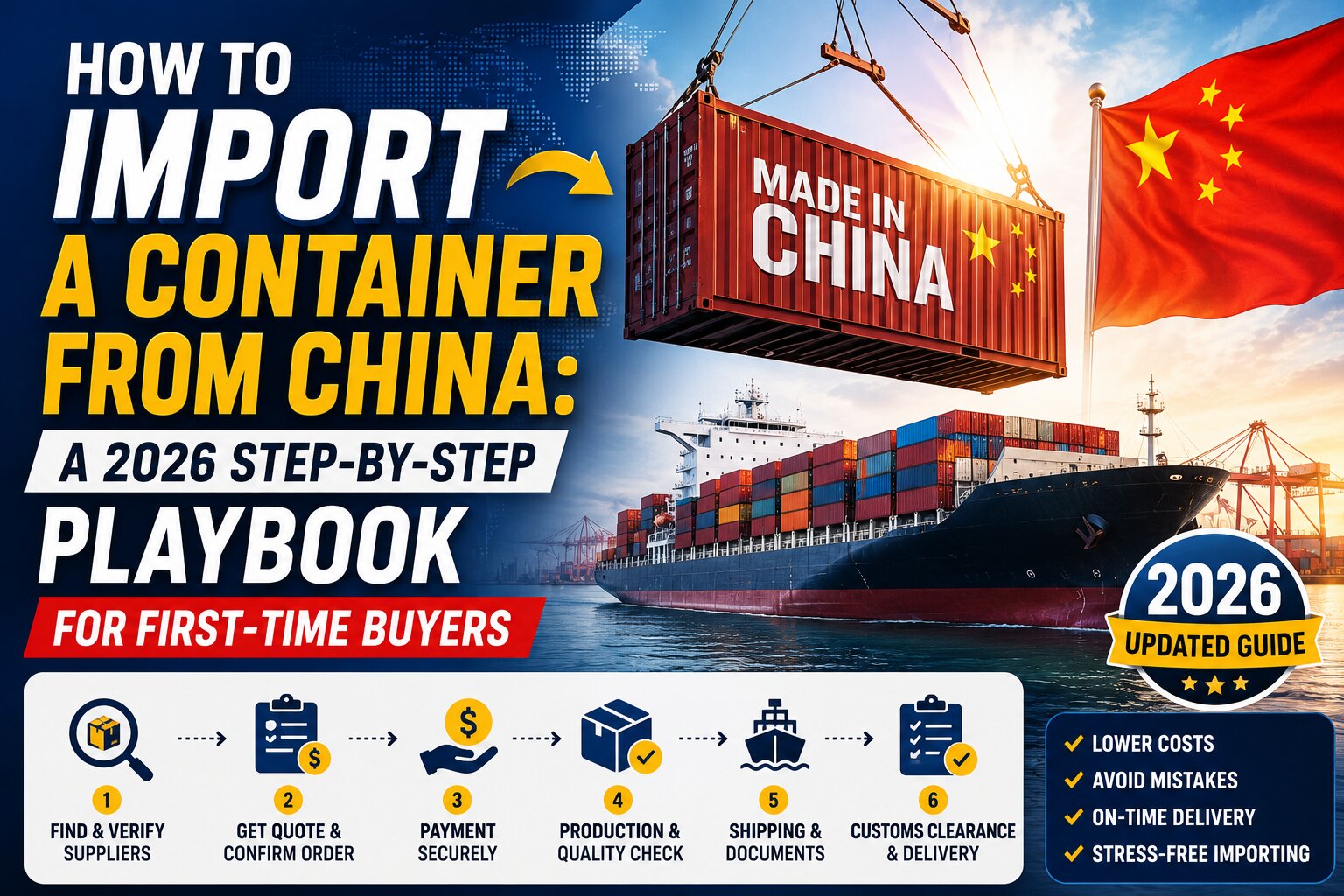
Importing a full container from China is one of the most cost-effective ways to source physical goods at scale. It is also one of the easiest places for a first-time buyer to bleed money. Wrong container size, wrong port of loading, wrong Incoterms, or a missed ISF filing can turn a profitable shipment into a costly lesson. This playbook walks you through how to import containers from China — from the booking decision to the final unload at your warehouse — with the real 2026 numbers, common mistakes, and the small details that separate professionals from beginners.
What you'll learn in this guide
- Why a full container is often the smartest way to import
- FCL vs LCL: which one fits your shipment
- Container types and sizes explained
- The full 9-step import process
- Chinese ports of loading: which one and why
- Real 2026 cost breakdown for a 40ft container
- Container loading and stuffing best practices
- US customs clearance and ISF filing
- Mistakes that drain new container importers
- Demurrage, detention, and how to avoid them
- Frequently asked questions
Why a full container is often the smartest way to import
Air freight feels fast. Express courier feels easy. Sea freight in a shared LCL container feels safe for a small order. But once your import volume crosses a certain threshold, the economics quietly tip in favor of a full ocean container — and they tip hard. A 40-foot container that costs $3,500 in ocean freight can carry $80,000 to $200,000 worth of consumer goods. That works out to less than 2 percent of cargo value in international shipping cost, which is a number no other mode can touch.
The catch is that the entire process is unforgiving. A container booking is not a parcel. You commit to a sailing date weeks in advance. You pay demurrage if your container sits at the port longer than the free-time allowance. You are the importer of record, and the IRS, CBP, and any product-specific regulator (FDA, FCC, CPSC) all have your name on file the moment the container clears US customs.
This guide assumes you have already validated your product and supplier. If you are still earlier in the journey, our parent guides on how to import from China and how to import from China to USA cover the supplier and product fundamentals. This article focuses specifically on the container side: when it makes sense, how to book it, how to load it, how to clear it, and how to avoid the most expensive mistakes.
FCL vs LCL: which one fits your shipment
Before you book anything, you need to decide whether your shipment moves as a Full Container Load (FCL) or as Less than Container Load (LCL). The difference shapes every other decision in the process.
FCL means your cargo fills (or nearly fills) one container and you pay a single container rate. You get a sealed container that only your goods ride in. The container is loaded at the factory, sealed, moved to port, shipped, and delivered to your facility (or unloaded at a container freight station) — all without other shippers' cargo touching yours.
LCL means your goods share a container with shipments from other importers. You pay per cubic meter (CBM) of cargo, your goods are consolidated at the origin port, deconsolidated at the destination port, and delivered to you separately. LCL costs less for small shipments but adds handling, time, and damage risk.
The CBM math that decides for you
The break-even point between LCL and FCL is roughly 15 cubic meters of cargo. Below that, LCL wins on price. Above that, FCL wins on price and on speed, handling, and damage risk. Between 13 and 15 CBM, get quotes for both and decide based on the specifics.
LCL ships
Best when:
- Cargo volume below 13 CBM
- Testing demand on a small first order
- Cargo can survive multiple handling cycles
- Flexible delivery timing acceptable
- Mixed-product, low-value samples
FCL ships
Best when:
- Cargo volume above 15 CBM
- Predictable, scaled product line
- Fragile or high-value goods
- Tight delivery timing matters
- Containers stay sealed factory to warehouse
Most beginners overestimate how much volume they need to justify FCL. A 20-foot container holds about 28 to 33 CBM of cargo (with reasonable stowage). A 40-foot container holds 58 to 68 CBM. If your order ships in cartons and you can fit 20+ pallets, FCL is almost always cheaper per unit even on a first order.
Container types and sizes explained
Not every container is the same box. Different cargo profiles call for different equipment, and choosing the wrong one will cost you in dead space, surcharges, or damaged goods. These are the formats you will encounter most often when importing from China.
← Swipe to see all columns →
| Container type | Internal capacity | Max payload | Best for |
|---|---|---|---|
| 20ft Standard (20'GP) | ~33 CBM | ~28,000 kg | Heavy, dense cargo: hardware, machinery, tile |
| 40ft Standard (40'GP) | ~67 CBM | ~26,500 kg | Most consumer goods at scale |
| 40ft High Cube (40'HQ) | ~76 CBM | ~26,500 kg | Light, bulky cargo: furniture, apparel, decor |
| 45ft High Cube (45'HQ) | ~86 CBM | ~26,000 kg | Very high-volume, light cargo runs |
| 20ft Reefer | ~28 CBM | ~27,000 kg | Temperature-controlled food and pharma |
| 40ft Reefer | ~58 CBM | ~25,500 kg | Larger temperature-sensitive shipments |
| Flat rack 40ft | N/A (open top/sides) | ~40,000 kg | Oversized machinery and vehicles |
| Open top 40ft | ~66 CBM | ~26,500 kg | Tall cargo loaded by crane |
Two practical rules. First, if your cargo is light and bulky (furniture, pillows, plastic homeware), the 40'HQ almost always beats the 40'GP because the extra foot of height gives you 9 more CBM at roughly the same freight cost. Second, always check the cargo's density before booking. A 40ft container weighing 28,000 kg of dense product will hit the road weight limit in the US before it hits the container's capacity limit — and you will pay for a road permit or get the container split.
The full 9-step container import process
The process below is what every successful container import follows, regardless of product, container size, or destination port. Skipping any of these steps is what separates importers who scale from importers who quietly stop after their first shipment.
Step-by-step process
Your roadmap to importing a container from China
1
Confirm product & supplier
PI signed, deposit paid, production scheduled.
2
Get freight quotes
Compare 3 forwarders, FCL or LCL, port-to-port or door-to-door.
3
Book the container
Confirm sailing date, port of loading, and Incoterms.
4
Pre-shipment inspection
Third-party QC before goods leave the factory.
5
Container loading
Factory or warehouse loads and seals the container.
6
File ISF (24+ hours pre-load)
10+2 data submitted to CBP before vessel departure.
7
Ocean transit
18 to 40 days depending on port pair.
8
Customs clearance
Entry summary, duties paid, container released.
9
Final delivery
Drayage to warehouse, unload, return empty.
From the moment you sign the proforma invoice to the moment the empty container is returned, expect 60 to 90 days for a standard FCL shipment. The number can stretch with port congestion, Chinese New Year disruptions, or last-minute documentation delays — so build a buffer into your inventory planning rather than promising customers a date based on the best-case timeline.
First-time container import?
Get a structured plan before you commit a deposit
Tell us about your product, target volume, and timeline. Our team will walk through container size, FCL vs LCL, port selection, and the realistic landed cost — at no charge, no obligation.
Chinese ports of loading: which one and why
China has more than 30 major container ports. The five below handle the vast majority of US-bound container exports, and choosing the right one is mostly about your factory's location. Shipping a container 800 kilometers inland to a port that "feels famous" costs you $400 to $800 in unnecessary trucking.
← Swipe to see all columns →
| Port | Region served | Typical use case |
|---|---|---|
| Shenzhen (Yantian) | Guangdong (Shenzhen, Dongguan, Foshan, Zhuhai) | Electronics, consumer goods, smaller manufacturers in the Pearl River Delta |
| Guangzhou (Nansha) | Guangdong inland (Guangzhou and west) | Apparel, furniture, light industrial |
| Shanghai | Shanghai, Jiangsu, lower Yangtze | Mid-range manufacturing, machinery, mixed cargo |
| Ningbo-Zhoushan | Zhejiang province (Yiwu, Ningbo, Hangzhou) | Yiwu small commodities, household goods, hardware |
| Qingdao | Shandong, Northern China | Agricultural products, steel, heavy industrial |
| Tianjin (Xingang) | Beijing, Tianjin, North China | Auto parts, machinery, North China factories |
| Xiamen | Fujian province | Footwear, stone, ceramics |
Two practical guidelines. First, ask your supplier which port they ship from regularly — they will have an established relationship with a freight forwarder there, and their inland trucking costs will be optimized. Second, compare freight quotes for the two closest ports if your factory sits between them. Ningbo and Shanghai compete heavily for Eastern China cargo, and you can often save 5 to 10 percent by picking the cheaper sailing without adding much to inland transport.
Real 2026 cost breakdown for a 40ft container
Numbers speak louder than principles. Below is a real example of a 40ft High Cube container of mixed consumer goods (let's say 1,500 units of small kitchen appliances) shipped from Shenzhen to Long Beach, California, with current 2026 tariffs and fees applied.
← Swipe to see all columns →
| Cost line | Amount (USD) | Notes |
|---|---|---|
| Product cost (1,500 units × $14.50) | $21,750 | FOB Shenzhen pricing |
| Inland China trucking (factory to port) | $220 | Within Pearl River Delta |
| Export documentation | $120 | Invoice, packing list, B/L |
| Ocean freight (40'HQ Shenzhen → Long Beach) | $3,400 | ~22-day transit, mid-2026 rate |
| BAF / fuel surcharge | $280 | Bunker adjustment factor |
| Cargo insurance | $130 | 0.5% of cargo value |
| Base US duty (~3.7% on HTS 8516) | $816 | On CIF value |
| Section 301 tariff (15%) | $3,309 | Stacks on top of base duty |
| Merchandise Processing Fee | $76 | 0.3464% MPF |
| Harbor Maintenance Fee | $30 | 0.125% on imports |
| Customs broker fee | $250 | Single-entry |
| Container Freight Station (LA) | $420 | Port handling, chassis |
| Drayage (port to warehouse) | $680 | Within Southern California |
| Container unload labor | $280 | 2 hours at warehouse |
| Total landed cost | $31,761 | $21.17 per unit |
Look at what the math just revealed. Your supplier quoted $14.50 per unit. The real landed cost is $21.17 per unit, almost 46 percent higher. The biggest single hit is the Section 301 tariff stack at $3,309. If you priced your retail at $39.99 expecting a $25.49 gross margin, your actual gross margin is $18.82 before any platform fees, ad spend, returns, or storage. That gap is exactly why so many first-time container importers lose money even on products that seemed to have great margins on the supplier's quote.
Hidden costs to budget for
Demurrage at the port if you don't pick up the container fast enough ($150 to $300 per day after free time). Detention if you hold the container too long at your warehouse ($75 to $200 per day). Chassis fees if you don't return the empty within the allowance. Currency conversion on the wire transfer (1 to 3 percent). Always add a 5 to 10 percent contingency buffer to your landed cost calculations on a first import.
Container loading and stuffing best practices
This is the section most "import from China" articles skip entirely, and it costs new importers thousands of dollars per shipment. How your goods are physically loaded into the container determines whether they arrive intact, whether you maximize the space you paid for, and whether the container weighs more than it should.
The five rules of smart container loading
- Heavy on the bottom, light on top. Sounds obvious. Many factories do it wrong unless you specify in writing. Heavy cartons crushed under nothing should sit on the floor; lighter cartons stack on top.
- Distribute weight front-to-back evenly. An unbalanced container causes road handling problems and can be rejected at the port if visibly off-center.
- Use dunnage to block movement. Cardboard inflatable bags ($8 to $20 each) wedged between cargo and container walls prevent shifting during ocean swell. Skipping dunnage is the single most common cause of in-transit damage.
- Don't exceed cargo height by container height. Sounds basic, but high cube containers have 9'6" internal height. Standard cube has 8'6". A pallet load that fits a high cube will not fit a standard.
- Photograph the load before sealing. Insist your supplier photograph the loaded container before the seal goes on. If goods arrive damaged or short, those photos are evidence for your insurance claim.
Floor loading vs palletized loading
Floor loading stacks individual cartons directly inside the container without pallets. You maximize cubic meters (10 to 15 percent more cargo fits) but unloading at the destination takes 4 to 6 hours of manual labor. Best when labor is cheap and cargo is durable.
Palletized loading stacks cartons on standard pallets (typically 40"×48" GMA or 48"×40" Euro). You lose 10 to 15 percent of cubic capacity but unloading at the destination takes 30 to 60 minutes with a forklift. Best for high-volume operations with established warehouses.
Most container importers choose palletized for the destination labor savings. The trade-off is well worth it once your operation scales past your first few containers.
Practical tip
If you ship multiple SKUs in one container, ask the factory to stuff each SKU on its own pallet stack rather than mixing them. The 30 minutes of extra factory loading time saves you hours at the destination warehouse and makes inventory counting clean from day one.
US customs clearance and ISF filing
US customs is where new container importers most often get bitten. The agency is US Customs and Border Protection (CBP), and they are uncompromising about timing on the filings they require. Get the documentation right and clearance takes 1 to 3 business days. Get it wrong and your container can sit at the port for a week or more, racking up demurrage fees.
The five filings every container import needs
ISF (Importer Security Filing), also known as "10+2". Required for every ocean shipment, this 10-data-point filing must be submitted to CBP at least 24 hours before the container is loaded onto the vessel in China. Late or inaccurate filings carry penalties of up to $5,000 per violation. Your customs broker prepares and files this from your commercial invoice, but the timing depends on you giving them the data on time.
Entry Summary (CBP Form 7501). Filed within 10 working days of arrival, this is your formal customs declaration including value, classification, country of origin, and any free trade agreement claims. The form drives your duty bill.
Customs bond. Required for any commercial shipment over $2,500. Single-entry bonds cost a few hundred dollars per shipment; continuous bonds (cover all your imports for a year) make more sense if you import regularly.
Power of attorney for your broker. You sign one POA per broker per shipment cycle. This authorizes them to file customs entries on your behalf.
Other agency filings as required. FDA Prior Notice for any food, beverage, or supplement. FCC compliance for radio-frequency electronics. CPSC certification for children's products. USDA for wood, plants, or food. Lacey Act declarations for wood. Each of these has its own timeline and must be filed in sync with the customs entry.
What to give your customs broker, and when
- Commercial invoice, packing list, and bill of lading — 5 to 7 days before vessel arrival
- HTS classifications for every line item — confirmed before booking, not after arrival
- Country of origin documentation — usually the certificate of origin from the supplier
- Any product-specific certifications (FDA, FCC, CPSC, USDA) — before arrival
- Your power of attorney and continuous bond — once per year for regular importers
- Wire transfer for estimated duties — 1 to 2 days before customs releases the container
Avoid the $5,000 ISF penalty
Get expert help with your customs and compliance setup
Our import consulting team helps first-time container importers get ISF, customs bonds, broker selection, and HTS classification right from day one — so you never lose $5,000 to a missed filing or a misclassified shipment.
Mistakes that drain new container importers
Most failed first containers trace back to the same handful of mistakes. Avoiding these alone puts you ahead of the majority of new importers.
- Picking the wrong Incoterm. EXW (Ex Works) means you arrange everything from the factory door. Most first-timers struggle with the inland China trucking and export documentation. FOB (Free On Board) is almost always the right starting choice — your supplier delivers to the port, you take it from there.
- Underestimating Section 301 tariffs. Calculating duty at the base HTS rate and forgetting the 7.5 to 25 percent Section 301 stack on top is how margins disappear at the port.
- Booking the wrong container size. A 40'GP for light bulky cargo wastes 9 CBM of paid space. Always check the cargo dimensions before booking.
- Missing the ISF 24-hour window. $5,000 per violation in CBP penalties for late or inaccurate filings on ocean shipments.
- Wiring to a personal bank account. If the supplier vanishes between deposit and shipment, your money is gone. Always use Trade Assurance, letter of credit, or escrow services.
- Ignoring port congestion. Add a 7 to 14 day buffer to any timeline that touches LA/Long Beach, NY/NJ, or any port with known recent congestion.
- Skipping cargo insurance. The freight forwarder's basic liability covers almost nothing. Real cargo insurance (0.3 to 0.5 percent of cargo value) is the cheapest piece of mind you will buy.
- Shipping during Chinese New Year. Factories shut down for 2 to 3 weeks in late January or early February. Plan production to ship before, not during, the holiday window.
Demurrage, detention, and how to avoid them
These two terms are responsible for more surprise costs than any other line item in container shipping. They sound technical and they are confusing on purpose. The numbers underneath them are real and they add up fast.
Demurrage
Demurrage is what the port charges you when your container sits on port property longer than the free-time allowance. Free time is typically 4 to 7 days at US West Coast ports and a bit less at East Coast ports. After free time expires, you start paying the port — usually $150 to $300 per day per container, and the rate often escalates the longer the container sits.
Detention
Detention is what the shipping line charges you when you hold their empty container too long after you have picked it up from the port. Once your container leaves the port, you typically have 3 to 5 days of free time to unload it and return the empty. After that, detention runs $75 to $200 per day per container.
The four moves that keep demurrage and detention bills small
- Pre-clear customs. Have your broker file the entry before the vessel even arrives. This means customs is ready to release the container on day one of free time.
- Pre-book your drayage. Schedule the trucker to pick up the container the day after vessel arrival, not the day before free time expires.
- Pre-stage your warehouse. The container should be unloaded and the empty returned within 48 hours of arrival at your facility. Anything slower starts the detention clock.
- Build relationships with your broker and forwarder. A broker who picks up the phone when CBP raises a question on your entry can save you days of demurrage.
"A single port hold that runs ten days past free time can cost more than the entire ocean freight bill. Speed at the destination is where amateur container importers become professional ones."
How container importing fits your bigger trade strategy
Importing a container is a tactical execution. The real question for most growing businesses is how container imports fit into a broader trade strategy. The companies who scale fastest treat each shipment as one node in a system — sourcing decisions, tariff strategy, supplier diversification, and product roadmap all connected. Learning how to import containers from China at scale is a skill that compounds, because each successful shipment makes the next one cheaper, faster, and lower risk.
If you find yourself thinking about second-country sourcing (China plus Vietnam, China plus Mexico), preferential tariff strategy (USMCA qualification, CPTPP rules of origin), or building an internal trade team for the first time, the work is now bigger than container logistics. Our companion article on foreign trade consulting walks through what that broader work looks like and when bringing in outside expertise pays off.
Going the other way?
Exporting to China: A Practical Guide for International Sellers
Frequently asked questions
How much does it cost to import a container from China to the USA in 2026?
Importing a 20ft container from China to the US West Coast typically costs $1,800 to $4,500 in ocean freight alone in 2026. A 40ft container runs $2,500 to $6,000. Add customs duties, Section 301 tariffs (7.5 to 25 percent on most categories), customs broker fees ($150 to $400), port handling ($300 to $700), and last-mile trucking ($500 to $1,800). The total landed cost on a typical $25,000 cargo value 40ft container often reaches $32,000 to $38,000 by the time it lands in your warehouse.
What is the difference between FCL and LCL shipping?
FCL stands for Full Container Load, where your cargo fills (or nearly fills) an entire container and you pay a flat container rate. LCL stands for Less than Container Load, where your goods are consolidated with other shippers' cargo in a shared container and you pay per cubic meter. FCL becomes more cost-effective above roughly 15 CBM of cargo; LCL wins for smaller shipments. FCL also reduces handling damage and clears customs faster than LCL.
How long does it take to import a container from China to the USA?
Total time from factory to your warehouse typically runs 45 to 75 days for a standard FCL shipment in 2026. That breaks down as 15 to 45 days of production lead time, 7 to 10 days from factory to port and loading, 18 to 30 days transit to the US West Coast (or 30 to 40 days to the East Coast via the Panama Canal), 2 to 5 days for customs clearance, and 3 to 7 days for last-mile delivery. Allow a buffer for port congestion, which has added 7 to 14 days to some routes in 2025 and 2026.
What documents do I need to import a container from China?
The core documents for importing a container from China include the commercial invoice, packing list, bill of lading, certificate of origin, importer security filing (ISF) for ocean shipments, and any product-specific certifications such as FCC for electronics, FDA for food and cosmetics, or CPSC for children's products. You will also need your EIN (or other importer of record number) and a customs bond for commercial shipments over $2,500.
Which Chinese port should I ship my container from?
The right port of loading depends on your factory location. Shenzhen (Yantian) is the best fit for factories in Guangdong province. Shanghai serves factories in Eastern China and the Yangtze River Delta. Ningbo-Zhoushan is excellent for Zhejiang-based suppliers including Yiwu. Qingdao and Tianjin serve Northern China. Choose the closest port to your factory to minimize inland transport costs in China, which can add $150 to $600 per container if the factory is far from the port.
Do I need a customs broker to import a container?
You are not legally required to use a customs broker, but virtually every successful container importer does. Self-filing is possible only if you understand HTS classification, ISF requirements, CBP entry forms, and any product-specific agency filings. The $150 to $400 broker fee per entry is cheap insurance against the kind of mistakes that cause days of delay or trigger CBP penalties.
What are demurrage and detention fees?
Demurrage is what the port charges when your container sits on port property beyond the free-time allowance (usually 4 to 7 days), typically $150 to $300 per day per container. Detention is what the shipping line charges when you hold their empty container too long after picking it up from the port, usually $75 to $200 per day. Both add up fast and can exceed your ocean freight bill in a few days of delay.
Can I import a container from China as an individual, not a business?
Technically yes, using your SSN as the importer of record number. Practically, almost no individual imports a full container from China for personal use — the volume is too high, and any resale activity legally requires a business entity, an EIN, a customs bond, and proper compliance with state sales tax laws. Set up an LLC before your first commercial container import.
Read more on importing from China
If this playbook was useful, here are related resources from our blog that go deeper on adjacent topics.
Foundations
How to Import from China: A Step-by-Step Guide for Beginners in 2026
USA-specific
How to Import from China to USA: A 2026 Buyer's Playbook
Strategic context
Foreign Market Entry Strategy: A 2026 Decision Playbook
Selecting a partner
How to Find Import & Export Consulting Services for Your Business
Ready to ship your first container?
Get expert support on every step of the way
From supplier vetting to container booking, customs clearance to final unload — our team helps first-time and growing importers turn a complex process into a repeatable one. Start with a no-cost conversation about your specific shipment.
Containers reward the prepared, not the lucky
Importing a container from China is one of the most powerful growth moves a business can make. The buyers who succeed are not the ones who got lucky on their first shipment. They are the ones who treated each container as a learning loop, picked the right size and port, calculated landed cost honestly, filed every document on time, and built relationships with the brokers and forwarders who help them move faster every cycle. Do that consistently, and the container becomes the engine of your business.



Contact us today to schedule a NO-CHARGE INTIALS 30-MINUTE consultation. Ask questions and learn from the experts.