

JDM Import Playbook
How to Import Cars from Japan to the USA: The Complete 2026 Guide with Real Costs, Tariffs, and Timeline
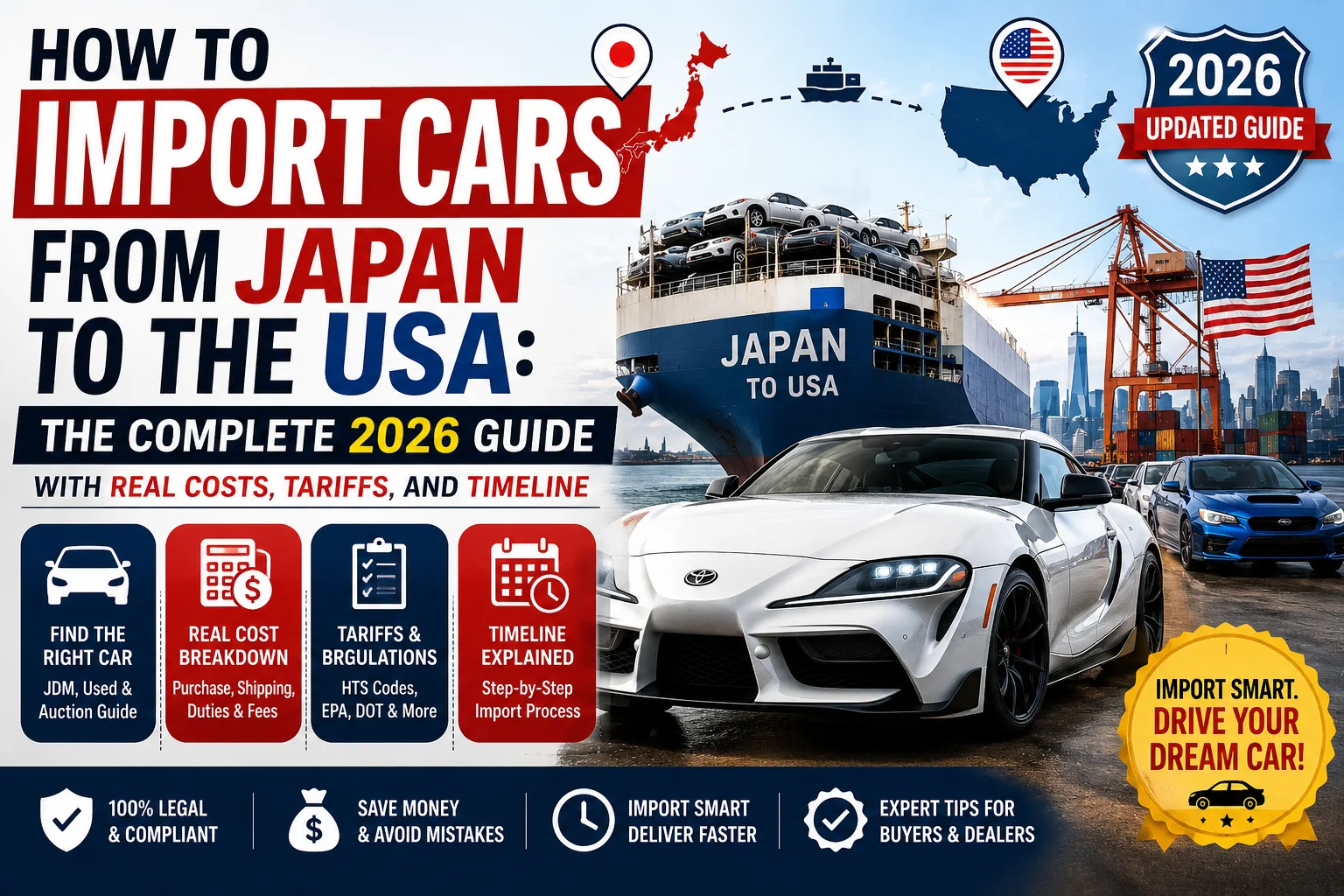
Learning how to import cars from Japan looks different in 2026 than it did even two years ago. The 25-year rule still governs which vehicles qualify for federal exemption from safety standards. But the cost picture has shifted dramatically since the Section 232 auto tariff took effect in 2025 — adding a 25 percent tariff on top of the base 2.5 percent duty, which nearly every ranking guide online is still failing to mention. Meanwhile, 2001-model-year JDM legends like the Nissan Skyline R34 GT-R are finally hitting eligibility. This guide walks through the complete 2026 process, including the tariff math nobody else is publishing, a real worked cost example, the auction grading system, shipping options, and the state registration reality that catches most first-time importers off guard.
What you'll learn in this guide
- The quick answer: what it actually takes to import a car from Japan
- The 25-year rule (and how the manufacture date really works)
- The 2026 tariff reality: Section 232 changed everything
- The seven-step import process
- How Japanese car auctions actually work
- Shipping options: RoRo vs container
- Documents you must have
- Real 2026 cost example: importing a Nissan Skyline R34
- What if the car is under 25 years old? Show or Display explained
- The state registration reality nobody warns you about
- Common mistakes and scam warnings
- Frequently asked questions
The quick answer: what it actually takes to import a car from Japan
Importing a car from Japan to the USA in 2026 comes down to four things: verifying the vehicle qualifies under the 25-year rule, working with a Japanese exporter or auction agent, arranging ocean shipping, and clearing US customs while paying the current tariff stack. The whole process takes 6 to 10 weeks from auction win to registration, and total costs run 45 to 90 percent above the vehicle purchase price once tariffs, freight, and fees are added in.
Here is where most guides go wrong. They still quote the pre-2025 tariff math, which had you paying just the 2.5 percent base duty plus about 10 to 15 percent in shipping and fees. That is no longer accurate. The Section 232 auto tariff introduced in 2025 added a 25 percent tariff on imported vehicles that stacks on top of the base duty. For a $30,000 JDM vehicle, that alone is $7,500 in additional cost. Anyone giving you a "$5,000 all-in" estimate for a mid-range import is working from outdated numbers.
The good news: even with the current tariff environment, importing from Japan remains genuinely attractive for the right vehicles. Cars that never came to the US market (Skyline GT-R, Toyota Chaser, Nissan Stagea, Mitsubishi FTO, various Kei trucks) have no domestic-market equivalent to compare against, so the tariff is just part of getting access to something otherwise unavailable. The math falls apart for common vehicles that were also sold in the US, where a domestic alternative usually makes more economic sense.
Adjacent playbook
How to Import a Sports Car: The 25-Year Rule and Show or Display Path
The 25-year rule (and how the manufacture date really works)
The 25-year rule is the single most important regulation for anyone importing a car from Japan. Under federal law, vehicles that are at least 25 years old from their date of manufacture are exempt from Federal Motor Vehicle Safety Standards (FMVSS) enforced by NHTSA. The EPA applies a separate 21-year exemption from emissions compliance, so vehicles crossing the 21-year mark can skip EPA testing entirely.
The clock runs by month, not by model year
This is the detail that trips up most first-time importers. NHTSA does not care about model year. It cares about the actual month and year the vehicle was assembled at the factory. A car with a 2001 model year could have been built in November 2000, in which case it becomes eligible in November 2025 — earlier than the model year would suggest. A car with a 2001 model year built in September 2001 does not become eligible until September 2026.
How do you find the manufacture date? Check the chassis plate on the vehicle body, request the build record from the Japanese registration authorities, or ask your exporter to provide official documentation. Never rely on model year alone. Attempting to import a vehicle that has not yet reached its exact 25-year anniversary triggers CBP seizure, and Customs does not release the vehicle just because it will be eligible next month.
What the exemption actually covers
The 25-year exemption removes the FMVSS compliance requirement, which means you do not have to use a Registered Importer to modify the vehicle to meet US safety standards. You skip the airbag conformity, bumper standards, side-impact requirements, and every other modern safety rule. The vehicle imports in its original right-hand-drive configuration, with its original headlights, mirrors, and specifications. No modifications required by federal law.
What the exemption does not cover: your state's registration requirements. That is a separate conversation we come back to later. Federal customs clearance and state registration are two different processes. Passing one does not guarantee the other.
The 2001 model year window
Right now in 2026, 2001-model-year vehicles are becoming eligible month by month. This includes some of the most sought-after JDM cars ever made: Nissan Skyline R34 GT-R (final production year), Toyota Chaser JZX100, various Subaru WRX STI variants, Mitsubishi Lancer Evolution VII, and countless Kei-class oddities. Prices in Japan for these vehicles have risen significantly as US and Australian demand pulls inventory out of the domestic Japanese market. If you have your eye on a specific 2001 model, verify its exact build date before making a plan.
The 2026 tariff reality: Section 232 changed everything
Here is the single biggest gap in every other guide on how to import cars from Japan: the current tariff stack. Every ranking article you can find online today is either working from pre-2025 numbers or glossing over the tariff math entirely. That leaves buyers with cost estimates that are 15 to 30 percent low, which is not a small error when you are calculating whether a purchase makes financial sense.
What Section 232 actually is
In 2025, the Section 232 auto tariff took effect on imported vehicles and certain auto parts. This adds 25 percent on top of the standard 2.5 percent HTSUS base duty for passenger vehicles. For imported light trucks (which include many Kei trucks), the total base rate was already 25 percent, and Section 232 stacks on top of that as well. Together, this dramatically raised the landed cost of imports from every country, including Japan.
The current tariff stack on a Japanese passenger car
← Swipe to see all columns →
| Component | Rate | On $30,000 vehicle |
|---|---|---|
| Base HTSUS duty (passenger car) | 2.5% | $750 |
| Section 232 auto tariff | 25% | $7,500 |
| Merchandise Processing Fee (MPF) | 0.3464% | $104 |
| Harbor Maintenance Fee (HMF) | 0.125% | $38 |
| Total customs cost | ~27.85% | ~$8,392 |
Compare this to the pre-2025 tariff math: 2.5 percent base duty plus MPF/HMF fees would have totaled about $900 on the same $30,000 vehicle. The Section 232 tariff adds roughly $7,500 on top. This is not a small change. It is the single biggest cost adjustment in the JDM import world in years, and most published guides have not caught up.
Why 2001-year cars still make sense despite the tariff
The counter-argument is straightforward. JDM cars that never came to the US do not have domestic alternatives. If you want a Nissan Skyline GT-R, you cannot buy one at a US dealer — no matter what you're willing to pay in tariffs. The tariff makes the total cost higher, but it does not eliminate the value proposition of getting access to vehicles unavailable domestically. What it does eliminate is the marginal case where importing a common vehicle from Japan was cheaper than buying its US equivalent. That math no longer works.
For the deep operational side of how import tariffs stack on any vehicle category, our companion piece on importing auto parts into the US walks through the Section 232 tariff mechanics with concrete examples across parts and components categories.
First time importing from Japan?
Get a structured import plan tailored to your specific vehicle
Our consultants walk through the exact tariff math for your target vehicle, evaluate whether the 25-year rule or Show or Display fits your situation, and map out a complete cost picture before you commit. No charge, no obligation for the initial planning conversation.
The seven-step import process
Every successful Japan-to-USA car import follows the same fundamental sequence. The seven steps below are the operational backbone, regardless of whether you are importing a $10,000 Kei truck or a $200,000 Skyline.
The complete process
Seven steps to import a car from Japan to the USA
1
Verify eligibility
Confirm exact manufacture date meets 25-year rule.
2
Purchase vehicle
Auction agent, dealer, or direct exporter.
3
Japan export
Deregistration, Export Certificate, port move.
4
Ocean shipping
RoRo or container. File ISF 24 hrs before loading.
5
US customs entry
CBP Form 7501, HS-7, 3520-1, pay tariffs.
6
Port pickup / transport
Collect from port or arrange US-side inland.
7
State registration
DMV inspection, title, plates. Rules vary by state.
Time from committed purchase to vehicle in your driveway is typically 6 to 10 weeks. Ocean shipping alone accounts for 3 to 5 weeks of that (West Coast) or 5 to 7 weeks (East Coast). The compressed portion — Japan export processing, US customs clearance, inland transport, registration — accounts for the remaining 3 to 5 weeks combined.
How Japanese car auctions actually work
Most JDM imports originate from Japanese domestic auctions. There are roughly 30 major auction houses across Japan (USS, TAA, HAA, JU, and others), with weekly auctions moving tens of thousands of vehicles. You cannot bid directly. You need a licensed auction agent — a Japanese-registered exporter with auction membership — who bids on your behalf.
The auction grading system
Every vehicle at a Japanese auction receives a grade from an independent inspector. Understanding these grades is essential before you commit any money. The scale runs from Grade S (new, less than 100 km) down to Grade R (accident-repaired or modified).
← Swipe to see all columns →
| Grade | Meaning | Buyer takeaway |
|---|---|---|
| S | New vehicle, less than 100 km | Essentially unused |
| 6 | Under 30,000 km, near-perfect | Excellent condition, premium price |
| 5 | Under 60,000 km, minimal wear | Very good, safe to buy remotely |
| 4.5 | Good overall, minor cosmetic issues | Common enthusiast target |
| 4 | Average condition, standard wear | Solid buy for driver-quality cars |
| 3.5 | Notable wear, some paintwork | Expect cosmetic issues |
| 3 | Poor condition, significant wear | Only for full restoration projects |
| R / RA | Accident-repaired or modified | Buy only with detailed inspection |
Alongside the numeric grade, every vehicle gets an interior/exterior grade (A/B/C/D) and a detailed condition sheet noting every scratch, dent, and rust spot on a diagram. Always insist on seeing the full auction sheet with translation before bidding. Reputable exporters translate these as a standard part of their service.
How pricing actually works
Auction bidding closes fast — typically 15 to 30 seconds per vehicle. Your agent bids up to your maximum, which is why setting the right ceiling matters. The winning bid becomes your base cost. Add auction house fees (~$300 to $500), export agent commission (typically $500 to $1,500 or a percentage of the sale price), Japan-side transport to the port (~$150 to $300), and export documentation (~$200 to $400). Then the ocean shipping starts.
Adjacent process
Exporting Vehicles from USA: The 72-Hour Rule and Complete Playbook
Shipping options: RoRo vs container
Two main shipping methods dominate the Japan-to-USA vehicle route. Each has real tradeoffs, and picking the wrong one costs you money either way.
Option A
RoRo (Roll-on/Roll-off)
- Vehicle drives on/off the ship
- $1,500 – $3,500 typical cost
- Faster loading, typically faster transit
- Vehicle exposed to elements during loading
- Cannot ship personal items or parts inside
- Best for standard cars, common ports
Option B
Container (20ft or 40ft)
- Vehicle sealed inside shipping container
- $3,000 – $5,500 for 20ft container
- Full protection from elements and handling
- Can include parts and personal items
- Multiple cars per 40ft container (cost-share)
- Best for high-value cars, non-standard ports
For a standard mid-value JDM car heading to Los Angeles, Long Beach, or Tacoma, RoRo is usually the right call. It is faster, cheaper, and the ports have well-established handling procedures. For a high-value or fragile vehicle heading to a smaller port, container shipping justifies the cost premium through better protection and more control over handling.
Main US destination ports
- Los Angeles / Long Beach — highest volume, most Japan-USA sailings, best broker network
- Tacoma — solid alternative West Coast option, strong RoRo infrastructure
- Newport News — East Coast option, longer transit but access to Mid-Atlantic and Southeast
- Baltimore — East Coast alternative, established RoRo terminal
- Jacksonville — Florida option, shorter East Coast transit than New York
Documents you must have
Missing documentation is the number one reason cars get held at US customs. The paperwork requirements are strict, and CBP does not release vehicles that arrive without complete documents. Here is the full list every import needs.
From the Japanese side
- Japanese Export Certificate — the deregistration certificate proving the vehicle was legally deregistered in Japan (also called Export Certificate of the JDM registration)
- English translation of Export Certificate — CBP requires English translations of any non-English documentation
- Commercial invoice — from the seller, showing the actual purchase price
- Bill of Lading — from the shipping line, confirming the vehicle is on the vessel
- Auction sheet (if applicable) — the inspector's condition report
Filed by your US customs broker
- CBP Form 7501 (Entry Summary) — the official entry document declaring the vehicle
- ISF 10+2 (Importer Security Filing) — filed 24 hours before vessel loading in Japan
- DOT Form HS-7 — declaration of 25-year exemption from FMVSS
- EPA Form 3520-1 — declaration of 21-year exemption from EPA emissions
- HTSUS classification — under 8703.23 for passenger cars, 8704 for light trucks
Filing errors compound quickly. An incorrectly declared manufacture date can trigger CBP holds and additional inspection. A missing HS-7 form delays release until it is filed. An incorrect HTSUS classification changes the duty rate and may require a corrected entry. This is why almost every serious importer uses a licensed customs broker rather than attempting a self-file.
Real 2026 cost example: importing a Nissan Skyline R34
Numbers make everything easier to understand. Here is a realistic 2026 cost breakdown for importing a Grade 4 Nissan Skyline R34 GT-R (built July 2001, eligible July 2026) from a Japanese auction to a US West Coast port, then inland to a Texas registration address.
← Swipe to see all columns →
| Cost line | Amount (USD) | Notes |
|---|---|---|
| Auction winning bid | $85,000 | Grade 4 R34 GT-R, mid-range 2026 market |
| Auction house fees | $400 | Standard fee |
| Export agent commission | $1,800 | ~2% of bid + fixed fee |
| Japan-side transport to port | $250 | Auction to Yokohama |
| Japan export documentation | $350 | Deregistration, Export Cert, translation |
| Ocean freight (container 20ft) | $4,200 | Yokohama to Long Beach |
| Cargo insurance | $650 | ~0.75% of vehicle value |
| Base HTSUS duty (2.5%) | $2,125 | On declared value |
| Section 232 auto tariff (25%) | $21,250 | The 2025 addition |
| MPF and HMF fees | $402 | Standard entry fees |
| US customs broker fees | $650 | Full entry filing service |
| Continuous customs bond | $500 | Annual, prorated |
| Port charges (Long Beach) | $450 | Terminal handling, storage |
| US-side inland transport | $1,400 | Long Beach to Dallas via enclosed hauler |
| Texas title and registration | $180 | State fees, VIN inspection |
| Texas sales/use tax (6.25%) | $5,313 | Applied to purchase value |
| Total landed cost | $124,920 | ~47% above auction winning bid |
Total landed cost: $124,920 on an $85,000 winning bid — approximately 47 percent above the purchase price. Under pre-2025 tariff conditions, the same import would have landed around $103,000 (about 21 percent above bid), so the Section 232 addition is roughly $21,000 in this scenario.
The math is different for lower-value vehicles because the fixed costs (broker fees, port charges, insurance) become a larger percentage of the total. A $15,000 Kei truck import can easily land at $25,000 to $28,000 — an 80 to 90 percent markup on the purchase price — because the fixed costs do not scale down proportionally.
What if the car is under 25 years old? Show or Display explained
The 25-year rule is the mainstream path. But what if you want a vehicle that has not yet reached its 25th anniversary? Federal law gives you two theoretical options, and one practical one.
Option 1: Registered Importer (RI) — theoretically possible, practically unfeasible
A NHTSA-approved Registered Importer can modify a non-compliant vehicle to meet all Federal Motor Vehicle Safety Standards. This includes crash testing, bumper compliance, emissions modifications, headlight conversions, and dozens of other adjustments. The problem: the modifications cost $30,000 to $60,000 on top of the vehicle purchase, and many JDM cars simply cannot be brought into compliance because the required parts do not exist. For 99 percent of buyers, the RI pathway is not economically feasible.
Option 2: Show or Display — the exemption for genuinely rare vehicles
The NHTSA Show or Display program allows import of vehicles the agency has determined to be of "unusual historical or technological significance." This is a limited list — only about 100 vehicles have been approved across the entire program's history. It includes the McLaren F1, Porsche 959, Jaguar XJ220, Ferrari F40, and a handful of specific JDM models like certain limited-edition Nissan Skylines and Honda NSX Type R variants.
If your target vehicle is on the Show or Display approved list, you can import it under 25 years old, but with two significant restrictions: (1) you may drive no more than 2,500 miles per year, and (2) you must comply with EPA emissions (typically requiring emissions modifications). The Show or Display application itself involves a detailed submission proving significance, VIN documentation, and NHTSA review taking 3 to 6 months.
The practical takeaway
For most JDM cars, waiting for the 25-year mark is the only viable path. Show or Display works for a very specific list of rare vehicles. If you want a standard 2004 Skyline V35, Toyota Aristo, or Subaru WRX STI, the answer is: wait until the exact 25-year anniversary of the vehicle's manufacture date. Trying to bypass this results in CBP seizure. A consulting call before committing to any pre-25-year purchase is often the cheapest hour you will ever spend.
Building a full import compliance plan
Expert help with tariffs, classification, broker selection, and DMV process
Our import consulting team supports individual buyers and vehicle dealers with the complete Japan-to-USA import process. From HTS classification and Section 232 tariff planning to customs broker selection, port operations, and state registration guidance. Whether you're importing one car or building a JDM dealer inventory.
The state registration reality nobody warns you about
Federal customs clearance and state registration are two completely different processes. Passing federal customs does not mean your state will register the vehicle. This is the single most overlooked step in every guide on how to import cars from Japan, and it catches first-time importers off guard regularly.
Why state rules matter
Every state sets its own vehicle registration requirements. Some states are extremely importer-friendly (Texas, Florida, Arizona). Some are extremely importer-hostile (California, New York in certain years). The variation is real, and it applies specifically to non-US-market vehicles even after they clear federal customs.
← Swipe to see all columns →
| State | Importer-friendliness | Key considerations |
|---|---|---|
| Texas | Very friendly | Straightforward process, no unique JDM restrictions |
| Florida | Very friendly | No state emissions inspections in most counties |
| Arizona | Very friendly | Easy VIN inspection, 25-year cars exempt from AZ emissions |
| Georgia | Friendly | Standard process with minor documentation requirements |
| Colorado | Moderately friendly | Emissions rules can complicate, RHD accepted |
| California | Restrictive | CARB emissions requirements very strict for post-1975 imports |
| New York | Restrictive | State inspection standards can complicate JDM imports |
| Massachusetts | Restrictive | Difficult inspection process for non-US-market vehicles |
What you actually need for state registration
Regardless of state, expect to provide the following for a JDM import registration:
- Proof of federal customs clearance (CBP Form 7501 stamped as released)
- Original Bill of Lading
- English-translated Japanese Export Certificate
- DOT HS-7 stamped by CBP
- EPA 3520-1 stamped by CBP
- VIN inspection by state-authorized officer
- Proof of insurance (state-minimum coverage)
- Payment of state sales tax and registration fees
- Some states: safety inspection at DMV-approved facility
- Some states: emissions test (though 25+ year cars are usually exempt)
Common mistakes and scam warnings
The Japan-to-USA car import business has its share of pitfalls. Here are the mistakes that catch new importers most often, and the scam patterns to watch for.
Operational mistakes
- Trusting the model year instead of the exact manufacture date. The single most expensive error. A car that is "close" to 25 years old is not yet eligible. CBP does not release vehicles based on being nearly eligible.
- Not budgeting for Section 232. Working from pre-2025 cost guides and being blindsided by an extra $5,000 to $20,000 in tariffs at customs clearance.
- Assuming state registration is automatic after federal clearance. Two different processes. Verify state rules before you ship, not after the car arrives.
- Skipping the auction sheet translation. Buying a car sight-unseen without understanding the condition sheet is how people end up with rust buckets or accident-repaired vehicles they cannot resell.
- Choosing the wrong US port for your destination state. Shipping to Long Beach then trucking across the country adds thousands. Match port to inland transport reality.
Scam warnings
- "We have this rare car in stock in Japan, wire the deposit today." If the deal is urgent and the deposit is non-refundable, it is almost certainly a scam. Legitimate exporters do not need urgency.
- Prices dramatically below auction market rates. Real inventory does not sell at 30 to 50 percent below market. Anything that looks too good to be true is either a scam or a badly damaged vehicle.
- Suspiciously low tariff estimates. Anyone quoting current landed cost without Section 232 either does not know current tariff rates or is deliberately downplaying the total.
- Unlicensed exporters. Verify your Japanese exporter is registered with the appropriate Japanese authorities. Unlicensed operators cannot legally handle the export documentation.
- Escrow-free wire transfers. Any legitimate transaction uses escrow, letters of credit, or verified payment mechanisms. Direct wire to an unknown foreign entity is how the money disappears.
"The importers who succeed with JDM cars in 2026 are the ones who did their tariff math before the auction, not after the container docks in Long Beach."
Frequently asked questions
How to import cars from Japan to the USA in 2026?
Importing a car from Japan to the USA in 2026 involves seven main steps: verify the vehicle is at least 25 years old from its manufacture date (for the FMVSS exemption), purchase through a Japanese exporter or auction agent, arrange ocean shipping (RoRo or container), file the Importer Security Filing (ISF) 24 hours before loading, engage a US customs broker to file CBP Form 7501 and pay duties, submit DOT HS-7 and EPA 3520-1 forms, and register the vehicle with your state DMV. The total process typically takes 6 to 10 weeks from auction win to registration. Total 2026 costs including 25% Section 232 tariff run 45 to 90 percent above the vehicle purchase price.
What is the 25-year rule for importing Japanese cars?
The 25-year rule exempts vehicles that are at least 25 years old from their date of manufacture from Federal Motor Vehicle Safety Standards (FMVSS) enforced by NHTSA. The EPA applies a separate 21-year exemption from emissions standards. The clock counts by month and year of manufacture, not by model year. For example, a Nissan Skyline R34 GT-R built in June 2001 becomes eligible for US import in June 2026. Vehicles older than 25 years can be imported without going through a Registered Importer (RI) or making modifications to meet US safety standards.
How much does it cost to import a car from Japan in 2026?
In 2026, importing a car from Japan typically costs 45 to 90 percent above the vehicle purchase price. For a $30,000 JDM vehicle, expect $13,000 to $25,000 in total additional costs including ocean freight ($1,500 to $3,500 for RoRo, $3,000 to $5,500 for container), 25 percent Section 232 tariff (approximately $7,500 on a $30,000 vehicle), 2.5 percent base HTSUS duty, customs broker fees ($400 to $800), ISF filing, cargo insurance, port charges, DOT/EPA compliance documentation, US-side inland transportation, and state registration. The Section 232 auto tariff introduced in 2025 has added roughly $5,000 to $10,000 to the typical import cost compared to pre-2025 figures.
Can I import a car from Japan that is less than 25 years old?
Yes, but the process is significantly more expensive and restrictive. Vehicles under 25 years old must either meet all Federal Motor Vehicle Safety Standards (FMVSS) or qualify for the NHTSA Show or Display exemption. The Show or Display program allows import of vehicles NHTSA has determined to be of unusual historical or technological significance, limited to no more than 2,500 miles of driving per year and typically requiring EPA emissions compliance. Only about 100 vehicles have been approved for Show or Display, mostly limited-production supercars. Otherwise, using a Registered Importer to modify a newer vehicle to FMVSS standards costs $30,000 to $60,000 in modifications alone, making it economically unfeasible for most buyers.
How long does it take to import a car from Japan to the USA?
The complete import process from winning an auction bid to driving your Japanese car in the US typically takes 6 to 10 weeks. Ocean shipping alone takes 3 to 5 weeks from Yokohama, Nagoya, or Kobe to US West Coast ports (Los Angeles, Long Beach, Tacoma) and 5 to 7 weeks to East Coast ports (Baltimore, Newport News, New York). Add 1 to 2 weeks for Japan-side export processing after purchase, 1 to 2 weeks for US customs clearance after arrival, and 1 to 3 weeks for inland transportation and state registration.
What documents do I need to import a car from Japan?
You need seven key documents: the Japanese Export Certificate (deregistration certificate), the Bill of Lading, the commercial invoice, CBP Form 7501 Entry Summary, DOT Form HS-7 Declaration, EPA Form 3520-1 Declaration, and Importer Security Filing (ISF 10+2) submitted 24 hours before vessel loading in Japan. State registration typically requires additional documentation including proof of federal customs clearance, VIN inspection, and any state-specific safety or emissions requirements.
Do I need a customs broker to import a car from Japan?
Technically no, you can self-file customs entries for personal-use imports under $2,500. Practically yes, almost every serious importer uses a licensed customs broker. Broker fees ($400 to $800 per entry) are inexpensive relative to the cost of mistakes. A single misclassification can trigger back-duty assessments larger than years of broker fees. For any vehicle valued over $2,500 (essentially every JDM import), a continuous customs bond is required, which brokers handle as part of standard service.
What is the best port to import a car from Japan?
For most importers, Los Angeles or Long Beach is the best port for Japan-to-USA vehicle imports due to the highest volume of Japan sailings, most established RoRo and container infrastructure, and largest broker network. Tacoma is a solid alternative West Coast option. For buyers on the East Coast, Baltimore or Newport News reduce the need for cross-country US-side trucking but add 2 to 3 weeks of ocean transit compared to West Coast ports. Match your port choice to your final destination state to minimize total logistics cost.
Read more on vehicle imports and international trade
If this guide was useful, here are related resources from our blog that go deeper on adjacent topics.
Port operations
Los Angeles Import Customs Clearance: The 2026 Complete Guide
Container shipping mechanics
How to Import a Container from China: A 2026 Playbook
Business structure
Top Import Company Guide for 2026: How to Start and Scale
Framework
What Is Import Export Procedure? The 2026 Framework
Ready to import your Japanese car?
Get expert support from auction to state registration
From verifying the 25-year eligibility on your target vehicle to HTS classification, Section 232 tariff planning, customs broker selection, and state-specific registration guidance — our team helps individual buyers and vehicle dealers turn the Japanese import process from a source of risk into a straightforward operational sequence. Start with a no-cost conversation about your target vehicle.
The JDM opportunity is real — but the tariff math is different now
Learning how to import cars from Japan in 2026 means updating everything you thought you knew about the process. The 25-year rule still governs eligibility. The auction system still delivers vehicles you cannot get any other way. But the Section 232 tariff added 25 percent to landed cost, and every serious import needs to build that into the pricing plan from day one. Get the math right, verify the manufacture date precisely, work with reputable exporters and brokers, and check your state's registration reality before the container ships. Do those four things and the JDM dream stays profitable in the 2026 tariff environment.



Contact us today to schedule a NO-CHARGE INTIALS 30-MINUTE consultation. Ask questions and learn from the experts.