Contractor's Playbook
How to Import Construction Equipment from Canada to the USA: The 2026 Contractor Playbook with Real Costs and USMCA Path
US contractors, equipment dealers, and rental fleet operators have been sourcing construction equipment from Canada for decades — the prices frequently run 15 to 30 percent below US dealer rates, and the equipment moves across the border in days rather than weeks. What has changed is the 2026 tariff environment. Section 122 reciprocal tariffs, refreshed USMCA enforcement, EPA Tier 4 emissions scrutiny on used equipment, and steel derivative product duties all now play into the math. This playbook walks through the complete 2026 process for importing construction equipment from Canada, with the real numbers on a Cat 320 excavator import, the auction-sourcing realities, and the specific documents that decide whether your machine crosses the border cleanly or sits at a bonded lot for two weeks.
What you'll learn in this guide
- What counts as construction equipment for customs purposes
- Why Canada wins on construction equipment landed cost
- The 2026 tariff landscape for construction equipment
- USMCA qualification for construction equipment
- The eight-step import process
- EPA Tier 4 emissions on used construction equipment
- On-road vs off-road: the DOT compliance question
- Documents you must have
- Buying from Ritchie Bros and IronPlanet auctions
- Real 2026 cost example: importing a Cat 320 excavator
- Common mistakes that stop equipment at the border
- Frequently asked questions
What counts as construction equipment for customs purposes
Construction equipment covers a broad category of heavy machinery used in building, site preparation, demolition, and infrastructure work. For US customs purposes, most construction equipment classifies under HTSUS Chapter 84 — nuclear reactors, boilers, machinery, and mechanical appliances. The specific subheadings depend on the equipment type and function, but the common categories include:
- Excavators and shovels — Caterpillar 320, John Deere 350G, Komatsu PC290, Volvo EC290 and equivalents. HTSUS 8429.52 or 8429.59.
- Bulldozers and crawler tractors — Cat D6, John Deere 850K, Komatsu D65. HTSUS 8429.11.
- Wheel loaders — Cat 966, John Deere 744L, Volvo L120. HTSUS 8429.51.
- Backhoe loaders — Cat 420F, John Deere 310L, Case 580N. HTSUS 8429.59.
- Skid steer loaders — Cat 262D, Bobcat S650, Kubota SVL95. HTSUS 8429.19.
- Motor graders — Cat 140M, John Deere 872G, Komatsu GD655. HTSUS 8429.20.
- Cranes and lifting equipment — Grove RT9130E, Manitowoc 999. HTSUS 8426.
- Off-highway trucks and dump trucks — Cat 745C, Volvo A40G. HTSUS 8704.10.
- Rollers and compactors — Cat CS56B, Hamm HD90. HTSUS 8429.40.
- Concrete pumps and mixers — Putzmeister, Schwing, Kimble. HTSUS 8474.
Getting the specific 10-digit HTSUS code right matters. A slight misclassification changes the base duty rate, changes whether Section 232 steel derivative duties apply, and can create audit exposure for years afterward. Your customs broker or a licensed classification specialist should verify the code for your specific equipment before entry.
Why Canada wins on construction equipment landed cost
Walk into any active job site in the Midwest or any equipment auction in Alberta and you will see the same picture: Canadian construction equipment prices consistently run 15 to 30 percent below US dealer rates for equivalent used equipment. Combine this pricing gap with USMCA duty-free treatment and the math becomes hard to argue with for anyone building an equipment fleet.
The pricing gap explained
Several structural factors drive lower Canadian construction equipment prices. The Canadian dollar exchange rate typically favors US buyers, adding 20 to 30 percent effective purchasing power depending on currency movement. Canadian equipment auction volumes are enormous — Ritchie Bros, IronPlanet, and regional auction houses cycle thousands of pieces monthly across major markets. And Canadian construction equipment often has fewer operating hours than equivalent US units due to shorter working seasons in northern regions.
The USMCA advantage stacked on top
Where the math truly becomes compelling is when you stack USMCA duty-free treatment on top of the underlying price gap. A $175,000 Cat 320 excavator sourced from Canada at USMCA duty-free treatment gets to your job site for roughly $185,000 total. The same excavator sourced from a Chinese manufacturer would face 25 percent Section 301 plus Section 122 reciprocal tariff plus Section 232 steel derivatives, pushing total landed cost well above $220,000. Canada wins the total landed cost math decisively for most core construction equipment categories.
Speed to job site
Cross-border trucking from Alberta, British Columbia, Ontario, or Quebec to US markets typically takes 2 to 5 days depending on origin and destination. Ocean freight from Asia or Europe runs 30 to 60 days from purchase to job site delivery. For contractors bidding on jobs with specific start dates, this speed advantage is often as valuable as the cost advantage.
The 2026 tariff landscape for construction equipment
The tariff picture on Canadian construction equipment in 2026 has three main components. Understanding each — and how they interact — is essential for accurate cost estimation before purchase.
The base HTSUS duty
Most construction equipment under HTSUS Chapter 84 carries relatively favorable base duty rates: 0 percent on some agricultural-adjacent equipment, up to about 2.5 percent on specific categories. Excavators typically face 0 percent base duty. Wheel loaders similarly. Bulldozers typically 0 percent. The base rate alone is not the challenge.
The Section 122 reciprocal tariff (10%)
This is the tariff most importers underestimate. The Section 122 reciprocal tariff surcharge introduced in 2025 adds 10 percent on imports from countries deemed non-reciprocal in trade relationships. Non-USMCA-qualifying equipment from Canada faces this 10 percent surcharge on top of any base duty. USMCA-qualifying equipment is exempt.
Section 232 steel derivative products
Construction equipment contains substantial steel content — a Cat 320 excavator alone is roughly 20 metric tons of primarily steel construction. Section 232 tariffs on steel derivative products may apply to non-USMCA equipment based on the steel content classification. The math varies by specific machine but can add 5 to 15 percent effective duty on the steel value portion of the equipment.
The stack in practice
Here is how the tariff stack works in practice on a $175,000 Cat 320 excavator, comparing USMCA-qualified versus non-USMCA scenarios:
← Swipe to see all columns →
| Tariff component | USMCA qualified | Non-USMCA |
|---|---|---|
| Base HTSUS duty (excavator) | 0% | 0% |
| Section 122 reciprocal tariff | 0% | 10% ($17,500) |
| Section 232 steel derivative duty | 0% | ~7% ($12,250 estimate) |
| MPF and HMF fees | ~$430 | ~$430 |
| Total tariff cost | ~$430 | ~$30,180 |
The delta between USMCA-qualified and non-USMCA on a single Cat 320 excavator is roughly $30,000 — nearly 17 percent of the machine's purchase price. This is why USMCA qualification is not a paperwork exercise; it is a strategic financial decision.
USMCA qualification for construction equipment
USMCA qualification is where the tariff math either works or falls apart. For construction equipment specifically, the good news is that most major-brand equipment manufactured or assembled in North America qualifies straightforwardly.
The rules of origin for construction equipment
Under USMCA, construction equipment qualifies for duty-free treatment if it meets one of the following:
- Wholly obtained in North America — rare for complex equipment but occasionally applies to specific components
- Tariff shift rule — all non-North American materials undergo the required tariff classification change during manufacturing in Canada, the US, or Mexico
- Regional value content — the equipment contains at least 60 percent (transaction value method) or 50 percent (net cost method) North American content
For most Caterpillar, John Deere, Case, Volvo, and Komatsu construction equipment assembled in Canada or the US, qualification is achievable. Caterpillar assembles many models in the US and Canada. John Deere operates major manufacturing in both countries. Case has substantial North American manufacturing footprint. These brands regularly generate USMCA-qualifying equipment through Canadian dealer channels.
The Certificate of Origin
The USMCA Certificate of Origin does not follow a mandatory form, but it must contain nine specific data elements: importer name, exporter name, producer name, description of goods, HTSUS classification, preference criterion, blanket period (if applicable), authorized signature, and date. Your Canadian equipment seller — dealer, auction house, or private seller — prepares this certificate. Your US customs broker uses it to claim USMCA preference at entry.
The deeper cross-border playbook
USMCA qualification for construction equipment is one piece of a much broader cross-border trade framework. The full operational playbook — covering Caterpillar-specific USMCA analysis, John Deere qualification, Case and Komatsu tariff strategy, seasonal auction timing, and border crossing logistics — is worth its own dedicated deep dive. Our comprehensive guide on importing heavy equipment from Canada to USA serves as the master playbook for contractors, dealers, and buyers looking to build a systematic cross-border equipment sourcing program with real cost examples and the strategic decisions that separate profitable operations from those getting caught by tariff surprises.
The strategic reality
For contractors and dealers building serious equipment fleets, USMCA-qualifying Canadian sourcing is not just a cost advantage — it is a competitive moat. Operations that master the paperwork and process consistently deliver equipment at lower total cost than competitors relying on US dealer channels or international sourcing. The paperwork discipline is what separates operational winners from those paying the full tariff stack.
Planning a Canadian equipment purchase?
Get a structured import plan with USMCA qualification analysis
Our consultants review your target equipment, verify USMCA rules of origin qualification, calculate exact tariff exposure across scenarios, and map out the complete import process before you commit to purchase. No charge, no obligation for the initial planning conversation.
The eight-step import process
Every successful Canadian construction equipment import follows the same fundamental sequence. Whether you are buying a $50,000 skid steer or a $500,000 crane, the operational backbone stays consistent.
The complete process
Eight steps to import construction equipment from Canada
1
Identify equipment
Dealer inventory, auctions, private seller.
2
Verify USMCA
Rules of origin, Certificate of Origin availability.
3
Classify HTSUS
10-digit code, steel derivative check.
4
Purchase agreement
Bill of Sale, serial numbers, price documentation.
5
Verify EPA compliance
Tier 4 emissions on engines, Form 3520-21.
6
Arrange transport
Flatbed hauler, cross-border coordination.
7
Customs entry
CBP Form 7501, USMCA claim, EPA declarations.
8
Delivery and registration
US-side transport, state title if applicable.
Total timeline from purchase agreement to equipment on the job site typically runs 7 to 21 days depending on Canadian pickup location, US destination, and how efficiently the paperwork moves. Ritchie Bros auction purchases often move within 5 to 10 days after auction close if the buyer has customs broker and hauler pre-arranged.
EPA Tier 4 emissions on used construction equipment
Here is the compliance issue that catches used construction equipment importers by surprise more than any other: EPA Tier 4 emissions requirements. Modern construction equipment must meet Tier 4 Final emissions standards for diesel engines, but older equipment with Tier 3 or earlier engines faces specific import restrictions.
What Tier 4 requires
Since 2015, all new non-road diesel engines above 25 horsepower have been required to meet Tier 4 Final emissions standards. This includes exhaust aftertreatment systems (DPF, SCR, DEF systems) and represents a significant technological jump from earlier tiers. New construction equipment sold in Canada and the US both meet Tier 4 requirements, so equipment manufactured after roughly 2015 imports without emissions complications.
The used equipment challenge
Used construction equipment manufactured before Tier 4 Final requirements — particularly Tier 3 or earlier engines — faces potential import restrictions. Simply importing a 2010-vintage Caterpillar excavator with a Tier 3 engine is not automatic. The EPA scrutinizes such imports to prevent circumvention of emissions requirements.
Practical scenarios
Straightforward path
Equipment made 2015 or later
- Tier 4 Final compliant engine
- EPA Form 3520-21 declaration
- Standard entry with no special exemption needed
- Cross-border transport, customs entry, delivery
- Timeline: 7-14 days typical
Complex path
Equipment made pre-2015
- Older tier engine (T3 or earlier)
- Specific exemption may apply based on age
- Additional documentation required
- Potential engine replacement to Tier 4 compliance
- Timeline: 14-45 days variable
For contractors and dealers focused on late-model equipment (2015 and newer), Tier 4 compliance is essentially automatic. For those targeting older equipment for cost reasons, the EPA compliance path deserves specific verification before commitment. Working with a customs broker experienced in used construction equipment imports prevents most of the emissions-related surprises at CBP.
On-road vs off-road: the DOT compliance question
This is the second question that catches new importers off guard. DOT Federal Motor Vehicle Safety Standards apply to on-road vehicles. Most construction equipment operates off-road on job sites, which means DOT compliance typically does not apply. But some crossover categories trigger DOT requirements, and getting the classification wrong creates entry problems.
Equipment that does not require DOT compliance
- Excavators (all sizes)
- Bulldozers and crawler tractors
- Wheel loaders (standard job-site models)
- Skid steer loaders
- Backhoe loaders
- Off-highway trucks (job-site use only)
- Rollers and compactors
- Motor graders
- Rough terrain cranes
Equipment that does require DOT compliance
- Dump trucks operating on public roads
- Concrete mixer trucks
- Mobile cranes operating over-the-road
- Boom lifts and aerial platforms operated on roads
- Sweepers used on public streets
- Water tank trucks with road operation
The distinction matters. DOT compliance adds significant complexity — FMVSS conformity, lighting standards, brake systems, emission control equipment tuned to on-road requirements. If your equipment falls into the on-road category, DOT compliance becomes a major operational challenge, particularly for imported equipment that may not have been manufactured to US FMVSS specifications.
The safe practice: verify the DOT classification for your specific equipment before purchase. If you plan to use a piece of equipment only on job sites, the off-road classification usually applies straightforwardly. If any public road operation is planned, the DOT compliance path deserves specific analysis before commitment.
Documents you must have
Missing documentation is the most common reason construction equipment gets held at CBP. Here is the complete documentation list for a typical Canadian construction equipment import.
Commercial and identification documents
- Bill of Sale — from the Canadian seller, showing purchase price, equipment identification (make, model, year, serial number), and any accessories included
- USMCA Certificate of Origin — required to claim duty-free treatment
- Manufacturer statement (new equipment) — for new equipment purchases from Canadian dealers
- Equipment specifications — engine type, horsepower, operating weight, EPA tier certification
- Prior title/registration (used equipment) — Canadian registration or ownership documentation
Customs and partner agency filings
- CBP Form 7501 (Entry Summary) — filed by your customs broker for the formal customs entry
- EPA Form 3520-21 — declaration of non-road engine emissions compliance
- DOT compliance documentation — only if the equipment triggers DOT requirements
- Continuous customs bond — required for entries above $2,500 (essentially all construction equipment)
For contractors and dealers moving multiple pieces of equipment cross-border, establishing a working relationship with a customs broker experienced in construction equipment saves substantial time. The broker learns your typical equipment categories, pre-populates classification data, and handles the routine paperwork efficiently after the first few entries.
Buying from Ritchie Bros and IronPlanet auctions
Canadian construction equipment auctions — particularly Ritchie Bros and IronPlanet — represent the single largest source of used construction equipment moving cross-border into the US. Understanding how these auctions work operationally is essential for anyone building a serious sourcing program.
The auction sourcing advantage
Ritchie Bros runs unreserved auctions with substantial volume across major Canadian markets — Edmonton, Regina, Toronto, Montreal, and others. IronPlanet operates online auctions with weekly cycles. Both platforms move thousands of pieces of construction equipment monthly, and the pricing typically reflects genuine market rates without minimum reserves.
The operational realities
- Pre-arrange customs broker. Auction lots move fast after winning bid. Have your broker relationship established before you bid.
- Pre-arrange transportation. Storage fees at auction yards accumulate quickly. Book haulers before auction close.
- Verify USMCA availability. Auction houses can typically provide manufacturer origin documentation, but confirm before bidding.
- Inspect thoroughly. Preview days matter. Photos can miss issues that on-site inspection catches.
- Budget for post-purchase costs. Auction winning bid is just the starting point. Add customs, transport, and any repairs.
- Understand the payment mechanics. Auction payment typically due within days of winning bid; failure creates penalties.
The typical Ritchie Bros sourcing sequence
For US buyers targeting Ritchie Bros auctions, the operational sequence looks like: identify target equipment through auction preview catalogs, verify USMCA qualification with auction house documentation, pre-establish customs broker relationship, pre-book cross-border hauler for likely winning scenarios, attend auction (in-person or online), win bids at target prices, execute payment within auction terms, coordinate hauler pickup, file customs entry with broker, deliver to US destination.
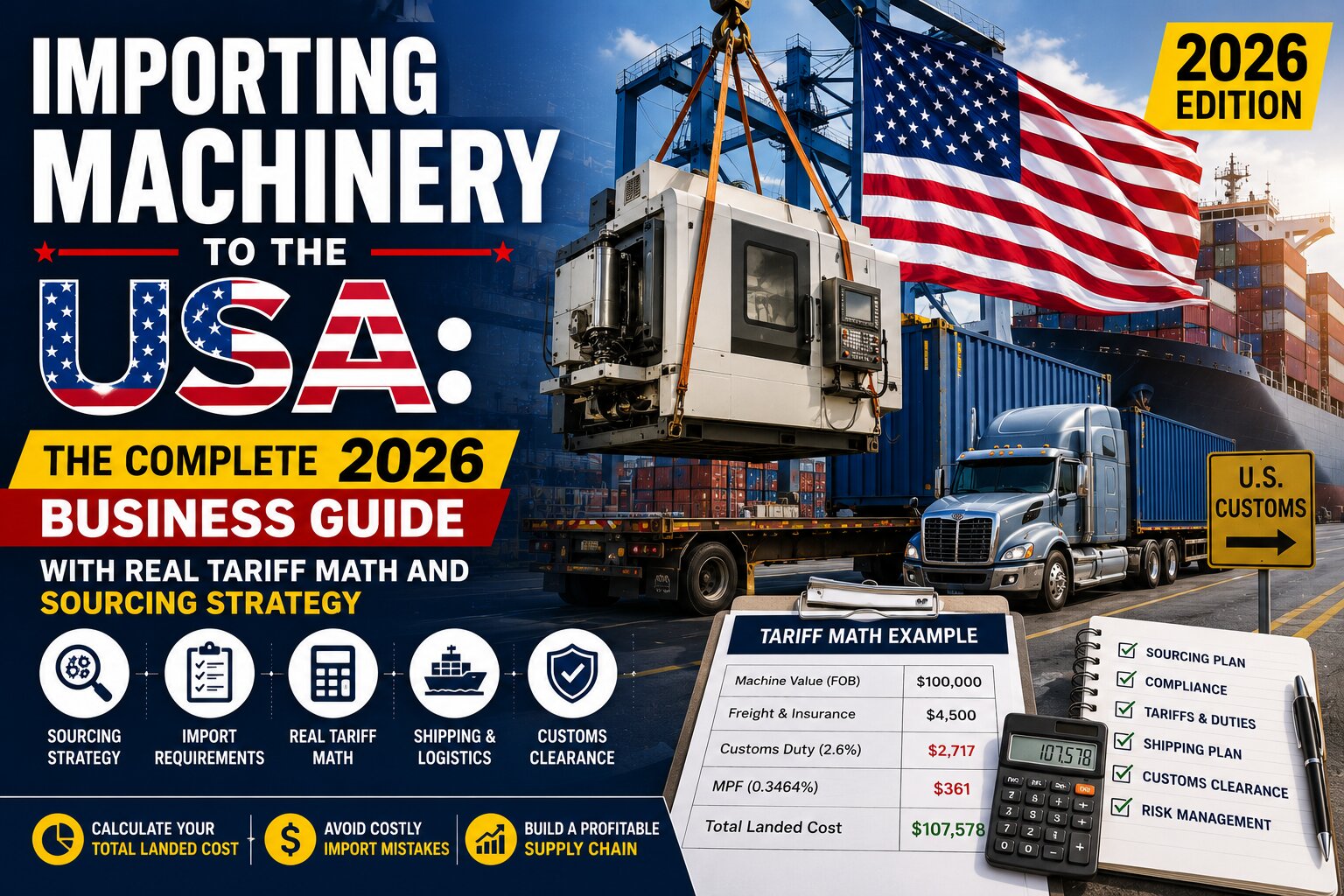
For a comparison of how construction equipment sourcing compares to other equipment categories moving across the same border, our companion piece on importing machinery to the USA covers the broader industrial machinery framework with sourcing comparisons across Canadian, Mexican, and Asian suppliers.
Building a serious equipment sourcing operation
Expert help with USMCA, EPA compliance, and cross-border logistics
Our import consulting team supports US contractors, equipment dealers, and rental fleet operators with systematic Canadian equipment sourcing programs. From USMCA qualification analysis and EPA Tier 4 compliance to customs broker selection, auction sourcing strategy, and delivery coordination. Whether you're importing one excavator or building a systematic fleet expansion program.
Real 2026 cost example: importing a Cat 320 excavator
Here is a realistic 2026 cost breakdown for importing a used Caterpillar 320 excavator from an Alberta Ritchie Bros auction to a construction site in Montana. This example illustrates how the various cost components combine on a typical USMCA-qualifying construction equipment import.
← Swipe to see all columns →
| Cost line | Amount (USD) | Notes |
|---|---|---|
| Winning auction bid (Cat 320, 2019, 3,200 hrs) | $175,000 | Grade condition, USMCA qualifying |
| Ritchie Bros buyer's premium | $2,000 | Auction fee |
| Base HTSUS duty (excavator, USMCA) | $0 | USMCA duty-free treatment |
| Section 122 reciprocal tariff (USMCA exempt) | $0 | Exempted by USMCA qualification |
| Section 232 steel derivative (USMCA exempt) | $0 | Exempted by USMCA qualification |
| MPF and HMF fees | $430 | Standard entry fees |
| US customs broker fees | $1,200 | Full entry with USMCA claim, EPA declaration |
| Continuous customs bond (annual prorated) | $500 | Required for entries above $2,500 |
| Cross-border heavy hauler (Alberta to Montana) | $4,800 | ~800 miles, specialized flatbed with permits |
| Cargo insurance | $875 | 0.5% of declared value |
| EPA Form 3520-21 filing | $150 | Non-road engine emissions declaration |
| Montana state fees | $85 | Off-road equipment registration |
| Total landed cost | $185,040 | ~5.7% above winning bid |
Total landed cost: $185,040 on a $175,000 winning bid — approximately 5.7 percent above the auction bid. This is the USMCA-qualified scenario. If the same excavator did not qualify for USMCA (unusual for major-brand equipment but possible for smaller specialty manufacturers), the landed cost would increase to approximately $214,000 with Section 122 and Section 232 derivative duties applied — a $29,000 delta driven entirely by USMCA qualification.
"The contractors who consistently win on equipment costs treat USMCA qualification as the first strategic decision on every Canadian purchase, not the last paperwork task before delivery."
Common mistakes that stop equipment at the border
Most construction equipment imports that get held at CBP fall into a small handful of preventable mistakes. Recognizing them before you commit to purchase saves days of storage costs, missed job start dates, and expensive rework.
- No USMCA Certificate of Origin. The single most expensive mistake. Without proper certification, your Canadian equipment defaults to MFN duty plus Section 122 surcharge plus potential steel derivatives. The certificate must be prepared before entry, not after.
- Skipping the pre-purchase USMCA qualification analysis. Not all Canadian equipment qualifies. Verify with the seller before bidding or committing to purchase, not after equipment arrives at the border.
- Missing EPA Form 3520-21 on engine-powered equipment. Every diesel-powered construction equipment import needs this declaration. Missing it stops entry release.
- Incorrect HTSUS classification. Construction equipment classifications are technical. Using an overly broad code triggers back-duty assessments; incorrect code triggers audits.
- Undervaluing used equipment. CBP scrutinizes used construction equipment valuation. Declared values suspiciously below market prices trigger inquiries and delays.
- Not confirming DOT classification. Assuming off-road classification without verification. Dump trucks, mixer trucks, and mobile cranes often trigger DOT requirements that need to be handled before import.
- Pre-Tier 4 engine oversights. Older equipment with Tier 3 or earlier engines needs specific EPA analysis. Assuming compliance without verification creates entry problems.
- Not pre-arranging customs broker and hauler for auction purchases. Post-auction storage fees accumulate quickly. Broker and transport arrangements should be established before bidding.
- Missing wood packaging (WPM) treatment. Equipment shipped with untreated wood dunnage or crates triggers USDA holds. All wood must meet ISPM 15 standards with proper marking.
- Skipping cargo insurance. Cross-border trucking carries genuine risk. Uninsured damage during transit creates real financial exposure that dwarfs the modest insurance cost.
Frequently asked questions
How do I import construction equipment from Canada to the USA?
Importing construction equipment from Canada to the USA involves eight main steps: verify EPA Tier 4 emissions compliance on the engine, confirm the equipment does not require DOT compliance (most off-road construction equipment does not), classify the equipment under HTSUS Chapter 84, verify USMCA qualification and secure a Certificate of Origin, arrange cross-border transportation (typically flatbed hauler or specialized heavy equipment transport), engage a licensed US customs broker for CBP entry filing, pay applicable duties (0 percent under USMCA, or MFN rate plus Section 122 surcharge plus potential Section 232 steel derivative duties if non-qualifying), and complete state registration and titling. USMCA-qualifying Caterpillar, John Deere, or Case equipment from Canadian dealers typically enters duty-free with total additional costs of just 8 to 15 percent above purchase price.
What is the tariff on construction equipment imported from Canada in 2026?
The tariff picture on Canadian construction equipment in 2026 depends entirely on USMCA qualification. Equipment qualifying under USMCA rules of origin enters duty-free. Equipment not qualifying under USMCA faces the base HTSUS Chapter 84 duty (typically 0 to 2.5 percent depending on specific machinery type) plus the 10 percent Section 122 reciprocal tariff surcharge introduced in 2025 plus potential Section 232 steel derivative product duties on machinery containing significant steel content. For most Caterpillar, John Deere, Case, Volvo, and Komatsu equipment manufactured or assembled in Canada with substantial North American content, USMCA qualification is achievable and represents the single largest cost advantage on cross-border construction equipment trade.
Do I need to meet EPA emissions standards on used construction equipment?
Yes, EPA emissions compliance applies to construction equipment with diesel or gasoline engines regardless of whether the equipment is new or used. Modern construction equipment must meet Tier 4 emissions standards. Used equipment with older Tier 3 or earlier engines faces additional EPA scrutiny at import to prevent circumvention of newer emission requirements. Some older equipment qualifies for narrow exemptions based on age or specific use, but most commercial imports need EPA Form 3520-21 declaration confirming Tier 4 compliance or an applicable exemption. Missing or incorrect EPA declarations are the single most common cause of construction equipment being held at CBP.
How much does it cost to import a Cat 320 excavator from Canada?
Importing a Caterpillar 320 excavator from Canada to the USA in 2026 typically costs 8 to 15 percent above the purchase price when USMCA qualification applies. For a $175,000 used Cat 320 purchased from a Canadian dealer or Ritchie Bros auction, total landed cost typically runs $185,000 to $195,000 including customs broker fees, continuous customs bond, cross-border trucking, EPA compliance filing, cargo insurance, state title and registration, and any applicable state use tax. Non-USMCA qualifying equipment would add roughly 10 percent Section 122 surcharge plus potential steel derivative duties, pushing total landed cost above $214,000.
Do construction equipment imports require DOT compliance?
Most off-road construction equipment does not require DOT compliance because DOT regulations apply primarily to vehicles operating on public roads. Excavators, bulldozers, wheel loaders, backhoes, dozers, and most other core construction equipment operate on job sites and do not require Federal Motor Vehicle Safety Standards (FMVSS) compliance. However, certain crossover equipment does trigger DOT requirements: dump trucks, mixer trucks, mobile cranes with over-the-road capability, and any equipment operated on public roads as its primary function. DOT compliance adds significant complexity when it applies, so verifying the classification before purchase is essential.
Can I import construction equipment from Ritchie Bros or IronPlanet auctions?
Yes, buying construction equipment from Canadian Ritchie Bros or IronPlanet auctions is one of the most common paths for US contractors and dealers to acquire equipment at competitive prices. The auction acts as the seller, providing the Bill of Sale and equipment documentation. USMCA qualification depends on the equipment's original manufacturing origin — Caterpillar, John Deere, Case, and other North American brands typically qualify even when sold through Canadian auctions. Buyers must arrange their own customs broker, transportation, and US-side compliance. Auction lots move fast, so having your customs broker and hauler pre-selected before bidding prevents storage costs at Canadian auction yards after winning bids.
How long does it take to import construction equipment from Canada?
The complete import process from purchase agreement to construction equipment on the US job site typically takes 7 to 21 days for Canadian imports. Cross-border trucking from Alberta or Ontario to major US markets runs 2 to 5 days depending on origin and destination. Customs entry processing takes 1 to 3 business days when documentation is complete. Pre-arranged customs brokers and haulers can compress the entire cycle to 5 to 10 days for Ritchie Bros auction purchases. This speed advantage compared to ocean freight imports (30 to 60 days from Asia or Europe) is one of the major structural advantages of Canadian sourcing.
Do I need a customs broker for construction equipment imports?
Yes, essentially every commercial construction equipment import requires a licensed customs broker. Equipment entries involve complex HTSUS classification (Chapter 84 contains hundreds of subheadings for machinery), USMCA rules of origin verification, EPA Form 3520-21 filings, potential Section 232 steel derivative analysis, and continuous bond requirements. Self-filing is theoretically possible for personal-use imports under $2,500, but no commercial construction equipment falls in that range. Broker fees ($800 to $1,500 per entry) are inexpensive compared to the cost of classification errors, missed USMCA claims, or CBP holds that delay project start dates.
Read more on cross-border trade and equipment imports
If this guide was useful, here are related resources from our blog that go deeper on adjacent topics.
Pillar guide
Importing Heavy Equipment from Canada to USA: A 2026 Playbook
Cross-border cluster
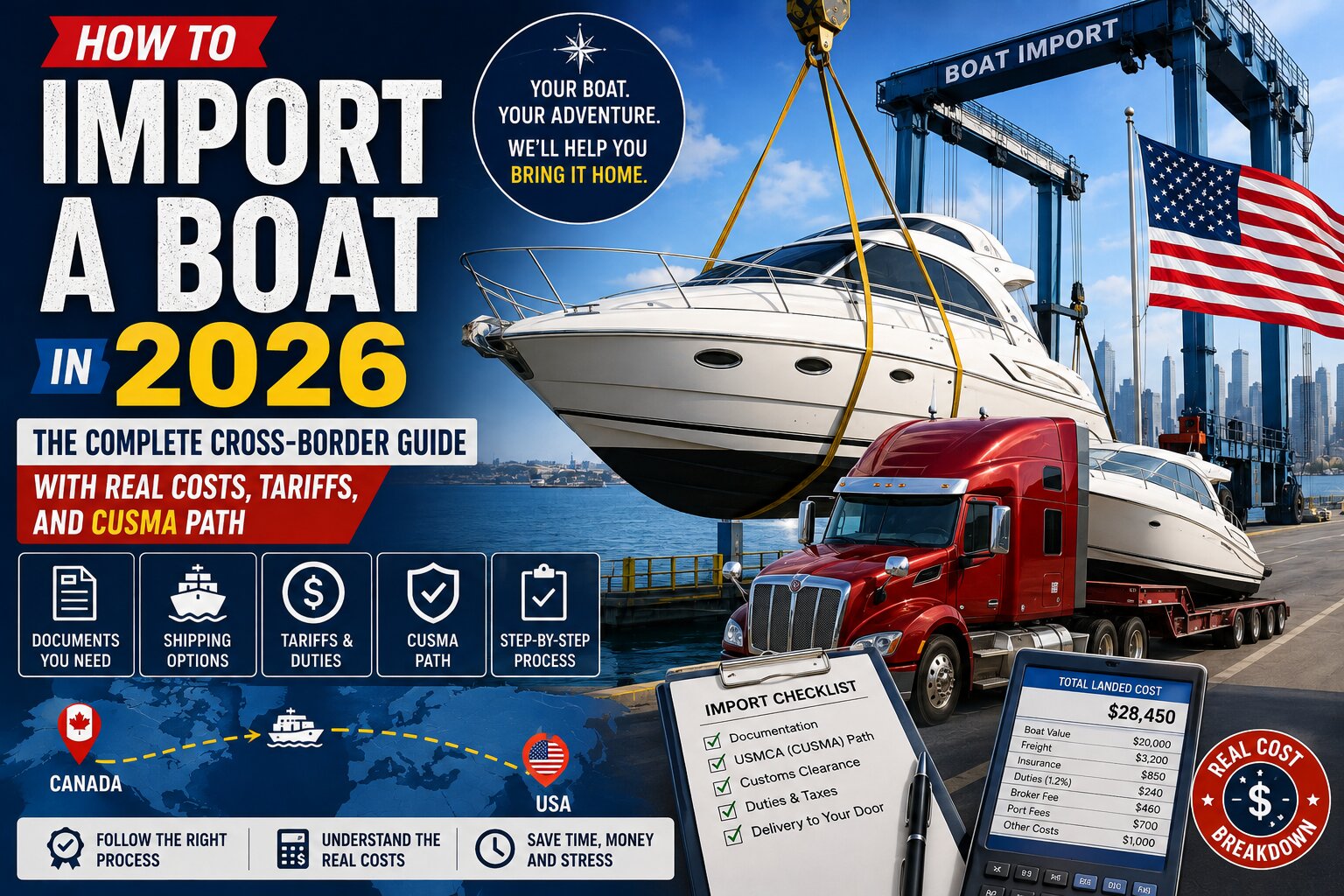
How to Import a Boat: The Complete 2026 Cross-Border Guide
Framework
What Is Import Export Procedure? The 2026 Framework
Business structure
Top Import Company Guide for 2026: How to Start and Scale
Ready to build your Canadian sourcing program?
Get expert support from USMCA analysis to equipment on your job site
From verifying tariff exposure and USMCA qualification to customs broker selection, EPA compliance, cross-border logistics, and delivery coordination — our team helps US contractors, equipment dealers, and rental fleet operators turn Canadian equipment sourcing from an occasional purchase into a systematic competitive advantage. Start with a no-cost conversation about your equipment needs.
The Canadian construction equipment opportunity is real — the process discipline determines whether it works
Learning how to import construction equipment from Canada in 2026 means understanding the tariff landscape (base HTSUS plus Section 122 plus potential Section 232 steel derivatives), the USMCA qualification pathway that eliminates all three tariff layers, the EPA Tier 4 emissions reality on engine-powered equipment, and the DOT versus off-road classification distinction. For contractors, dealers, and fleet operators willing to invest in the paperwork discipline, USMCA-qualifying Canadian equipment sourcing represents one of the strongest structural cost advantages available in the current market. Get the process right and you build a sustainable operational edge over competitors relying on US dealer channels alone.



Contact us today to schedule a NO-CHARGE INTIALS 30-MINUTE consultation. Ask questions and learn from the experts.